She Tried to Take My Beach House—But the Envelope Changed Everything.
on the first night in the beach house I had bought with my own money, my stepmother called and told me she and my father were moving in the next morning.
Not visiting.
Not stopping by.
Moving in.
She informed me that she would be taking the master suite, my stepsister Khloe would get the ocean-view guest room, and I could use one of the smaller bedrooms at the back of the house.
Then, in the same smooth voice she used whenever she wanted to make cruelty sound civilized, she added that if I had a problem with the arrangement, I was free to stay somewhere else.
I stood barefoot on the terrace, my phone pressed to my ear, the Pacific roaring below me in the dark.
For a second, I honestly thought I had misheard her.
Then I realized I had heard her perfectly.
My name is Bianca Riley.
I am thirty-four years old, and for most of my life I was the person in the family photo who looked like she had arrived a second too late.
You can survive a lot when you are young if you still believe fairness eventually catches up with people.
I believed that longer than I should have.
My mother died when I was seventeen.
Ovarian cancer.
Five months from diagnosis to funeral.
Before she got sick, she had a way of making every room feel finished just by standing in it.
Even ordinary things felt softer when she was there.
She remembered tiny details.
She laughed with her whole body.
She loved the ocean and used to say that if life had gone a little differently, she would have spent mornings near the water and grown old somewhere with salt in the air.
Then she was gone, and the house changed overnight.
My father didn’t fall apart in the visible way people expected.
He didn’t cry in front of me.
He didn’t rage.
He simply receded.
He started staying later at the office.
He let calls go to voicemail.
He answered questions with one-word replies and stared past me like he was always listening for a voice that no longer existed.
Two years later, he married Vanessa Crowe.
At first, Vanessa was almost offensively perfect.
She brought desserts to neighbors.
She learned everyone’s preferred coffee order.
She kept a hand lightly on your forearm when she spoke, as if warmth itself had chosen her as a vessel.
Her daughter, Khloe, was twenty at the time and had inherited her mother’s beauty and none of her subtlety.
Khloe was the type to walk into a room already expecting the best seat, the best view, the best version of everyone’s attention.
I was in college by then, working two jobs and piecing together my tuition through scholarships, tutoring, and whatever hours I could get between classes.
When I came home one weekend and found my childhood room converted into Khloe’s dressing room, Vanessa treated my shock like I was making a scene over a towel color.
“Oh, Bianca,” she said, smiling gently.
“You’re barely here anymore.
Khloe needed somewhere to get ready.”
Family pictures began appearing on shelves without me in them.
Sometimes I had been at work.
Sometimes I had supposedly been invited but had never gotten the text.
Once, I was in the house while they took them in the backyard, and Vanessa later told me she thought I was sleeping.
Khloe’s college was fully paid for.
Mine was a patchwork of grants, loans, and raw stubbornness.
Whenever I pointed out the difference, even carefully, Vanessa would look at me with that polished, sympathetic expression and say, “You’ve always liked being independent.”
It was almost artistic, the way she weaponized compliments.
She could make rejection sound like recognition.
She could deprive you of something and leave you with the social burden of pretending it had been a favor.
Eventually, I stopped arguing.
Not because she was right.
Because I had started to understand that defending your own pain to people invested in minimizing it is a second form of pain.
So I turned my energy elsewhere.
I graduated summa cum laude in finance.
I built a career in consulting and stayed in it for twelve years.
I learned to read balance sheets faster than most people read restaurant menus.
I invested early.
Lived below my means.
Bought property when the numbers were right.
Saved aggressively.
Stayed quiet.
At holidays, Vanessa would wave a hand and tell relatives I did “something with spreadsheets.” The room would move on.
I let it.
Silence can be humiliating when it is imposed on you.
It can also become a discipline.
By March 2025, I had enough money to do something my mother had once dreamed about and never lived long enough to see.
I bought a house by the ocean in La Jolla.
It was white with a wraparound terrace and six bedrooms, all bright lines and open glass.
The Pacific sat right outside like a permanent witness.
When the wind rose at night, I could hear the water before I could see it.
The price was $5.6 million, and every dollar that brought me there was mine.
I did not post a giant announcement.
I did not call for praise.
I carried a few glasses into the kitchen, opened one bottle of wine, and sat on the porch after sunset with my shoes off and the waves rolling in below me.
For the first time in years, I felt a version of peace that did not depend on anyone else behaving decently.
Then Vanessa called.
Her voice was brisk, almost bored, the way someone sounds when they are issuing instructions about a housekeeper forgetting flowers.
Khloe had seen the house in the background of an Instagram story, recognized enough of the exterior from a real estate article, and run to her mother.
Vanessa skipped every normal human step between discovery and entitlement.
She said she and my father would be arriving the next day.
She said the master bedroom suited them better.
She said Khloe loved waking up to water views, so the ocean-facing room would be hers.
She said I was practical enough not to care about the smaller room in the back.
Then came the line that changed everything.
“If that’s a problem,” she said, “you’re free to stay somewhere else.”
I asked to speak to my father.
There was a pause long enough for me to picture her choosing how much truth she could risk.
“He’s asleep,” she said.
“And honestly, Bianca, don’t start being difficult now.”
The
word difficult landed exactly the way she intended.
Not as a description of behavior.
As a threat about identity.
The old version of me might have taken the bait, raised her voice, demanded respect, and lost the argument before it began because Vanessa was always best when there was a scene to point at.
Instead, I looked out at the black water and smiled into the dark.
“I’ll make sure everything is ready,” I told her.
She sounded pleased when she hung up.
The second the line went dead, I called my father.
He answered immediately.
“Bianca? Is everything okay?”
He was fully awake.
I asked him, very carefully, what Vanessa had told him about the trip.
He sounded confused.
Then embarrassed.
Then slowly, unmistakably alarmed.
He said Vanessa had told him I invited them for a quiet weekend at the new house because I wanted family time.
He said she had presented it as my idea.
He said he thought it sounded unlike me, but he had been happy enough by the invitation that he had not pushed.
I stayed very still while he talked.
Something inside me settled that night.
Not softened.
Settled.
Because I suddenly saw the architecture of her behavior.
She had always done this in miniature—changing details, speaking for other people, creating realities she could benefit from and then acting offended when someone questioned them.
Only now the scale was different.
The next morning, I called my attorney, Adrien Cole.
Adrien was one of those men whose calm made other people confess without meaning to.
He had careful eyes, an even voice, and the habit of laying out bad news like a surgeon laying out clean instruments.
Months earlier, he had flagged a transfer deed tied to my father’s Del Mar property and told me the signature looked suspicious.
At the time, I had wanted a harmless explanation.
Fatigue.
An administrative mistake.
A sloppy notary.
That morning, I asked him to pull every related document he could find.
By noon, we were in his conference room with records spread across the table.
An LLC registered in Vanessa’s name.
A deed transferring my father’s home into that company.
Retirement withdrawals he had never knowingly authorized.
A line of credit opened under his identity.
Bank movement in increments small enough not to trigger immediate panic, large enough to matter enormously when viewed over time.
My father had recently recovered from a heart condition.
During that period, Vanessa had handled documents, mail, and financial communication while he slept heavily through medication and let her tell him what needed signing.
Adrien’s expression hardened as he read.
“This is not one bad decision,” he said.
“This is a pattern.”
A forensic document examiner was brought in.
Subpoenas were prepared.
Records widened.
The story got uglier the longer we looked.
And while that was happening, Vanessa arrived at my beach house like a woman checking into a resort she assumed had been prepared in her honor.
She stepped out of the SUV in linen and sunglasses with Khloe behind her carrying two designer garment bags and complaining about the driveway angle.
My father followed more slowly, looking tired and vaguely uncomfortable, but not yet ready to challenge the version of events Vanessa had built around him.
Vanessa kissed the air beside
my cheek.
“Beautiful place,” she said.
“You did well.”
Then she walked straight past me.
She took the master bedroom without asking.
Khloe claimed the ocean-view room and asked whether the lighting was good enough for morning content.
At some point while I was downstairs speaking quietly to my father on the phone with Adrien waiting on hold, someone moved my clothes into the smallest bedroom at the back of the hallway.
I returned upstairs, opened the door, and found my dresses hanging from a temporary rack beside stacked storage bins.
I stood there for a long moment.
Then I closed the door again.
That is the detail people often misunderstand when they hear this story.
They imagine a dramatic confrontation.
They imagine fury, shouting, ultimatums.
What actually happened was much more dangerous for Vanessa.
I let her feel safe.
Over the next few weeks, I watched.
Vanessa moved through my house as if possession had already become law.
She directed the staff I hired for occasional cleaning like she was their employer.
She switched table settings.
Reorganized kitchen shelves.
Told friends on speakerphone that the house “worked so much better” with mature taste guiding it.
Khloe posted little fragments online: a hand on my terrace rail, a champagne glass against my sunset, bare feet beside my pool.
Never enough to identify the property clearly, but enough to claim mood, status, belonging.
I documented everything.
Dates.
Comments.
Photos.
Room changes.
Mail.
Deliveries.
Conversations.
Meanwhile, Adrien and the forensic examiner kept building.
The examiner’s report was devastating.
Several signatures did not match my father’s known handwriting patterns, including pressure distribution, slant consistency, and connecting strokes.
Not just suspicious.
Likely forged.
My father was horrified.
He came to Adrien’s office twice in one week, each time looking older than he had the visit before.
He gave a sworn affidavit stating he had not approved the deed transfer, had not knowingly authorized the credit line, and had not intended to move permanently into my La Jolla home.
The hardest moment was not his anger.
It was his shame.
He sat across from me after signing and said, very quietly, “I should have seen what was happening to you years ago.”
I did not know what to do with that sentence.
There are apologies that heal, and there are apologies that simply tell the truth too late.
By June, Vanessa’s attention had shifted to what she valued almost as much as money: public admiration.
She had been selected as Philanthropist of the Year by the California Legal Foundation.
It was exactly the kind of recognition she craved—wealthy donors, judges, attorneys, cameras, people in formalwear nodding at words like service and generosity.
She treated the invitation like an anointing.
Every night, she rehearsed her acceptance speech in my living room.
I would be at the far end of the room with my laptop open while she practiced in a champagne-colored sheath dress she had bought weeks early just to feel the fabric move when she thanked invisible applause.
She talked about community.
Legacy.
Responsibility.
Once, while reading a line about integrity, she paused to ask whether the cadence felt sincere.
I looked up from my screen and said, “It depends who’s listening.”
She laughed like I had made a joke.
A few days before the
gala, she told me I should wear something simple because the evening was not about me.
I smiled.
She was right about that.
By then, Adrien had everything we needed: the forensic report, bank records, corporate filings, my father’s affidavit, and one final document that reframed the entire room Vanessa thought she controlled.
Judge Eleanor Carter, a longtime donor and one of the evening’s presiding figures, had agreed to review the materials through counsel before the event after Adrien made a careful, devastating call.
Vanessa knew none of this.
On the night of the gala, the ballroom glowed gold under chandeliers.
Waiters moved through the room balancing stemware.
A trio played near the wall.
The air smelled like perfume, polished wood, and expensive optimism.
Two hundred twenty guests filled the space.
Vanessa sat near the front in a champagne gown that caught the light every time she turned her head.
Khloe was beside her in silver.
My father sat one seat away looking drawn and remote, his silence no longer passive but loaded.
I was placed near the back.
Vanessa had done that intentionally.
She wanted me present enough to witness her triumph and far enough away to disappear in it.
The program moved forward.
Introductory remarks.
Donor acknowledgments.
A video montage celebrating generosity.
Vanessa smiled at all the right moments.
Then the master of ceremonies paused.
Not stumbled.
Paused.
There is a difference, and everyone in that room felt it.
He adjusted the cards in his hand and said there had been a request, approved by event leadership, to address a matter relevant to the honor being given that evening.
A current moved through the ballroom.
Vanessa’s smile held for exactly one second too long.
Then Judge Carter stood.
Her voice was measured, unmistakably formal, and impossible to ignore.
She said my name.
At first, half the room turned to see who Bianca Riley was.
Then all of it did.
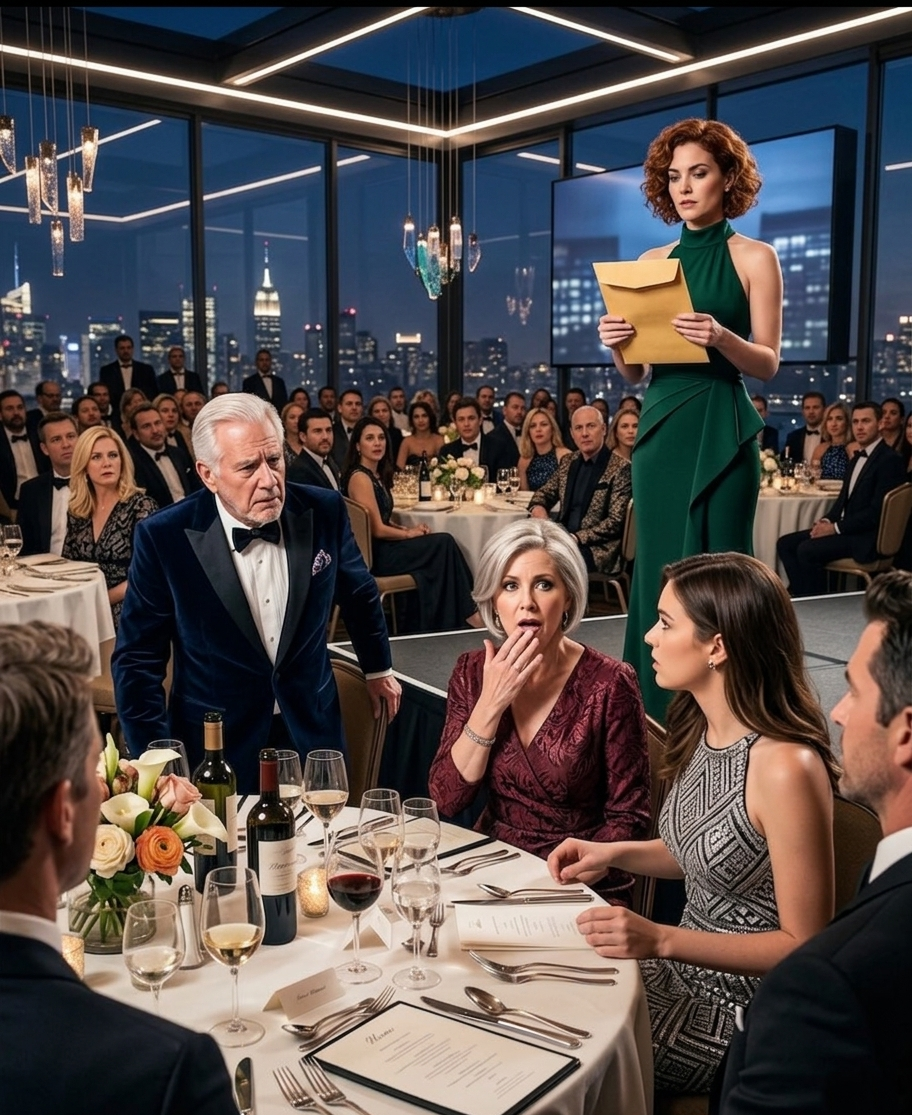
I stood from my table with a sealed manila envelope in my hand.
I could feel Vanessa watching me before I looked at her.
When I finally did, her face had changed.
Not dramatically.
Not enough for the room to read.
But enough for me.
Recognition.
Fear.
The instant comprehension that the quiet girl she had spent years editing out had not spent those years disappearing.
I walked to the stage slowly, each step echoing louder in my body than in the room.
Judge Carter moved aside and gave me the microphone.
I broke the seal on the envelope.
The paper inside felt heavier than paper should.
I looked first at my father.
He stood.
Not quickly, not theatrically, but with the visible effort of a man deciding in public that whatever happened next, he was done hiding inside someone else’s version of him.
Then I turned to Vanessa.
Her hands were clasped too tightly in her lap.
Her lips had parted, but no sound had come out yet.
Khloe leaned toward her, confused rather than concerned, still not understanding the scale of what was about to happen.
I faced the room.
“Before anyone celebrates Vanessa Crowe,” I said, my voice carrying farther than I expected, “there is something you need to see.”
You could hear glass being set down at the nearest table.
No one moved.
I held
up the first page: the forensic report.
Then the next: deed records tied to the LLC in Vanessa’s name.
Then the affidavit signed by my father.
I did not rush.
I did not dramatize.
The facts had their own force.
I explained that the woman being honored for civic integrity was under active legal scrutiny for transferring property she did not own, for moving money she had no authority to move, and for using deception not only against institutions but within her own family.
There were audible reactions then—small ones, sharp ones, the sounds moneyed rooms make when scandal pierces etiquette.
Vanessa rose halfway from her chair.
“This is absurd,” she said, finally finding her voice.
“This is a misunderstanding and a personal attack.”
But she didn’t sound offended.
She sounded afraid.
Judge Carter asked her, in a tone that left no room for theater, whether the LLC named in the records belonged to her.
Vanessa hesitated.
That hesitation did more damage than any accusation I could have made.
My father stepped fully into the aisle.
His voice shook, but it reached the room.
“You forged my signature,” he said.
Gasps rippled outward like someone had opened a hidden door and let cold air into the ballroom.
Khloe stared at him.
“Dad, what are you talking about?”
He didn’t look at her.
He looked only at Vanessa.
And in that moment, the polished woman in champagne silk—the benefactor, the hostess, the keeper of everyone else’s appearances—had nowhere left to stand except inside the truth.
Security did not drag her out.
This was not that kind of ending.
It was worse for her.
The foundation quietly suspended the award on the spot.
Several guests stepped back as though proximity itself had become compromising.
Two attorneys I recognized from Adrien’s circle approached Judge Carter and requested copies of the documents.
The emcee looked like he wanted to vanish into the wallpaper.
Vanessa tried one last pivot.
She said she had only done what was necessary to protect the family.
She said my father had been unwell, confused, irresponsible with paperwork.
She said everything she touched, she touched for all of us.
But that line—usually so effective in private—collapsed under public light.
Because this time she had records against her.
Witnesses.
Timelines.
Signatures.
Banking trails.
And this time I was not the only one hearing her.
My father sat down at the edge of the stage steps after it was over, looking like a man who had just watched the house of his life split down the center.
I sat beside him, not close enough to perform forgiveness, not far enough to deny the history that connected us.
“I’m sorry,” he said again.
I believed he meant it.
The problem was that belief and repair are not the same thing.
Vanessa left the ballroom under a pressure of silence no applause could have drowned out.
Khloe followed her in tears, still trying to assemble a version of events in which her mother remained the victim.
Maybe she still believes one exists.
Maybe that is the inheritance Vanessa truly meant to leave her.
The legal case moved forward after that night.
The property transfers were challenged.
The financial accounts were frozen.
My father started the long, humiliating process of reclaiming what trust had cost
him.
As for the beach house, it became quiet again.
One morning not long afterward, I sat on the terrace with coffee and watched the ocean turn silver under low sun.
No one was rehearsing speeches in my living room.
No one was moving my things while I slept.
No one was telling me that losing space was proof of strength.
For the first time, the house felt not just purchased, but protected.
I thought about my mother then.
About the life she wanted.
About the years I spent making myself smaller because it seemed easier than fighting for a place in rooms determined to forget me.
Vanessa lost the award, her social standing, and eventually the legal cover she thought charm had built around her.
But what stayed with me was not her downfall.
It was the fact that she had counted on something for years, and she had not been wrong until the very end.
She had counted on silence.
She had counted on the daughter no one bothered to see.
And maybe that is the part people argue over most when they hear what happened.
Some think I should have exposed her sooner.
Some think I was too cold to let her walk into that gala before the truth came out.
Some think public humiliation was the only language she would ever understand.
I know this much: she did not break because I became cruel.
She broke because I finally stopped making her lies easier to live inside.