My Parents Trashed My Wedding Invitation—Then Watched the Entire Ceremony Air on National TV.
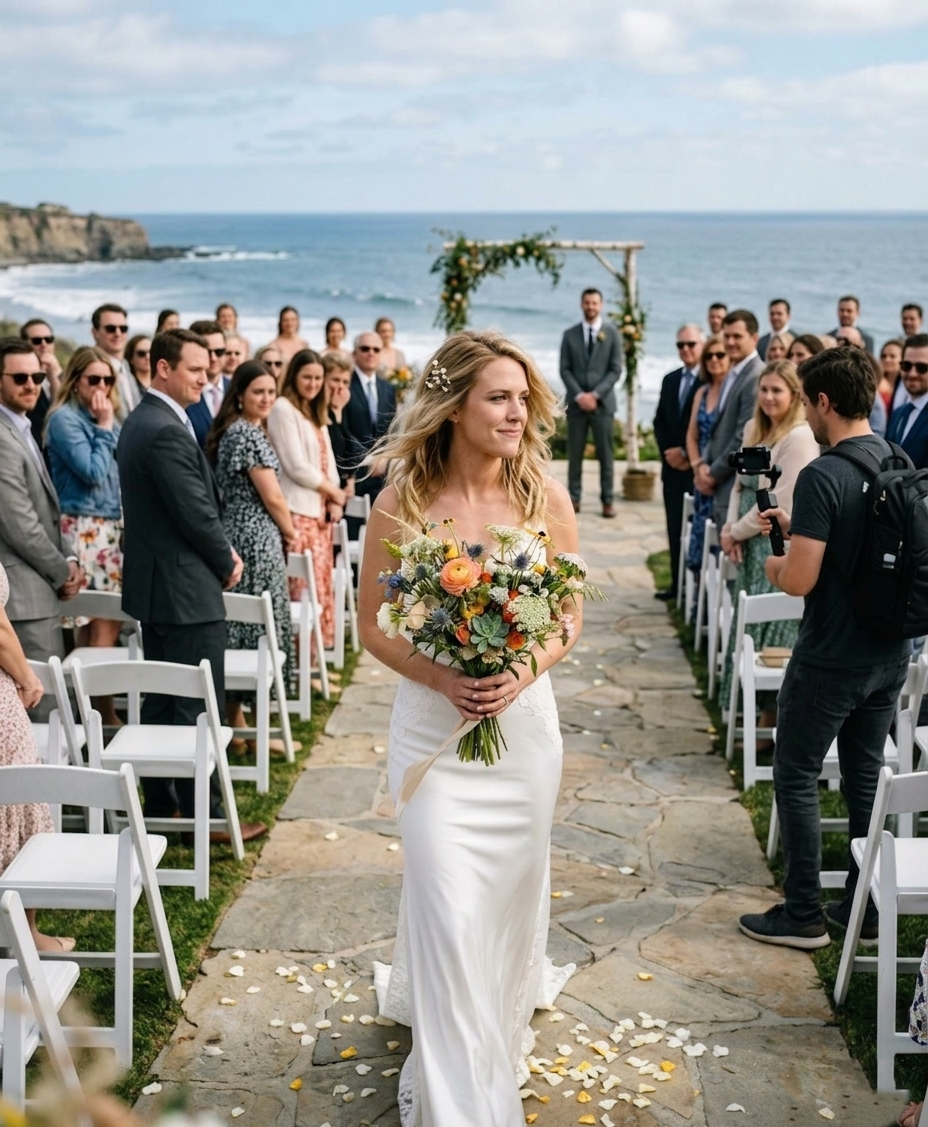
My parents threw my wedding invitation in the trash and told me not to embarrass myself, but the morning they watched me walk alone down the aisle at a $40 million Malibu estate, with cameras following every step, they finally understood that the daughter they had treated like an afterthought had built a life too big for them to ignore.
The envelope came back three days after I mailed it.
I knew it was mine before I touched it.
Same heavy cream cardstock.
Same gold calligraphy.
Same little indentation on the bottom corner where I had pressed too hard while sealing it.
I had spent an absurd amount of time choosing that invitation because I wanted it to feel warm.
Not fancy for the sake of being fancy.
Just careful.
Like I was saying, I know things haven’t been easy between us, but this still matters to me.
When I opened it, the RSVP card was gone.
In its place was a torn piece of notebook paper in my mother’s handwriting.
Don’t bother.
We won’t come.
That was it.
No congratulations.
No question about the date.
No curiosity about the man I was marrying.
No attempt at softness.
Just six words from the woman who used to write proud of you on my lunch napkins when I was little, before my family decided there were two daughters in our house and only one of them was worth celebrating.
Shelby was the easy daughter.
Shelby stayed in Bartlesville.
Shelby went to the same church, married young, had children young, and built the kind of life that could be explained to neighbors in one smiling sentence.
My parents loved sentences like that.
They liked lives that looked familiar from the outside.
I was the daughter who complicated the picture.
The one who asked too many questions.
The one who wanted to leave.
The one who came home with grades instead of babies, plans instead of recipes, a scholarship instead of a fiancé from down the road.
I learned early that people will call you difficult when what they really mean is you refuse to stay small enough for their comfort.
The favoritism was never dramatic enough for strangers to notice.
That was part of what made it so effective.
It was my mother saying there were only four tickets to some event and somehow mine never materialized.
It was me saving up to buy her concert seats for Christmas and watching her invite Shelby instead because “she’d enjoy it more.” It was my father showing up to Shelby’s school events with flowers and a camera while asking me to “understand” when he missed mine because work was busy.
When I got a full scholarship to UCLA, I thought for one reckless second that everything would change.
I still remember standing in the kitchen with the letter in my hand, shaking with relief and disbelief and pride, waiting for my mother to hug me.
She looked at the paper, looked at me, and said, “That piece of paper won’t keep you warm at night.”
I don’t remember what Shelby said.
I only remember that everybody went back to what they were doing as if my entire future had not just cracked open in my hands.
So I left Oklahoma at eighteen with two
suitcases, a scholarship, and the kind of quiet anger that turns into ambition if you feed it long enough.
Los Angeles was not kind, but it was fairer than home.
I studied until my eyes burned.
I took internships nobody glamorous wanted.
I learned how to read stress patterns in concrete and how to make myself useful in rooms full of men who assumed I was there to take notes.
I became a structural engineer because numbers held steady when people didn’t.
Steel either carried the load or it didn’t.
Buildings either stood or they failed.
There was a brutal comfort in that.
The life I built was not shiny from the outside.
It was early alarms, job-site dust, permit revisions, steel-toe boots in my trunk, coffee gone cold on my desk, and the deep satisfaction of creating something that could hold.
But it was mine.
I met James on a retrofit project in downtown Los Angeles.
He was an attorney for the developer, and I disliked him immediately because he smiled too easily and seemed like the kind of man who had never had a truly bad day in his life.
Then I sat across from him in a meeting and realized he was the rare person who asked questions because he cared about the answers.
He remembered details.
He listened all the way through.
He never made my ambition sound like a personality flaw.
He made me laugh at the end of ugly weeks.
He showed up with coffee when he knew I’d be on-site before sunrise.
He didn’t turn kindness into a debt I owed him later.
By the time he proposed on the rooftop of a building I had helped save, the city stretched below us in a wash of lights and traffic.
He was nervous enough that his voice shook when he pulled the ring out.
I said yes before he finished the sentence.
Then I did the one thing I should have known would hurt.
I mailed an invitation to my parents.
Some part of me was still eleven years old, still standing on a porch after school waiting for a car that came late or didn’t come at all, still believing one clean miracle could reset the whole story.
Three days later, my mother mailed back the note.
That same night, Shelby sent me a photo of my shredded invitation spread across our old kitchen table.
The strips of cardstock were fanned out like party confetti.
Her caption was a laughing emoji and, Girl, be serious.
Then came the calls.
My father went first, because that was his specialty.
He liked entering after the damage had already been done, speaking in a low voice as if moderation erased cruelty.
“It’s complicated, Harper,” he said.
That phrase had followed me my entire life.
It always meant the same thing.
Somebody else’s comfort mattered more than my pain.
My mother called next.
She said she wasn’t flying to California for “some production,” and the contempt in her voice made it clear the real problem wasn’t the wedding.
It was the fact that I had built a life she could not control.
The city offended her.
My career offended her.
The man I loved offended her because she had not chosen him and could not reduce
him to one dismissive sentence.
Everything about my life made her feel excluded from a narrative she no longer directed.
Then Shelby called and said, “You need to be realistic about who you are to this family.”
That one landed hardest because she wasn’t wrong.
I knew exactly who I was to them.
I was the daughter who would understand.
The daughter who would absorb the hit and call it peace.
The daughter who could be counted on to keep swallowing disappointment so everybody else got to remain comfortable and decent-looking from the outside.
I told James I wanted to cancel the wedding.
He didn’t launch into a speech.
He didn’t tell me not to let them win.
He just sat down beside me on the kitchen floor while I cried so hard my ribs hurt and said, very quietly, “I’m not leaving because they left.”
That was James.
He never made my pain about proving something.
He just stayed.
A few days later, his mother arrived at my apartment with hot stew, side dishes from her own kitchen, a loaf of bread still warm at the center, and the kind of practical tenderness that doesn’t ask what you need because it has already noticed.
She filled my fridge, wiped down my counters, and kissed my forehead as if she had always had the right.
That was the first moment I understood something I should have learned years earlier.
Family is not who shares your blood.
Family is who sets the table when you can’t feed yourself.
So we kept planning.
One of my former clients, a private investor whose hillside home I had helped reinforce after a landslide scare, heard a trimmed-down version of what had happened and offered us his Malibu estate for the ceremony.
The place sat above the Pacific like a postcard someone had decided to overachieve on—glass walls, white stone, impossible gardens, and ocean light everywhere you looked.
It was valued at around $40 million, which was a number so absurd I couldn’t say it out loud without laughing.
James’s mother pinned a silver crane in my hair on the wedding morning.
I chose wildflowers that reminded me of Oklahoma roadsides—soft blue, pale yellow, unruly white.
Not because my mother would have liked them, but because I did.
That distinction mattered more than it used to.
The morning air smelled like salt and rosemary.
The ocean moved behind us in long, calm breaths.
Eighty-five people stood when the music began.
And I walked down the aisle alone.
Not because nobody came for me.
Because I had finally stopped waiting for the wrong people to do it.
I expected the moment to break me.
Instead, it steadied me.
I saw James at the altar with tears in his eyes and that look on his face like he could see every version of me that had survived long enough to arrive there.
By the time I reached him, the emptiest places in me were no longer empty.
They were simply no longer reserved for people who had never learned how to fill them.
The ceremony was beautiful in the unshowy way that real joy often is.
There was laughter during the vows because James mispronounced a word and blamed nerves.
His mother cried openly.
My best friend
Nia squeezed my hand so hard before the ceremony that my ring finger tingled for twenty minutes.
At dinner, people clinked glasses and told stories about me that made me sound loved in complete sentences.
Two days later, the videographer posted a short clip online.
He had cut together the moment I stepped onto the aisle alone, the ocean behind me, guests rising, James taking one involuntary step forward like he wanted to meet me halfway.
The estate owner shared it.
Then a local station picked it up, framing it as a story about a bride who walked herself down the aisle after family refused to attend.
By Thursday morning it was airing on national television.
That was when my phone lit up with Bartlesville, Oklahoma.
Three missed calls from my mother.
Two from my father.
Four from Shelby.
A voicemail from a number I hadn’t seen in years—our old pastor’s wife.
A message from a woman who used to babysit us.
A text from a florist near my parents’ church saying, I saw you on TV.
You looked radiant.
I stared at my screen until it vibrated in my hand.
James asked if I wanted him to turn it off.
I almost said yes.
Then Shelby texted, Call me before Mom does.
You don’t understand what’s happening here.
I called her.
She answered so fast she must have been staring at the phone.
No hello.
No sarcasm.
Just breathless panic.
“Mom didn’t just tell people she skipped your wedding,” she said.
“She told people you never wanted us there.”
I sat down so suddenly the edge of the sofa hit the back of my knees.
Shelby rushed on.
A woman from church had recognized the invitation paper in the TV segment because my mother had shown that note to people earlier in the week like it was proof she was finally setting “boundaries” with her difficult California daughter.
She had expected people to laugh.
They didn’t.
Someone asked why any mother would be proud of refusing her child on her wedding day.
Someone else asked why I had to walk alone if our family was so loving.
The video kept looping online.
By lunchtime, half of Bartlesville had seen it.
My father left work early because people kept stopping him to say they were sorry.
Then Shelby said the part that mattered most.
“They’re not calling to congratulate you,” she whispered.
“They’re calling because everyone knows.”
Another call came through while we were talking.
My mother.
Then a second.
Then a third.
When the voicemail notification appeared, the transcript preview read: Harper, you need to call me back before this gets worse.
Not I’m sorry.
Not Are you happy.
Not You looked beautiful.
Before this gets worse.
I put the call on speaker when I finally returned it.
James sat beside me, close enough that our knees touched.
My mother picked up on the first ring.
“Harper, thank God.
You need to post something.”
I said nothing.
She filled the silence instantly.
“People have the wrong idea.
They’re acting like we abandoned you.
Your father is getting cornered at work.
I’ve had three women from church call me today.
One of them was crying.
This has become a spectacle.”
I could hear my father in the background muttering, “Tell
her to clear it up.
Tell her.”
I looked at James.
His jaw tightened, but he stayed quiet.
“What exactly do you want me to post?” I asked.
My mother exhaled hard, relieved to hear cooperation where there was none.
“Just say there were private family circumstances.
Say travel didn’t work out.
Say there were emotions on both sides and the internet ran with a story that isn’t fair.”
I laughed, and it surprised even me.
It was not a happy sound.
“Not fair?” I said.
“You mailed my wedding invitation back with a note that said, ‘Don’t bother.
We won’t come.’ Which part was the misunderstanding?”
There was a silence so complete I could hear the ocean outside our open balcony door.
Then my father got on the phone.
“You don’t need to drag this any further,” he said.
“We all said things.
Your mother was upset.
You know how emotional she gets.”
I had spent most of my life translating their choices into gentler language so they could live with themselves.
Hearing him ask for that again after my wedding did something final inside me.
“No,” I said.
“You said things.
You did things.
I just stopped protecting you from the truth of them.”
My mother came back on, voice sharp now.
“We didn’t know there would be cameras.”
That was it.
That was the sentence that stripped the whole thing bare.
Not we didn’t understand how much this would hurt you.
Not we made a terrible mistake.
Not we are ashamed.
Just we didn’t know anyone important would see.
I felt strangely calm after that.
Some betrayals hurt less once they identify themselves fully.
“You didn’t think my life was big enough for anybody to notice,” I said.
“That’s different.”
My mother started crying.
Real tears, maybe.
Maybe not.
She said people were being cruel, that strangers online were calling her heartless, that the church women were whispering, that she had not raised me to humiliate my family in public.
I told her the truth she had avoided for years.
“You humiliated yourselves in private,” I said.
“The public just happened to see it this time.”
My father told me I was being unforgiving.
Shelby, somehow now on the extension at my parents’ house, said my mother had been overwhelmed and I was making it impossible to fix.
Then even Shelby’s voice cracked and she added, quieter, “But they were wrong.”
That was the first honest sentence anyone in my family had spoken all day.
I took a breath.
“Here’s what happens now,” I said.
“I’m not posting a lie so you can feel respectable again.
I’m not explaining your behavior for you.
If either of you wants a relationship with me after this, it starts with a real apology that doesn’t mention church, gossip, embarrassment, optics, or what this cost you socially.
It starts with the truth.”
My mother said my standards were impossible.
I said, “No.
They’re just new.”
Then I hung up.
My hands were shaking so hard I had to put the phone down on the coffee table.
James reached for me, and for a second I just leaned into him and listened to my own breathing come back.
An hour later, Shelby texted me from her own phone.
I’m sorry, she wrote..
Then another message.
I’ve been cruel to you because it was easier than admitting you were brave.
I cried harder at that than I had at my mother’s call.
Not because it fixed anything.
It didn’t.
But because truth, when it finally arrives, has a sound to it.
It doesn’t twist.
It doesn’t bargain.
It doesn’t ask for applause.
That evening, James’s family came over with leftover cake boxes, too much pasta, and a bottle of champagne someone had forgotten in the car after the wedding.
His mother reheated food.
His brother argued with James about music.
Nia stole my shoes because she said newly married women should not be allowed to wear heels in their own house.
At one point I looked around the table and realized nobody there was waiting for me to make myself smaller to preserve the mood.
Nobody needed me to be understandable at my own expense.
A week later, my parents mailed a card.
It wasn’t an apology.
It was a careful little document full of phrases like unfortunate misunderstanding and painful timing.
I put it in a drawer and left it there.
Months have passed now.
I am still open to the truth if they ever decide to speak it.
I am no longer available for theater.
Some people think I should have rushed to forgive them because public shame can make people say desperate things.
Maybe.
But what they wanted from me that day was not reconciliation.
It was a rescue.
And maybe that is the part people argue about most.
Whether blood should buy more chances than dignity.
Whether a parent’s regret counts if it only appears after witnesses do.
Whether protecting your peace is wisdom or cruelty when the people losing access to you are the ones who taught you how to live without them in the first place.