PART 3: The Man Who Refused to Let Me Disappear
I had known Jack Hayes for twenty-three years.
He was the sort of man who could walk into a room full of senior officers, recognize the most important person there, and still direct his first question toward whoever was responsible for the coffee.
He had spent much of his career as a Navy SEAL.
He carried himself with the quiet confidence of someone who had faced circumstances that made ordinary arguments seem remarkably unimportant.
He had once crawled through enemy gunfire to drag a teammate to safety.
He complained far more about terrible coffee than he ever complained about his old wounds.
And he had absolutely no patience for self-pity.
“You sound like somebody kicked your dog,” he said.
“I don’t have a dog.”
“Then somebody must have kicked your imaginary dog.”
“Is there a reason you called?”
“Several.
But first, tell me what happened.”
I considered pretending nothing had happened.
Jack would have recognized the lie before I finished delivering it.
“My father doesn’t want me wearing my uniform to the wedding.”
“Why?”
“He thinks it’s embarrassing.”
There was silence.
Then Jack said something that would have earned a junior sailor a rather unpleasant conversation with a superior officer.
I laughed.
“Language, Master Chief.”
“I’m retired.”
“So am I, almost.”
“Good.
Then neither of us has to pretend I’m not right.”
I leaned against the headboard.
“He wants me to wear civilian clothes.”
“And what do you want?”
The question was so straightforward that it caught me off guard.
I had spent most of the evening considering what my father wanted.
What my mother expected.
What Melanie might prefer.
I had barely considered my own wishes.
“I planned to wear my dress whites.”
“Then wear them.”
“It’s not that simple.”
“Why not?”
“Because it’s my sister’s wedding.”
“Does she have a dress code?”
“Formal.”
“Are your dress whites formal?”
“Obviously.”
“Are you entitled to wear them?”
“Yes.”
“Are you planning to interrupt the ceremony, steal the microphone, or announce your military accomplishments during the vows?”
“No.”
“Then it sounds pretty simple.”
I shook my head.
“You’ve always had a remarkable gift for reducing complicated family dynamics to ridiculous questions.”
“And you’ve always had a remarkable gift for making unreasonable people comfortable.”
That silenced me.
Jack had known enough about my family to recognize the pattern.
He had never met my father.
But he had been present for some of the telephone conversations that ended with me looking older than I had looked before answering.
He had seen me rearrange personal plans to assist relatives.
He had heard the excuses.
Years earlier, when we were attending a professional conference, my mother called to ask whether I could fly home that weekend because Melanie was upset about a relationship.
I had been scheduled to deliver a keynote address and participate in a series of important meetings.
My mother asked whether somebody else could handle those responsibilities.
When I declined, she told me my sister needed me.
Jack had been sitting nearby.
After I ended the call, he handed me a cup of coffee.
“Does your sister know how many people need you?”
“That isn’t relevant.”
“Seems relevant to me.”
I told him families were complicated.
He didn’t disagree.
He simply asked whether the complications were ever allowed to inconvenience anyone other than me.
I remembered that question for years.
Our friendship had begun under considerably less personal circumstances.
I was serving in a command position that required close coordination with special operations personnel.
Jack had earned a reputation for being exceptionally competent and unusually direct.
During one of our first meetings, he questioned an assumption underlying a proposed schedule.
Several officers appeared uncomfortable.
The schedule had already been approved by people senior to him.
Jack wasn’t interested in that fact.
He believed the plan placed unnecessary strain on personnel and created risks that had not been adequately considered.
He explained his reasoning.
I listened.
Then I asked the staff to examine the issue again.
Jack’s concern proved valid.
The schedule changed.
Afterward, he approached me.
“Didn’t expect that.”
“Expect what?”
“You listening.”
“Would you prefer that I hadn’t?”
“No, ma’am.”
“Then continue telling me when something doesn’t make sense.”
He studied me briefly.
“Yes, ma’am.”
That was the beginning.
Over the years, we encountered each other through different assignments, professional gatherings, ceremonies, and mutual friends.
Eventually, our conversations extended beyond work.
We learned about each other’s families.
He told me about his wife, Susan, and the difficulty of returning home after prolonged absences.
He spoke about the teammates he had lost.
I told him about my parents, though I usually presented the stories with enough humor to conceal their effect on me.
Jack understood anyway.
His father had been a mechanic.
His mother had worked in a school cafeteria.
They had not always understood his military responsibilities, but they had made an effort.
When he came home, they wanted to hear what he could tell them.
When he couldn’t discuss something, they respected his silence.
When he advanced in rank, they asked what the new responsibilities meant.
They had been imperfect parents.
But curiosity had never been in short supply.
That was something I envied.
The first time I met Susan, she asked me how my family handled the demands of my career.
“Fine,” I replied.
Jack snorted.
She glanced at him.
“What?”
“Nothing.”
I changed the subject.
Later that evening, Susan took me aside.
“You know you don’t have to make things sound better than they are around us.”
I didn’t know how to answer.
I had spent so many years presenting my family relationships as ordinary that honesty felt almost disloyal.
What kind of daughter admitted that her parents never celebrated her accomplishments?
What kind of sister acknowledged resentment toward the person everyone adored?
What kind of admiral confessed that a telephone call from home could leave her feeling powerless?
I had assumed those admissions were evidence of weakness.
Jack and Susan treated them as ordinary truths.
That made their friendship more valuable than I knew how to express.
Now, on my final evening before retirement, Jack had called because he somehow knew about Melanie’s wedding.
And he sounded concerned.
“You said half the defense community received invitations,” I reminded him.
“Figure of speech.”
“Jack.”
“All right.
It’s going to be a substantial crowd.”
“How substantial?”
“Very.”
“Who exactly is Matthew Whitaker?”
Jack laughed.
“You really haven’t met him?”
“No.”
“Not even a video call?”
“Melanie and I haven’t had much opportunity.”
“Claire, what has your sister told you about him?”
“He works in defense consulting.
Nonprofit projects.
Apparently travels quite a bit.”
“Anything else?”
“He’s disciplined.
He likes sailing.
He has a house near Charleston.”
“That’s it?”
“More or less.”
Jack released another slow breath.
“Your family really is something.”
“Would you care to explain?”
He hesitated again.
I recognized what he was doing.
He knew something significant, but he was deciding how much of it was his to share.
“Matthew has some connections you might recognize,” he finally said.
“To whom?”
“People I’ve worked with.”
“Special operations?”
“Among others.”
“Why didn’t Melanie mention that?”
“Maybe she doesn’t realize how much of it overlaps with your world.
Maybe Matthew doesn’t advertise his history.
Maybe nobody asked the right questions.”
The explanation was reasonable.
It also made me uncomfortable.
My family had spent decades treating my profession as irrelevant.
Now Melanie was marrying a man with connections to the very community my father considered embarrassing.
I wondered how much my parents knew.
“Does Matthew know who I am?”
I asked.
“He knows your sister has a Navy career.”
“That could mean anything.”
“Exactly.”
Jack sounded amused, but there was something beneath the amusement.
“Your father seems to have developed a rather inaccurate presentation of you.”
I didn’t respond.
“Claire?”
“He’s entitled to his opinion.”
“Sure.
He’s not entitled to your agreement.”
I looked again at the garment bag.
Jack continued.
“You spent your whole life standing tall for people who couldn’t even be bothered to look up.”
The words landed with unexpected force.
I pressed my lips together.
For years, I had considered endurance one of my greatest strengths.
Enduring long deployments.
Enduring loneliness.
Enduring uncertainty.
Enduring the familiar disappointments waiting at home.
But endurance, I was beginning to understand, could become a prison when applied to circumstances that should have changed.
“Don’t go into that wedding trying to keep everyone else comfortable,” Jack said.
“Your father may not give a damn about your Navy career.
But tomorrow, he’s going to discover exactly who does.”
I frowned.
“What does that mean?”
“It means Charleston is smaller than you think.”
“Jack.”
“I’m not arranging anything dramatic, Admiral.”
“I didn’t accuse you of that.”
“You were about to.”
He knew me too well.
“I won’t turn Melanie’s wedding into a confrontation.”
“Nobody’s asking you to.”
“I mean it.”
“So do I. Tomorrow is about two people getting married.
Go there to celebrate them.
Just don’t leave yourself at the door.”
For several seconds, neither of us spoke.
Then I said, “Thank you.”
His voice softened.
“You know Susan and I are proud of you, right?”
I closed my eyes.
“Yes.”
“Good.
Because somebody ought to say it on the day you finish thirty-six years.”
I swallowed.
“Jack.”
“Yeah?”
“Don’t make me emotional.”
“Wouldn’t dream of it, Admiral.”
He ended the call after making me promise to drive safely.
I remained seated for a while, holding the phone.
Some conversations do not immediately change your circumstances.
They change the position from which you view them.
Jack had not made my father kinder.
He had not made my mother more willing to defend me.
He had not erased the years of disappointment.
But he had interrupted the argument I had been having with myself.
I no longer wanted to spend the evening deciding whether my existence was an inconvenience.
I got up and walked downstairs.
My leather portfolio rested on the dining table.
I opened it and removed a copy of my retirement documents.
Then I turned on my laptop.
I transferred the screenshot of my father’s text to the computer and printed it.
The printer made a series of mechanical sounds in the otherwise silent house.
A few moments later, the message emerged on a sheet of paper.
There was my father’s name.
There was the timestamp.
There were the words.
Nobody gives a damn about your Navy career.
Please don’t humiliate us by showing up in that uniform at Melanie’s wedding.
I stared at the printed page.
Then I placed it inside the portfolio with my retirement papers.
I was not going to Charleston to create a scene.
I was going as myself.
The next morning, I rose early.
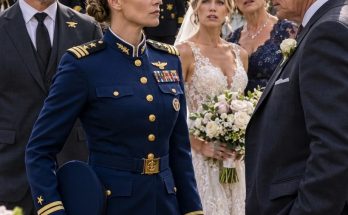
I showered, prepared my hair, and carefully put on my dress whites.
The fabric settled against my shoulders with familiar weight.
I adjusted the stars.
Checked the ribbons.
Ensured every detail was correct.
When I looked in the mirror, I did not see the daughter my father found difficult.
I saw the officer who had spent a lifetime earning the right to wear that uniform.
I drove to Charleston.
The wedding was held in a historic venue overlooking the water.
Guests were already gathering when I arrived.
I recognized several faces from the defense community.
Jack was near the entrance with Susan.
He smiled when he saw me.
“You look sharp, Admiral.”
“Thank you.”
He glanced toward the main room.
“Your sister’s fiancé has some interesting friends.”
I followed his gaze.
The room was filling with men and women whose posture, bearing, and quiet awareness marked them as people who had spent years in high-stakes environments.
Many of them were Navy SEALs or former special operations personnel.
Matthew Whitaker stood near the front, speaking with a small group.
He looked up, saw me, and something like recognition crossed his face.
Melanie was with our parents near the floral arrangements.
My father noticed me first.
His expression tightened.
My mother placed a hand on his arm.
Melanie turned, saw the uniform, and froze for a moment.
Then she forced a smile and walked toward me.
“Claire.”
“Melanie.”
She hugged me carefully, as though the uniform might somehow contaminate the occasion.
“You look… formal.”
“The invitation said formal.”
She glanced at our father.
“Dad’s a little concerned.”
“I know.”
Matthew approached.
He extended his hand.
“Admiral Bennett. It’s an honor.”
Melanie looked startled.
“You two know each other?”
“Not personally,” Matthew said. “But your sister’s reputation precedes her.”
My father arrived beside us.
“Claire. I thought we discussed this.”
I met his eyes.
“We did. You gave instructions. I chose differently.”
Before he could respond, a familiar voice carried across the room.
“Admiral on Deck!”
The effect was immediate.
Over two hundred men and women rose from their seats almost as one.
The room fell silent.
Chairs scraped.
Conversations stopped.
Every person in uniform snapped to attention.
Civilians stood as well, following the lead of those who understood the protocol.
Commander Cole, a SEAL officer I had worked with years earlier, stood near the front.
His voice had carried the announcement.
Jack stood slightly behind me, expression calm.
My father stared.
My mother looked confused.
Melanie’s mouth opened slightly.
Matthew watched with quiet understanding.
I walked forward.
The silence held.
When I reached the front rows, Commander Cole nodded once.
“Welcome, Admiral.”
“Thank you, Commander.”
I took my seat.
Only then did the room settle.
The ceremony proceeded.
Melanie and Matthew exchanged vows.
Guests smiled and wiped tears.
Photographers moved quietly.
Yet something fundamental had shifted.
My father spent the rest of the afternoon answering questions he could not answer.
People approached him with respect and curiosity.
They asked about my career.
They shared stories of working with me or knowing colleagues who had.
They assumed he must be enormously proud.
He smiled tightly and gave vague replies.
After the reception began, Jack found me near the terrace doors.
“Well?”
I looked across the room at my father, who was speaking with a retired admiral.
“He looks uncomfortable.”
“Good.”
I glanced at him.
Jack shrugged.
“Sometimes discomfort is the only teacher certain people will listen to.”
Melanie approached later, slightly flushed from champagne and attention.
“Claire… I didn’t realize…”
“Realize what?”
“How many people know you.”
I smiled gently.
“Most of them know the work. Not necessarily me.”
She hesitated.
“Dad is… processing.”
“I imagine so.”
She looked down.
“I’m sorry about the message. I didn’t know he was going to send that.”
“I know.”
“And about the uniform. I should have told him it was fine.”
I studied her.
“Yes. You should have.”
She nodded, accepting the truth without defense.
It was a small beginning.
Later that evening, as guests began to leave, my father found me alone near the water.
The harbor lights reflected on the surface.
For a long time he said nothing.
Then he spoke without looking at me.
“I didn’t know.”
I waited.
“All those people. Standing.”
Still I said nothing.
He finally turned.
“Why didn’t you ever tell us?”
The question was so late it almost hurt more than the original message.
“I tried,” I said quietly. “For years.”
He looked away.
We stood in silence until he walked back inside.
I remained by the water, feeling the night air against my face.
I had not gone to the wedding to humiliate anyone.
I had simply refused to make myself smaller.
And for the first time, the people who had spent decades overlooking me were forced to see the space I actually occupied in the world.
**Part 3**
In the weeks that followed, the consequences of that evening continued to unfold.
My mother sent a package containing old photographs and letters from my grandmother.
One letter, written decades earlier, contained a paragraph that stopped me cold:
Claire has decided to go to the Naval Academy.
Richard worries she is making a mistake.
I think she knows her own mind better than most people twice her age.
I hope he learns to be proud of her before she stops expecting him to.
I cried when I read it.
My grandmother had understood the danger long before I did.
Melanie and Matthew visited.
For the first time, we went through photographs of my career together.
Melanie asked questions.
She apologized for years of assumptions.
Matthew spoke with my father and made it clear that the respect shown at the wedding required no explanation or apology from anyone.
Then, one ordinary Wednesday, my father appeared at my door.
He carried a large envelope filled with public information about my career—biographies, announcements, photographs—that had been available for years.
He admitted he had never looked.
He apologized for the message.
He apologized for the years of absence.
He said the words I had waited a lifetime to hear:
“I’m proud of you.”
The apology was imperfect.
It stumbled.
It came far too late to erase decades of damage.
But it was real.
I told him we could not return to the old relationship.
We would have to build something better, with clearer boundaries and mutual respect.
He agreed to try.
In the months that followed, small changes accumulated.
My father learned to ask questions instead of issuing judgments.
My mother began calling without requests or instructions to keep the peace.
Melanie started showing up for ordinary moments in my life rather than only when she needed something.
We went sailing together—my father and I—on a modest boat under a clear sky.
He accepted instruction from me without defensiveness.
It was one of the most meaningful afternoons of my life.
A year after the wedding, I hosted a small gathering at my home.
Friends from the Navy.
Family.
People who had known different versions of me.
My father raised a glass and publicly acknowledged that he had not been present for my retirement and that he regretted it.
He called me his daughter.
And a very fine admiral.
The words still moved me.
But they no longer defined me.
I had already become whole without them.
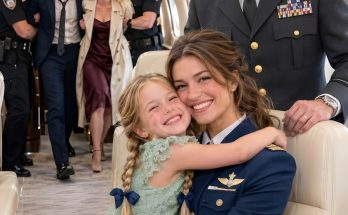
Later that night, alone in my study, I looked at the four silver stars and the photograph from the wedding—the moment the room had risen.
I understood something essential.
The stars had never been the reason I mattered.
Neither had the standing ovation.
I had mattered when I was seventeen and applied to Annapolis against my father’s wishes.
I had mattered during every lonely deployment.
I had mattered in every quiet decision to do the right thing when no one was watching.
The hardest battle of my life had not been fought at sea.
It had been the long campaign to stop disappearing for the comfort of people who refused to see me.
On the day those Navy SEALs stood, my father discovered that my career meant something to hundreds of people.
What he could not see immediately was that I had already made the most important decision before I ever walked through those doors.
I had decided to stand for myself.
And this time, I was not sitting back down.
**THE END**