**Part 1**
PART 1: The Message That Broke Thirty-Six Years of Silence
My father sent me a text that said, “Nobody gives a damn about your Navy career.”
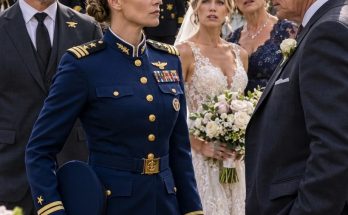
Twenty-four hours later, I stepped into a wedding ceremony, and over two hundred battle-hardened Navy SEALs stood up from their seats.
Then a commander’s voice boomed across the room.
“Admiral on Deck!”
And the silence that came afterward changed everything.
My name is Admiral Claire Bennett, and the hardest battle I ever faced was not fought at sea.
It took place inside my own home.
For thirty-six years, I had believed that if I worked hard enough, sacrificed enough, and accomplished something extraordinary enough, my family would eventually look at me with pride.
I had been wrong.
The message arrived on a Thursday afternoon as I was signing the final page of my retirement documents at Naval Station Norfolk.
Heavy rain pounded against the office windows, turning the harbor into a blurred landscape of steel, gray water, and distant lights.
Somewhere beyond the glass, a ship sounded its horn.
I had always loved that sound.
There was something about it that reminded me that no matter how complicated life became on land, there were still places in the world where duty meant something.
Where a person’s word carried weight.
Where loyalty was earned rather than demanded.
Where respect did not depend on whether you happened to be someone’s favorite child.
My office was unusually quiet.
Most of my personal belongings had already been packed into cardboard boxes.
Photographs had been removed from the walls.
Books that had accompanied me through years of assignments were stacked beside the door.
On my desk sat a leather portfolio, a black pen, a photograph of my first ship, and the documents that officially concluded thirty-six years of military service.
Admiral Claire Bennett.
United States Navy.
Four stars.
Thirty-six years.
I ran my fingers across the printed words.
They represented more than half my life.
They represented birthdays spent thousands of miles from home, Christmas dinners eaten beneath fluorescent lights, friendships forged during impossible circumstances, and countless nights when sleep had been less important than the safety of the people entrusted to my command.
They represented sailors whose names I would remember until my final breath.
Some had become admirals themselves.
Others had returned home to raise families, open businesses, or pursue dreams that had nothing to do with the military.
Some had never returned home at all.
Every one of them had changed me.
I had just positioned my pen above the signature line when my phone illuminated beside the documents.
DAD.
For one hopeful, foolish second, I thought he might have remembered.
My retirement date had been on the family calendar for months.
I had mentioned it during our last telephone conversation.
I had sent my parents an invitation to a small retirement gathering.
I had even forwarded the official announcement after my chief of staff suggested that my family might appreciate having a copy.
Perhaps, I thought, my father was finally going to acknowledge what this day meant.
Perhaps he would say congratulations.
Perhaps he would tell me that he was proud.
At fifty-eight years old, after commanding thousands of people and sitting across conference tables from some of the most powerful officials in the country, I was still capable of hoping for those four simple words.
I’m proud of you.
I picked up my phone.
“Nobody gives a damn about your Navy career.
Please don’t humiliate us by showing up in that uniform at Melanie’s wedding.”
I read it once.
Then twice.
Then a third time.
Outside, lightning briefly illuminated the harbor.
I remained completely still.
There were insults that made you angry.
There were insults that made you defensive.
And then there were words so precisely aimed at an old wound that your body seemed to forget how to respond.
My father had always possessed an extraordinary talent for finding that wound.
I placed the phone facedown on my desk.
For several seconds, I stared at the retirement papers without seeing them.
I had stood aboard destroyers during fierce storms, gripping railings as waves crashed against steel.
I had made decisions under pressure that ensured sailors returned home safely.
I had delivered letters to families whose loved ones would never return.
I had endured congressional hearings, casualty reports, command assessments, and retirement boards without allowing my voice to tremble even once.
Yet a single message from my seventy-nine-year-old father had accomplished what years of pressure had not.
It made me question whether anything I had done would ever be enough.
There was a knock at my office door.
“Come in.”
My executive assistant, Commander Rachel Morgan, entered carrying a small folder.
She had worked with me for four years.
In that time, she had learned to recognize the difference between my ordinary concentration and the particular stillness that meant something was wrong.
“Admiral?”
“Yes?”
“Personnel confirmed receipt of the remaining documents.
Whenever you’re ready, ma’am.”
“Thank you, Commander.”
She remained near the door.
“Is everything all right?”
I almost gave her the standard answer.
Everything is fine.
That was what I had said to my family for decades.
It was what I said whenever they forgot an important occasion, mocked a promotion, or asked me to rearrange military obligations because Melanie needed help with something.
But Rachel was not my family.
She had watched me manage crises without complaint.
She had seen me sit with grieving officers and confront difficult decisions.
She knew better than to mistake composure for the absence of pain.
“Family matter,” I said.
Her expression softened.
“Understood, ma’am.”
I expected her to leave.
Instead, she glanced at the retirement papers.
“For whatever it’s worth, Admiral, there are a lot of people who wish this day wasn’t happening.”
I looked up.
She smiled.
“You’ve made a difference here.”
The simple kindness of her words nearly undid me.
“Thank you, Rachel.”
“It’s been an honor.”
“The honor has been mine.”
She nodded and quietly closed the door behind her.
For a long time afterward, I sat alone.
I thought about the difference between my father’s message and Rachel’s words.
One had come from a man who had known me since the day I was born.
The other had come from a woman who had known me for four years.
Only one of them seemed to understand who I was.
My father had never called me Admiral Bennett.
Not once.
To him, I had always been Difficult Claire.
The daughter who challenged everything.
The daughter who refused to accept that her future should be decided by someone else.
The daughter who had chosen the Naval Academy instead of the respectable, uncomplicated life he had imagined for her.
My younger sister, Melanie, had never presented him with those problems.
She knew how to laugh at his jokes.
She knew when to remain silent.
She knew how to turn disagreements into charming conversations that ended with everyone pleased.
I had never mastered that particular art.
As children, we had been taught different lessons beneath the same roof.
Melanie learned that love was something she could expect.
I learned that love was something I had to earn.
The distinction had followed us into adulthood.
I was seventeen when I announced that I wanted to attend Annapolis.
It was a Sunday afternoon.
My mother was carrying a baking dish from the kitchen.
Melanie was seated at the dining table with a glass of lemonade.
My father was reading the newspaper.
I remembered the precise moment I spoke.
“I’ve decided to apply to the Naval Academy.”
My mother nearly dropped the baking dish.
Melanie laughed into her glass.
My father slowly lowered his newspaper.
“The what?”
“The United States Naval Academy.
In Annapolis.”
He stared at me as though I had announced that I intended to abandon civilization altogether.
“Women have no place aboard warships.”
“Things are changing, Dad.”
“You’ll eventually grow out of this phase.”
“It isn’t a phase.”
He folded the newspaper.
“Claire, you’re seventeen.
You don’t know what you want.”
“I know this is what I want.”
My mother set the dish on the table.
“Perhaps you should think about a nice college closer to home.”
“I have thought about it.”
“You could study business,” my father continued.
“Meet somebody.
Get married.
Have a family.
There’s nothing wrong with a respectable, normal life.”
“I didn’t say there was.”
“Then why are you making everything so difficult?”
That question would become the defining question of our relationship.
Why are you making everything so difficult?
Whenever I refused to surrender something important, my father interpreted my resistance as aggression.
Whenever I defended myself, my mother interpreted it as a threat to family harmony.
Whenever Melanie received something I had been denied, I was expected to congratulate her without acknowledging the difference.
At seventeen, I did not understand how deeply those patterns would shape my life.
I understood only that I wanted something my father did not approve of.
And that surrendering it would have meant surrendering myself.
I applied to Annapolis anyway.
I remembered completing the application at the small wooden desk in my bedroom, long after everyone else had gone to sleep.
I remembered hiding my excitement whenever another piece of correspondence arrived.
I remembered the teacher who helped me prepare for interviews and told me that determination mattered more than other people’s expectations.
I remembered receiving my appointment.
And I remembered my father’s response.
“Well, I hope you’re prepared to live with the consequences.”
There had been no celebration.
No photograph.
No special dinner.
Melanie had received a new car the previous month after graduating from high school.
I received a lecture about disappointment.
Still, I went.
I packed my belongings into two suitcases, hugged my mother beside the driveway, and boarded a plane carrying a future that nobody in my family seemed interested in imagining.
The Academy challenged me in ways I had never anticipated.
It demanded discipline, resilience, humility, and the willingness to begin again after failure.
I discovered quickly that determination alone did not guarantee success.
I struggled.
I made mistakes.
I encountered people who believed, as my father did, that I had no business being there.
But I also encountered people who cared about my performance rather than my father’s opinions.
For the first time in my life, standards were explained to me before I was judged against them.
If I failed, I could identify what needed improvement.
If I succeeded, the accomplishment belonged to me.
That clarity was liberating.
I learned to trust myself.
Slowly, painfully, deliberately.
Then I commissioned as an officer.
Then came my first assignment.
Then another.
Years passed.
The gold insignia on my uniform changed.
My responsibilities expanded.
My decisions carried increasingly serious consequences.
Yet every time I returned home, I became seventeen again.
My father would ask when I intended to find a real job.
My mother would introduce me as her daughter who worked for the government.
Melanie would complain that I never understood what was happening in the family because I was always somewhere else.
Nobody asked where I had been.
Nobody asked what I had seen.
Nobody asked what it cost.
And I rarely volunteered the answers.
I had spent decades believing that achievements would eventually speak loudly enough to reach them.
At fifty-eight, staring at a text message beside my retirement papers, I finally understood that they had heard me all along.
They had simply chosen not to listen.
I turned my phone over again.
The message remained on the screen.
For a moment, I considered answering.
I could have explained that my dress uniform was not a costume.
I could have reminded him that I had worn those stars in rooms where decisions affected thousands of American families.
I could have asked whether he understood what thirty-six years meant.
But I had explained myself before.
Hundreds of times.
Nothing had changed.
I opened the message thread and took a screenshot.
Then I returned to my retirement documents.
At precisely 6:18 p.m., I signed my name.
Claire Bennett.
The pen moved smoothly across the page.
No hesitation.
No trembling.
Thirty-six years of service concluded with a signature so ordinary that anyone passing my desk might have mistaken it for routine paperwork.
I leaned back in my chair.
For the first time since entering the Navy, I had no next assignment waiting for me.
No ship to join.
No command to assume.
No immediate crisis requiring my attention.
I was about to become a retired officer.
The change should have frightened me.
Instead, the thing that frightened me most was the realization that I might spend the rest of my life waiting for a father who would never become the man I needed.
I gathered the documents into my leather portfolio.
Before leaving, I stood beside the office window.
Rain continued to strike the glass.
Across the harbor, navigation lights blinked through the darkness.
I thought about every sailor who had stood a watch in bad weather.
Every officer who had wondered whether they were capable of the responsibility placed upon them.
Every person who had left home carrying the quiet fear that the people they loved might never understand their choices.
I had been one of them.
I would always be one of them.
“Fair winds,” I whispered.
Then I turned off the lights.
Commander Morgan was waiting near the outer office.
So were several members of my staff.
Nobody had planned a large ceremony for that evening.
We had already completed the formal farewells.
But they had remained behind anyway.
One by one, they shook my hand.
A lieutenant handed me a small envelope.
A civilian administrator hugged me.
A senior chief cleared his throat before thanking me for something that had happened years earlier, something I barely remembered but that apparently had changed the course of his career.
By the time I reached the elevator, I was carrying three handwritten notes and a small wooden plaque.
I held them close against my chest.
My father had told me nobody cared.
Yet the people standing behind me had stayed late in a rainstorm because they did.
I wished that contradiction had been enough to erase the pain.
It wasn’t.
By the time I reached my townhouse, the rain had soaked the cuffs of my uniform trousers.
Across the street, warm golden light spilled from restaurant windows.
Families crowded into booths, sharing plates and laughing beneath hanging lamps.
A young woman raised a glass while the people around her applauded.
Perhaps it was a birthday.
Perhaps a graduation.
Perhaps an ordinary Thursday evening made special because the people she loved were there.
I watched for a moment before unlocking my front door.
My own house remained quiet.
There were no balloons.
No relatives waiting.
No congratulatory banner.
No familiar voice calling from the kitchen.
Only the soft hum of the refrigerator and the ticking of a clock.
I set my portfolio on the table, removed my wet shoes, and climbed the stairs.
In my bedroom closet, a single garment bag hung from a brass hook.
Inside were my dress whites.
Flawlessly pressed.
Four silver stars positioned on the shoulders.
I stood before them for several seconds.
My father’s message echoed in my mind.
Please don’t humiliate us by showing up in that uniform.
I reached toward the garment bag.
Then I stopped.
Because beneath the anger and the disappointment was a question I could no longer avoid.
After spending thirty-six years defending what I believed in, was I really going to spend the first day of my retirement apologizing for who I had become?
PART 2: The Daughter They Never Learned to See
I poured two fingers of bourbon into a glass before settling onto the edge of my bed.
I rarely drank alone.
That evening, however, seemed to demand something stronger than coffee.
I took one small sip and studied the garment bag hanging across the room.
The white uniform inside represented a lifetime of work.
To my father, apparently, it represented embarrassment.
I wondered how two people could look at the same thing and see such completely different realities.
My phone vibrated again.
This time, the message was from my mother.
“Please don’t cause problems with your father this weekend.
Melanie deserves a peaceful wedding.”
A soft, humorless laugh slipped from my lips.
Of course.
My father had insulted me on the final day of my military career, and somehow I was the person responsible for preventing trouble.
I stared at the message.
Not a word about retirement.
Not a single question about how I was feeling.
No acknowledgment of what my father had said.
Just the familiar instruction.
Keep the peace.
My mother, Margaret Bennett, had spent most of her adult life keeping the peace.
When I was young, I admired her for it.
She possessed an ability to recognize tension before anyone else noticed it.
She knew when my father’s mood was beginning to change.
She knew which subjects to avoid, which opinions to soften, which jokes might make him smile.
She called it understanding him.
As an adult, I came to recognize it as a way of organizing an entire household around one man’s comfort.
My father, Richard Bennett, was not a cartoon villain.
That would have made things easier.
He could be generous with strangers.
He volunteered at community events.
He remembered the names of waiters and tipped them well.
He took enormous pride in maintaining his property and helping neighbors with practical problems.
People liked him.
Many thought he was an exemplary family man.
They saw the version of Richard Bennett that appeared when things went according to his expectations.
I knew the version that appeared when they didn’t.
Growing up, I had been the child most likely to disrupt those expectations.
I asked questions.
If a rule seemed unfair, I wanted to understand why it existed.
If Melanie and I were treated differently, I pointed it out.
If my father made a sweeping statement about what women could or could not accomplish, I challenged him.
My father called that disrespect.
I called it curiosity.
My mother called it exhaustion.
Melanie learned early that remaining agreeable brought rewards.
I learned that disagreeing carried consequences.
One summer, when I was fourteen, our father decided that both daughters should learn to sail.
He had purchased a modest used sailboat and seemed delighted by the idea of teaching us.
I remember the smell of sunscreen, the wooden dock warming beneath my bare feet, and the sunlight reflecting across the water.
Melanie disliked the entire experience.
She complained about the wind, the uncomfortable life jacket, and the possibility of getting her hair wet.
I fell in love immediately.
There was something thrilling about understanding how the boat responded to the wind.
My father explained the lines, the sails, and the importance of paying attention to changing conditions.
Within weeks, I could perform maneuvers he had expected would take me months to learn.
One afternoon, another sailor complimented me.
“She’s a natural, Richard.”
My father laughed.
“Until she finds something more interesting.”
I waited for him to tell the man how hard I had worked.
He didn’t.
The following weekend, he took Melanie shopping instead of taking us sailing.
I asked whether we could go another time.
“Don’t get obsessed with it, Claire.”
I didn’t understand.
He had introduced me to something I loved.
Why was my enthusiasm suddenly a problem?
Years later, I realized he had enjoyed teaching me as long as I remained the student he expected.
My growing confidence had changed the experience.
I wanted to know more.
I wanted to become better.
I wanted to go farther than the small stretch of water he had chosen.
That was when his encouragement disappeared.
It happened repeatedly.
At school.
At home.
Eventually at Annapolis.
My accomplishments were acceptable only while they remained small enough to fit within his understanding of me.
When I became something larger, he withdrew his approval.
I spent years trying to recover it.
One of the notes I had received that evening came from a senior chief named Daniel Harper.
I opened it beside my bourbon.
Inside, in careful handwriting, he had written:
Admiral,
You probably don’t remember the conversation we had eighteen years ago.
I was ready to leave the Navy because I thought I had ruined my career.
You told me that a mistake honestly confronted was not the same thing as a character defect.
I stayed.
Today, my daughter is considering the Naval Academy.
I hope she meets leaders like you.
Thank you for seeing something worth saving when I couldn’t see it myself.
I lowered the note.
I remembered Daniel.
He had been a young sailor struggling with personal circumstances that were affecting his performance.
He had made a mistake and expected it to define him.
Instead, we had found a way forward that balanced accountability with the possibility of growth.
I hadn’t considered the conversation extraordinary.
Apparently, he had.
That was the strange thing about a career spent serving other people.
You rarely understood the full consequences of your smallest decisions.
A few minutes of your time might change somebody’s future.
A sentence you forgot might become a sentence they remembered for the rest of their life.
I wondered whether my father understood the same principle.
His words had certainly shaped me.
Just not in the way a father should wish to shape a daughter.
I opened my phone and began scrolling through old family photographs.
There was Melanie at her college graduation, surrounded by flowers.
Melanie at her first engagement party, smiling beside a man she would eventually decide not to marry.
Melanie celebrating a promotion in the event-planning business where she worked for several years before establishing her own consultancy.
Melanie at our parents’ anniversary dinner.
Melanie at Christmas.
Melanie on vacations.
My parents had documented her life with loving enthusiasm.
My own appearances were scattered.
In one photograph, I was seated at the edge of a crowded dinner table, still wearing a business suit after arriving directly from an airport.
In another, I stood behind my parents at a Thanksgiving gathering.
In another, I was barely visible in the background while Melanie opened presents.
There were no photographs of my commissioning ceremony.
None from my first command.
None from my first promotion to flag rank.
My family had not attended any of them.
There had always been reasons.
My father had work.
My mother didn’t enjoy traveling.
Melanie had an important commitment.
The dates were inconvenient.
The locations were too far away.
The ceremonies sounded too formal.
I accepted those explanations because challenging them would have created conflict.
Or so I told myself.
The deeper truth was that I feared asking a question whose answer I already suspected.
Would you come if it were Melanie?
I knew they would.
Once, when I was promoted to captain, I telephoned my father from a quiet passageway.
“Dad, I have some news.”
“Can it wait?
I’m helping your sister with something.”
“It won’t take long.”
“All right.
What is it?”
“I’ve been selected for promotion.”
“Again?”
I smiled despite myself.
“Yes.
To captain.”
“Does that mean you’re moving somewhere else?”
“Possibly.”
“Your mother’s going to be disappointed if you miss Christmas.”
That had been the entire conversation.
I returned to my colleagues and celebrated with people who understood what the promotion meant.
Later that evening, my mother called.
I hoped my father had told her.
Instead, she asked whether I could contribute toward replacing Melanie’s car.
I sent money.
I didn’t mention the promotion again.
That pattern continued for years.
When Melanie needed help with a deposit on an apartment, I contributed.
When she encountered financial trouble after ending a relationship, I helped.
When our parents needed assistance arranging repairs to their house, I handled the details.
I called on birthdays.
I sent gifts.
I remembered anniversaries.
Whenever I returned home, I made myself useful.
Yet somehow my presence remained optional while my absence was treated as a personal failure.
I had become the dependable daughter nobody seemed interested in knowing.
Melanie was not entirely responsible for the arrangement.
She had grown up inside it, just as I had.
But unlike me, she had benefited from it.
Over time, she began repeating the language our parents used.
“Claire, you’re too serious.”
“Claire, not everything has to be a military operation.”
“Claire, you wouldn’t understand.”
Sometimes she said those things affectionately.
Sometimes she said them when she wanted to end a conversation.
Either way, the message was clear.
My experiences were inconvenient whenever they challenged hers.
Six months before the wedding, Melanie had called to announce her engagement.
Her fiancé was Matthew Whitaker.
I knew little about him.
They had met through mutual acquaintances in Charleston.
He was thoughtful, financially stable, and apparently much less interested in displaying his success than Melanie’s previous partners had been.
“He’s different,” she told me.
“Different how?”
“He listens.”
“That’s important.”
“And he’s incredibly disciplined.
Sometimes it drives me crazy, but in a good way.”
I smiled.
“Sounds familiar.”
She laughed.
“Don’t start.”
I asked what Matthew did.
“He’s involved in defense consulting and a couple of nonprofit projects.
It’s complicated.”
“What kind of projects?”
“Oh, Claire.
I don’t know all the technical details.”
“All right.”
“You’ll meet him at the wedding.”
I had tried to meet him sooner.
My schedule complicated the first opportunity.
Melanie canceled the second because of a venue appointment.
Then our parents suggested that everyone should simply wait until the wedding weekend.
I agreed.
I had no reason to suspect Matthew’s professional background was particularly significant.
Defense consulting covered an enormous range of work.
Charleston was full of people whose careers intersected with the military.
I was glad Melanie had found someone who made her happy.
At least, I hoped he did.
When the invitation arrived, I noticed that the ceremony was scheduled for the day after my retirement.
I called her.
“That’s a remarkable coincidence.”
“What is?”
“Your wedding date.
It’s the day after my retirement becomes effective.”
There was a pause.
“Oh.”
“I’ll finally have some flexibility.”
“Great.
So you can definitely come?”
“Of course.”
“Good.
Mom’s worried you might have some emergency.”
“Not this time.”
She sounded pleased.
But the conversation moved immediately to seating arrangements, flowers, and our mother’s dress.
I received the unmistakable impression that my retirement mattered only because it removed a potential obstacle to my attendance.
Nevertheless, I planned to go.
I purchased a wedding gift.
I reserved a hotel room.
I arranged to have my dress whites professionally prepared.
The invitation specified formal attire, and after thirty-six years in the Navy, wearing my formal uniform to a wedding felt entirely natural.
I had attended countless civilian and military weddings that way.
Nobody had ever suggested it was inappropriate.
Then my father heard about my plans.
He called the previous weekend.
“Your mother tells me you’re bringing your Navy clothes.”
“My dress uniform, yes.”
“Why?”
“It’s a formal wedding.”
“It’s Melanie’s wedding.”
“I’m aware of that.”
“People don’t need to be reminded of what you do.”
“I’m not wearing it to remind anyone.”
“Then wear something normal.”
I exhaled slowly.
“Dad, there’s nothing abnormal about my uniform.”
“Don’t argue with me.”
“I’m not arguing.”
“Good.
Then we’ve settled it.”
He hung up.
I had not agreed.
He apparently assumed my silence meant surrender.
Thursday’s message was his attempt to ensure compliance.
I placed Daniel Harper’s note on my bedside table.
Then I reopened my mother’s text.
Please don’t cause problems with your father this weekend.
For the first time, I allowed myself to imagine responding truthfully.
Mother, I have spent thirty-six years preventing problems that mattered far more than Father’s embarrassment.
I have made impossible decisions.
I have taken responsibility for consequences he cannot begin to imagine.
I have served my country, supported this family, and repeatedly swallowed my own disappointment so that nobody else would have to experience discomfort.
Why am I still expected to disappear whenever he demands it?
I typed none of those words.
Instead, I set the phone down.
My house was quiet enough that I could hear a car passing on the wet street outside.
I walked to my closet and unzipped the garment bag halfway.
The white fabric emerged beneath my fingers.
I remembered the first uniform I had ever worn.
How nervous I had been.
How carefully I had learned to prepare it.
How much I had wanted to prove that I belonged.
I had spent decades growing into that responsibility.
The stars had not arrived through family connections or convenient favors.
They had come through years of service, evaluations, assignments, decisions, sacrifice, and the trust of people who expected me to justify that trust every day.
They were not proof that I was better than anyone.
They were evidence that extraordinary responsibilities had been entrusted to me.
That distinction mattered.
And it was precisely what my father had never bothered to understand.
I zipped the garment bag closed.
Then I sat down again.
At 9:12 p.m., my phone began to ring.
The name on the screen made me smile for the first time that evening.
Retired Master Chief Jack Hayes.
A Navy SEAL.
A longtime friend.
One of the few people in the world who could tell me exactly what he thought without caring whether I outranked him.
I answered.
“You’re heading to Charleston tomorrow,” he said.
“Nice hearing from you too, Jack.”
“I heard about the wedding.”
“Of course you have.”
“Half the defense community received invitations.”
I straightened.
“What exactly are you talking about?”
For once, Jack Hayes hesitated.
That alone was enough to get my attention.
“Claire,” he finally said, “you honestly don’t know who’s going to be there, do you?”
“No.”
He let out a long, slow breath.
And when he spoke again, the tone of his voice told me that whatever awaited me in Charleston was nothing like the quiet family wedding I had imagined.
**Part 2**