PART 1
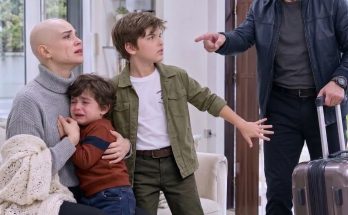
“If your mom dies, let Child Protective Services take care of you. I’m not raising two orphans,” my father said as he zipped his suitcase.
I was nine years old and my brother Ben was only six. Mom was lying on the couch in our house on the east side of Tulsa, a scarf over her head and a bucket by her feet because the chemo made her sick. Her name was Marianne. I still remember how she tried to sit up to defend us, but she could barely hold herself up on her elbows.
“Vernon, don’t talk like that in front of them. They’re your children.”
My father pointed at the suitcase as if that explained everything.
“I’ve been paying the bills for months. I have a right to live my own life.”
“You can leave this house,” I told him, “but don’t ever call yourself our dad again.”
He laughed. He was forty years old, with a new pickup truck and a woman named Tiffany waiting outside. He looked at me the way you look at a kid who’s threatening to quit eating vegetables.
“When you grow up, you’ll understand that nobody is obligated to sacrifice themselves for anyone else.”
He slammed the door. Ben started crying and asked whether Child Protective Services was a school. Mom held him without answering. I picked up a family photograph that had fallen off the wall from the slam and hid it in a drawer. I was ashamed that anyone might see we had once been happy.
Mom died seven months later. During that time, her sister, my Aunt Carol, drove us to the hospital, helped with school, and arranged for us to stay with her. A neighbor cooked for us when Carol worked double shifts. My father never came to say goodbye to Mom and never showed up at the funeral. He didn’t even call to ask who would take care of us.
Carol never asked us to forget what happened. She only kept saying we didn’t have to become anyone like him. It was harder on Ben. Some nights he woke up asking where Mom was. I lied and told him she was in the kitchen. Then I’d walk in there, turn on the light, and stand looking at an empty table.
Fifteen years later, I worked in the office of a trucking company and Ben was studying engineering at night. We shared a modest apartment, paid our own way, and visited Carol every Sunday. We had learned to say “my mom” without adding anyone else’s name.
That’s why I froze when a call from an unknown number came in early in November 2026.
“Wesley? It’s Vernon. Your dad.”
I recognized the voice instantly, even though it was hoarser. The first thing I did was look at the clock, as if that could explain why a man disappears for fifteen years and calls on a Tuesday at eleven in the morning.
“You’ve got the wrong person.”
“Wait. I’m sick. My kidneys are failing. They’re going to start me on dialysis.”
I didn’t answer.
“Tiffany left. I can’t drive, I get tired just taking a shower. I need you and your brother to come.”
He told me about his illness before asking how I was. He didn’t mention Mom. He didn’t even know Ben was in school. He’d found me through a post on my company’s website that listed my number, not because he’d ever stayed in touch.
“There are people you can hire to take care of you,” I said.
“It’s not the same as having your kids. Family is who you need at a time like this.”
I felt my jaw tighten.
“You taught us something different.”
I hung up and called Carol to make sure it was really him. My aunt was quiet for a few seconds. Then she asked a strange question.
“Did he tell you he never could find you?”
“Not yet. Why?”
“Because that was the excuse he used after the funeral. And there’s something you two need to know before you decide whether you want to see him.”
That afternoon I went to her house. Carol took an old folder out of the closet where she kept Mom’s medical papers. Inside were printed emails, receipts, and a folded sheet in an envelope with no stamp. I recognized my mother’s handwriting before I read a single word.
“I didn’t show you this when you were kids,” my aunt said. “I wanted you to grow up without carrying this decision too.”
I picked up the first email. The date was after my father left. It was addressed to his usual email address. On the printed screen was a reply from Vernon.
I looked up at my aunt when I read the first sentence. My father hadn’t just known where we were. He had received a specific request from Mom when she could hardly walk. And what he answered explained why he never showed up again.
PART 2
The reply was barely five lines long. Mom had written asking him to pick Ben up from elementary school during her sessions at the hospital. She didn’t ask for money or for him to come back to her. She attached the school schedule and Carol’s address, in case he preferred not to come into our house.
Vernon answered: Don’t drag me into this. I’ve chosen another life. If you can’t handle the kids, get help from the government.
Below it was a second message from Mom: I’m not asking you to be my husband. I’m asking you to be their father. He never wrote back.
“Why didn’t you ever show us?” I asked.
“Because you were ten when she died. You already felt you had to protect everyone. I didn’t want you to feel responsible for convincing him, too.”
In the folder were receipts for medicine Carol had paid for and a letter Mom had written but never sent. They weren’t proof of some conspiracy. They were something worse: a record of ordinary, simple chances my father had decided to ignore.
When I got home I showed the emails to Ben. He read them standing next to the refrigerator. When he finished, he set the pages on the table carefully, as if they were hot.
“I thought he really didn’t know where we lived,” he murmured. “It was the only excuse I could still make for him.”