Part 1 — I Found My Mother in the Laundry Room
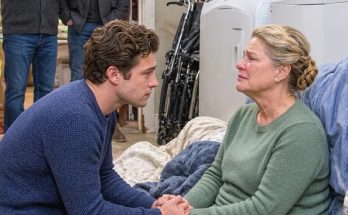
I came home from college five days early to surprise my mom for Thanksgiving. At eleven that night, I found her sleeping on an air mattress between the washer and dryer, with her wheelchair folded against a wall she couldn’t reach. Upstairs, my stepbrother was asleep in her bed with his boots on.
“Don’t make a fuss, honey,” she whispered when I turned on the light.
I’m Julian Saunders. I was nineteen that fall, studying social work at a college in Colorado. My dad died when I was twelve, and for years it was just Mom and me in our house in Tucson.
Mom’s name is Diane. She was diagnosed with multiple sclerosis when I was fifteen, and by my high school graduation, she was using a wheelchair most days. Her hands shook more than they used to, and she had started asking me to read the small print on her mail.
She married Lonnie two years before I left for college. In the beginning, he fixed things around the house and drove her to appointments. When I told Mom I was thinking about staying in Tucson for school, she knew exactly why.
“Lonnie will take care of me,” she said. “Go live your life.”
In September, Lonnie’s twenty-seven-year-old son, Colt, lost his job and moved in. Mom said it was temporary. After that, our calls got shorter, and when I asked how she was doing, she always seemed to give me the same answer.
“I’m fine, honey. Just tired.”
My last test before Thanksgiving break ended early, so I changed my flight. I took a shuttle from the Tucson airport and let myself in with my old key. I remember thinking I should be quiet in case Mom was already asleep.
The living room smelled like cigarettes. Empty beer cans stood on the coffee table, and somebody had left a video game paused on the TV. I went upstairs to leave my bag in my old room and saw Colt sprawled across Mom’s bed.
I came back down and checked the den, then the kitchen. The laundry room was the last place I looked. There was a plastic chair piled with her clothes, and the mattress was so low to the floor that when she tried to sit up, she couldn’t get her elbow underneath her.
“How long have you been sleeping in here?” I asked.
She looked past me toward the hallway.
“Colt needed a real bed,” she said. “It’s his back.”
I heard Lonnie coming before I saw him. He stopped in the doorway in his undershirt and looked down at the mattress like it was exactly where it belonged.
“Well,” he said. “Somebody’s home early.”
Part 2 — The Envelope Under the Dryer
“Why is my mother sleeping on the floor?” I asked.
Lonnie leaned against the doorframe. He said Mom couldn’t get upstairs anymore and the laundry room was right by the downstairs bathroom. He called it practical, as if he’d spent a great deal of time thinking about what would make her life easier.
Colt came down rubbing his eyes. He looked at Mom and said she practically lived in the laundry room anyway. Lonnie laughed. Mom began smoothing the blanket over her knees, fixing a little fold that kept coming back.
“Her chair’s across the room,” I said. “How is she supposed to get to the bathroom?”
“I put it there so she wouldn’t try getting up and fall.” His voice changed when I looked back at him. “This is my house now, kid. Your mother’s lucky I stayed. Who else is going to marry a woman in a wheelchair?”
Mom turned her face away. For a second I wanted to say something that would hurt him as much as he’d just hurt her. Then I remembered the case files I’d read the previous summer as an intern at the county Adult Protective Services office. The details that mattered were usually ordinary things someone could show a caseworker later, like a call that went unanswered or a piece of equipment left out of reach.
“I’m sleeping down here with Mom tonight,” I said.
Lonnie snorted and headed upstairs. Colt went with him. As soon as their footsteps faded, I took a photo from beside Mom’s mattress that showed how far away the chair was. Then I unfolded it and brought it to her. I photographed the mattress and the prescription bottles on the dryer, several of them empty.
I sat beside her on the floor and asked if she wanted me to call someone. She reached for my sleeve.
“There’s something else,” she whispered. “Yesterday Lonnie took me to a lawyer’s office. He said there were insurance papers I had to sign.”
She told me the print was too small for her to read. When she asked Lonnie to explain it, he pointed to the stickers and told her to sign where he’d marked. She’d brought the copies home and put them in the drawer beneath the dryer.
I pulled out the manila envelope and opened it on my lap. The first page was a deed. I read Mom’s name, then Lonnie’s and Colt’s. Neither of their names had ever belonged on paperwork for our house.
At the bottom of the page was the amount they claimed to be paying her for it. Ten dollars.
Part 3 — What the Caseworker Saw
I read the deed three times. Then I took pictures of every page and put the copies back in the envelope.
When Dad got sick, he placed the house in a family trust. On my eighteenth birthday, I signed the paperwork to become a co-trustee with Mom. I remembered being impatient to get through it because I had plans that afternoon. Now, sitting on the laundry room floor, I remembered one thing the attorney had gone over twice. Under the terms Dad had set, both trustees had to sign to transfer the house.
There was only one signature on that deed. It was Mom’s.