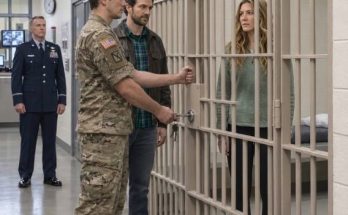
Chapter 3: THIRTY YEARS OF THE SAME JOKE
It was a soft laugh, almost an instinctive reaction.
“Well,” he remarked, “I suppose everyone’s little misunderstanding has finally been sorted out.”
I turned to face him.
He had spent the entire time standing outside those bars while I was locked behind them, enjoying the situation because it seemed to validate the version of me he had believed in since we were children.
Thirty years of pretending.
Thirty years of making jokes.
Thirty years of minimizing everything I accomplished until he could feel comfortable standing beside it.
And now, when the truth could no longer be dismissed, he wanted to call the whole incident a simple misunderstanding.
“Is that really what you believe happened?” I asked.
Glenn shrugged slightly.
“Your identification didn’t work. The kid panicked. You’re free now.”
Brandt stared at my brother.
So did the officer of the day.
When Glenn realized they were both watching him, he shifted uncomfortably.
“What?” he demanded. “She’s my sister. I can give her a hard time.”
And there it was.
Not remorse.
Permission.
For years, Glenn had used that exact reasoning whenever someone in our family suggested that his comments had crossed a line.
He was only joking.
He was my brother.
I knew what he was like.
I shouldn’t be so sensitive about everything.
The language might have changed over the years, but the pattern had always remained identical.
He was allowed to wound me.
I was expected to demonstrate that I wasn’t wounded.
He could dismiss my accomplishments.
I had to keep proving what I had achieved.
He could come to me whenever he needed something.
I was expected to prove I still cared about family by being there for him.
And I had been there countless times.
Being deployed never prevented my phone from ringing when someone back home needed assistance.
Holding command positions never stopped me from spending time in hospital rooms when a family member needed someone sitting beside them.
Advancing through the ranks never ended the money transfers, the personal favors, or the rental agreements I had co-signed because Glenn had once again persuaded himself that things would turn out differently this time.
He relied on the stability I provided while openly ridiculing the career that had made that stability possible.
That understanding struck me more deeply than being locked inside the cell.
Glenn had always believed in my career when its salary, dependability, or discipline could benefit him.
He only pretended it wasn’t real when accepting it would mean acknowledging who I actually was.
The officer of the day cleared his throat and asked whether I needed a vehicle to take me to the command building.
“No,” I replied. “I brought my own car.”
My aging sedan was still parked outside.
That seemed to astonish Brandt almost as much as discovering my rank.
I nearly smiled.
I had deliberately chosen that older car and ordinary civilian clothing because I wanted to reach the installation before the official ceremony transformed everything into a carefully prepared presentation.
I wanted to observe an ordinary morning.
I wanted to understand how the installation operated when nobody believed the new commander was watching.
I had certainly observed more than I anticipated.
Glenn followed as I headed toward the exit.
For several steps, the corridor remained silent.
Then Brandt called after me.
“General.”
I stopped walking.
He stood at attention, but the fear that had been written across his face was no longer there.
Something more constructive had replaced it.
Embarrassment, certainly.
But also genuine attention.
“I should’ve made that phone call,” he admitted.
The words weren’t rehearsed.
He wasn’t delivering a speech.
They were enough.
“Yes,” I answered. “You should have.”
He gave a single nod.
Then I added, “The next time this happens, verify the facts before your confidence outruns the evidence.”
“Yes, ma’am.”
I continued outside.
Glenn caught up with me beside the sedan.
“Are you seriously going to turn this into some huge issue?” he asked.
I unlocked the driver’s door.
“I’m going to treat it with exactly the seriousness it deserves.”
“He’s practically a child.”
“He’s a Marine performing his duty.”
“So you’re angry because he treated you the same way he’d treat anybody else?”
That made me stop.
Glenn seemed to recognize something in his own words almost immediately, because his eyebrows drew together.
I placed one hand along the top edge of the open car door.
“No,” I replied. “I’m concerned because he abandoned verification the moment his assumptions seemed more believable to him than the evidence right in front of his eyes.”
Glenn turned his gaze toward the gate.
Then came that familiar little snort I had heard at family dinners, during holidays, and at nearly every important milestone he had somehow managed to undermine.
“Sounds like a problem for the general to handle.”
He had intended those words to hurt.
Instead, they made everything perfectly clear.
“Yes,” I said. “It does.”
He turned back toward me.
I slid into the driver’s seat.
For the first time, Glenn didn’t immediately reach for the passenger door.
He remained standing outside, looking as though he was no longer certain he was welcome in that seat.
Chapter 4: THE CEREMONY I THOUGHT WOULD CHANGE HIM
I waited.
Not because I needed him to ride beside me.
I waited because I wanted him to make the next decision himself.
Eventually, he opened the door and climbed into the car.
The drive through the installation was far quieter than our earlier trip to the gate.
Only a few hours before, Glenn had filled practically every moment of silence with jokes about military ceremonies, uniforms, titles, and how absurdly seriously service members seemed to take everything.
Now he simply stared through the passenger-side window.
Marines moved between buildings and vehicles, carrying documents, inspecting equipment, reporting for duty, and completing the ordinary responsibilities that keep an organization running long after the formal speeches have finished.
I made no attempt to explain what he was seeing.
I had already spent thirty years explaining myself.
By the time we arrived at the command building, word of the incident at the gate had already spread.
News travels fast within close-knit organizations, particularly when the incoming commander arrives ahead of schedule and somehow winds up locked in a holding cell.
Nobody needed to say anything for me to recognize their curiosity.
But I noticed something else as well.
They were observing how I would handle the situation.
That was far more significant than the original mistake.
Exercising command is relatively simple when an entire room has already been prepared for your arrival.
The genuine challenge comes when someone humiliates you, misjudges you, or hands you enough authority to retaliate against them.
I wasn’t about to squander that opportunity.
The ceremony proceeded as planned.
This time, I wasn’t sitting on a steel bench with fluorescent lights humming overhead.
Instead, there were military uniforms, official remarks, responsibilities formally changing hands, and Marines who already knew exactly who I was before I walked into the room.
Glenn stood with the invited guests.
I watched him listen.
I watched him hear my rank announced without a trace of sarcasm.
I watched him observe senior officers greeting me with the professional respect he had spent decades turning into a family joke.
But what surprised me was that I no longer needed the moment I had imagined during our drive to the base.
I had brought Glenn because I believed the ceremony would finally prove something to him.
I had pictured him hearing the formal proceedings and at last understanding.
Perhaps he would apologize.
Perhaps he would begin seeing me differently.
Perhaps thirty years of mocking remarks would suddenly embarrass him as much as they had exhausted me.
But standing there, I understood that I had invested too much hope in a response I had no power to control.
I could command Marines.
I could lead an entire military installation.
I could take command of my own decisions.
But I couldn’t order my brother to respect me.
Respect had to be freely given, or it had no value at all.
When the ceremony ended, Glenn approached me before I could leave the building.
He waited until we had moved away from nearly everyone else.
“So,” he began, “General.”
He said the title differently this time.
There was no affection in it.
But there wasn’t any obvious mockery either.
It sounded as though he was trying the word out for the first time.
I said nothing.
He reached behind his neck and rubbed it awkwardly.
“I didn’t realize they were going to make such a big production out of all this.”
I almost laughed, but I couldn’t find anything amusing about it anymore.
“They didn’t turn it into something important, Glenn. This is my responsibility.”
He tilted his head toward the hallway behind us.
“Right. Your job.”
There it was again.
Another attempt to make something smaller.
It was subtler than before, but the instinct hadn’t disappeared.
I could have challenged him.
I could have reminded him how many years it had taken to reach that position, how many difficult decisions I’d made, how many separations I’d endured, and how many people’s careers and lives had depended on my ability to make the correct choices.
I could have presented my entire life to him one more time and asked him to judge it honestly.
But instead, I asked him a single question.
“Why were you smiling when they locked me in that cell?”