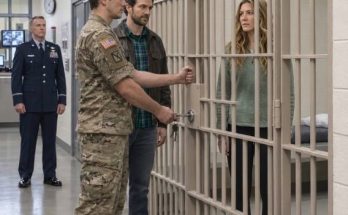
THE OFFICER WHO RECOGNIZED ME
The officer on duty crossed the holding room and headed directly toward the cell door.
Corporal Jared Brandt moved uneasily beside him, still clutching the identification card that had caused the entire situation. For the first time since this ordeal began, I watched doubt begin to replace the confidence on the young Marine’s face.
But the officer of the day did not immediately open my cell.
First, he looked at Brandt.
Then he glanced at Glenn.
Finally, his eyes returned to me.
And that was when his entire bearing shifted.
It wasn’t anything dramatic. Marines learn early in their careers that even the smallest changes in posture can communicate more than words.
His shoulders straightened, his expression became serious, and he spoke a single word that finally silenced Glenn and ended his enjoyment of the holding room as though it were his own personal comedy show.
“General.”
Brandt blinked in disbelief.
I remained on the bench.
The officer approached the bars, visibly trying to understand how the woman whose arrival the command group had been preparing for could have ended up locked inside a cell before the ceremony had even started.
“Ma’am,” he asked, “are you okay?”
“I’m fine.”
And I meant it.
Embarrassed? Not really.
Angry? Not nearly as much as Brandt probably imagined.
Exhausted was a more accurate description.
Thirty years in the Marine Corps had taught me that rank could make people pay attention the instant they recognized the insignia on your uniform. But wearing civilian clothes removed that advantage entirely.
In some ways, that was valuable.
Yet there was also something profoundly unsettling about watching a perfectly reasonable security concern transform into a firm judgment that nobody had bothered to confirm.
The officer extended his hand toward Brandt.
“Hand me the credential.”
Brandt surrendered the card.
The officer studied it carefully before asking to see my orders.
I passed the paperwork between the bars.
He examined the first page, reviewed the information a second time, and let out a controlled breath through his nose.
Then he made a phone call.
It was precisely the same call I had requested that Brandt make when we were standing at the gate.
The entire conversation lasted less than sixty seconds.
When the officer hung up, he turned toward my cell and reached for the locked door.
Chapter 2: THE MISTAKE THAT COULDN’T BE IGNORED
The lock disengaged with a sharp metallic click.
There was no applause.
There was no reason for any.
I rose from the bench, straightened the front of my civilian jacket, and walked out into the corridor.
Brandt looked as though he desperately wished the concrete beneath his boots would swallow him whole.
“Ma’am, I—”
“Stop.”
He immediately closed his mouth.
I retrieved my identification card from the officer of the day and faced the young corporal. Only minutes earlier, he had been confident enough in his judgment to have me detained. Now that he knew my actual identity, he looked frightened.
“You were correct to challenge a credential that wasn’t valid,” I told him.
Brandt appeared startled.
The officer seemed equally surprised.
Glenn, however, did not.
My brother wore that familiar expression he always displayed when he assumed I was about to turn an insult into a lecture nobody wanted to hear.
I wasn’t finished.
“What you were wrong about was deciding that verification wasn’t necessary simply because you’d already made up your mind about the person standing before you.”
Brandt swallowed hard.
“Yes, ma’am.”
“I provided my orders.”
“Yes, ma’am.”
“I asked you to contact the command group.”
“Yes, ma’am.”
“And rather than verify anything, you grew more convinced of your own conclusion every time I offered you information that could have been checked.”
His gaze briefly dropped toward the floor before he looked at me again.
“Yes, ma’am.”
The officer of the day began to say something, probably preparing to apologize for the actions of the security watch, but I raised one hand to stop him.
I wasn’t interested in receiving some formal apology in the middle of a detention corridor.
What I wanted was for the failure to be understood.
Those were two entirely different things.
Brandt was only twenty-two years old and had been handling watch duties independently for just two weeks.
That was relevant.
It didn’t excuse what had happened, but it was important.
A young Marine who exercised poor judgment and fully understood why his decision was wrong could learn from that experience and become better.
But a young Marine who walked away believing only that important people were dangerous to inconvenience would take away entirely the wrong lesson.
So I instructed the officer of the day to ensure the incident was recorded exactly as it had occurred.
Nothing was to be rewritten.
Nobody was to spare me embarrassment.
And nobody was to shield Brandt from responsibility.
The credential had failed.
Brandt had challenged it.
I had presented my orders.
I had requested that my identity be verified.
He had declined to make the necessary call and detained me while continuing to treat my explanation as a lie.
Those were the facts.
Whatever consequences followed would be determined by the people responsible for supervision and training, not by whatever anger I might have felt.
Brandt’s shoulders relaxed a little, although he still looked deeply uncomfortable.
And then Glenn started laughing.