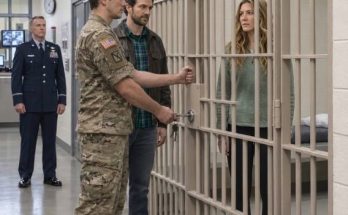
Chapter 5: THE DOOR I FINALLY CLOSED
Glenn’s expression tightened.
“I was just messing around with you.”
“You believed I was lying.”
“No, I didn’t.”
“You told me they’d finally figured me out.”
“That’s just the kind of thing brothers say.”
“Not my brother anymore.”
He fell silent.
I kept my voice steady.
“You don’t have to admire what I’ve done in my career. You don’t have to understand every detail of my service. But if the only way you can be my brother is by making my entire life into a joke, you don’t get to pretend that’s what being close means.”
Glenn stared at me without speaking.
There was no sudden, emotional apology.
And I was actually relieved there wasn’t.
An impressive speech would have been simple.
Undoing thirty years of behavior would be considerably more difficult.
“So what?” he asked. “You don’t want me in your life anymore?”
“That depends on how you decide to be part of it.”
He lowered his eyes toward the floor before looking at me again.
For once, I didn’t hurry to relieve his discomfort.
Respect you have to plead for becomes nothing more than another obligation someone owes you.
And I had spent enough of my life carrying those.
Eventually, Glenn nodded.
It was a small gesture.
It wasn’t a complete resolution.
But it was more genuine than another joke would have been.
We left the building together, although our relationship no longer felt the same as it had when we arrived.
When we reached my sedan, Glenn put his hand on the passenger door handle and paused.
“I really expected you to yell at that corporal,” he admitted.
“He made a mistake.”
“He put you in a jail cell.”
“Yes.”
“And you’re not planning to destroy his career over it?”
“No.”
Glenn studied my expression.
“Why not?”
“Because my responsibility is to make this command stronger, not to make myself feel more important.”
He considered my answer without immediately responding with another joke.
Then he opened the passenger door.
Several weeks later, the holding-cell incident remained exactly where it belonged: in the official record, in a discussion about training, and in the memories of everyone who had witnessed it.
Brandt was still held responsible for his decision, but the lesson focused on judgment and proper verification rather than public humiliation.
When I encountered him on duty again, he stood with professional bearing and paid careful attention to his responsibilities.
He verified the information that required verification.
He asked the questions that needed to be asked.
When he had the opportunity to confirm something, he no longer relied on assumptions.
That was progress.
Glenn took longer.
Family relationships often do.
He didn’t suddenly become the brother I had spent so many years wishing he could be.
There were moments when an old joke would begin forming, and I could almost see him stopping himself before the words escaped.
Sometimes he would ask a genuine question about my responsibilities and actually listen when I answered.
Other times, several days passed without either of us speaking, because neither of us quite understood what this new version of our relationship should look like.
I allowed the uncertainty to exist.
Our previous arrangement had depended on me rushing to fill every uncomfortable silence for both of us.
I no longer did that.
Several months later, Glenn came to visit the installation again.
There was no ceremony on this occasion.
No spectators.
No reason for him to put on a show of pride, and no reason for me to pretend that his opinion meant nothing.
As we walked past the building containing the holding room, Glenn glanced in its direction.
“Still playing dress-up?” he asked.
The words were the same ones I had heard for decades, but something about his tone had changed.
He looked almost ashamed of them before he had even finished the sentence.
I stopped.
He stopped beside me.
For thirty years, that particular remark had always demanded something from me.
Anger.
An explanation.
Another accomplishment.
More evidence.
This time, it demanded absolutely nothing.
Glenn gave a single nod, almost as though he understood that as well.
“Yeah,” he said softly. “That was stupid.”
Then he resumed walking.
I fell into step beside him.
There was no sweeping apology afterward.
No flawless reconciliation arrived exactly when it was needed.
There was only a brother beginning to understand, much later than he should have, that loving someone did not grant him unlimited permission to belittle them.
And there was a sister beginning to understand that she could stop trying to earn respect without having to stop loving her brother.
On the first morning I arrived at that Marine base, a locked door had stood between me and the command I was about to take over.
By the time that day ended, the door that truly mattered had already been opened.
It wasn’t the holding-cell door.
It was the door I had spent years keeping open for anyone who insisted that I prove my life, my accomplishments, and my identity were real.
And at last, I allowed that door to close behind me.