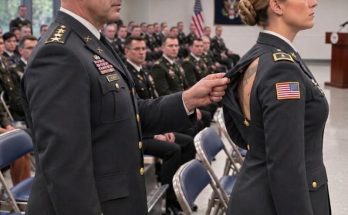
Chapter 1: THE RANK THEY COULDN’T SEE
“You’re a traitor!” my father, a general, shouted as he ripped the insignia from my uniform in front of everyone.
Admiral Malcolm Reid slowly stood to his feet.
He was seventy-one years old, a highly decorated naval officer whose reputation had been established over four decades of intelligence operations, maritime security, and classified assignments that were never mentioned in public biographies.
I had known him for eleven years.
My father had known him for thirty.
Yet the expression on Reid’s face was something I had never witnessed before.
He wasn’t afraid of me.
He was afraid of what my father had just done.
“General Mercer,” Reid said softly, “move away from her.”
My father turned toward him.
“Admiral, this is an internal disciplinary proceeding.”
“No,” Reid replied. “It is not.”
Silence fell across the room.
My father drew himself upright.
“With all due respect, Admiral, you have no authority to interfere with my command.”
Reid glanced at the ripped uniform dangling from my hands.
Then his eyes moved to the dark wings and silver star stretching across my back.
“General,” he said, “you have absolutely no idea whose command you’ve just interfered with.”
My father’s jaw grew tense.
“This officer happens to be my daughter.”
Reid’s expression became stern.
“That is the least significant fact about her at this moment.”
A low murmur swept through the room.
My father stepped forward.
“Explain what you mean.”
Reid turned his attention toward the officers sitting along the front row.
“Remove everyone from this room who lacks compartment authorization.”
For a moment, nobody reacted.
Then a civilian official dressed in a dark suit rose from his seat.
“Admiral, this proceeding received authorization from the Joint Review Committee.”
Reid faced the official.
“And that committee was given incomplete information.”
He stopped briefly.
“Possibly on purpose.”
My father glanced from one man to the other.
“What exactly is happening here?”
Reid turned back toward him.
“Sir, the woman standing before you is not the officer you think she is.”
My father let out a laugh without any humor.
“I know my own daughter.”
Reid lowered his voice.
“Then you should have identified the insignia before tearing it apart.”
He gestured toward the silver star.
“Orion.”
That single word changed everything.
Three officers immediately got to their feet.
A fourth officer reached toward his phone but stopped when Reid lifted one hand.
My father stared at the admiral.
“Orion was shut down.”
“Publicly,” Reid replied.
The color drained from my father’s face.
Reid went on.
“The program’s operational authority was restructured under a restricted national command directive. Its continued existence and present leadership remain compartmented.”
My father turned his eyes toward me.
I didn’t move.
He whispered:
“That can’t be possible.”
Reid slowly shook his head.
“No, General. What should have been impossible is your decision to convene this proceeding without first confirming the authority of the officer you planned to accuse.”
Then the admiral spoke the words that would haunt my father throughout the remainder of his military career.
“Sir… my God. Her rank is higher than yours.”
My name is Evelyn Mercer.
I was thirty-nine years old.
And until that morning, my father had believed I was a colonel serving in a classified intelligence coordination unit.
That was the rank shown on my uniform.
It was a legitimate rank for the assignment under which I traveled, but it didn’t reveal the complete extent of my current appointment.
My actual position was Director of Orion Strategic Operations, a fictional special command authority established under an extraordinary joint directive following a national security crisis.
Within Orion’s specifically designated operational jurisdiction, I possessed command authority that took precedence over General Mercer’s.
That difference was important.
It didn’t mean I outranked every general throughout the military.
It didn’t put me beyond the reach of the law.
And it certainly didn’t authorize me to ignore lawful oversight.
But it did mean my father had attempted to discipline someone whose operational responsibilities he was neither cleared to understand nor authorized to investigate in that particular manner.
And worse still, he had done it in public.
I had never wanted my father to learn about my position under circumstances like these.
In fact, I had spent years doing everything I could to avoid precisely this situation.
General Grant Mercer believed a person’s rank was the ultimate measure of their worth.
He had been a soldier before becoming a husband.
A commander before becoming a father.
And an institution long before he became a man anyone felt comfortable approaching.
When I was eight years old, he forced me to stand in the driveway for twenty minutes because I had cried after falling from my bicycle.
“Mercers don’t fall apart because of pain,” he told me.
When I was thirteen, he refused to come to my school’s science exhibition because I had finished in second place rather than first.
When I was seventeen, he informed me that a military career wasn’t appropriate for someone who questioned authority.
I enlisted in that path anyway.
Not because I wanted to impress him.
Not because I wanted to rebel against him.
But because I believed serving one’s country could represent something greater than power.
My mother, Helen, understood that.
She had worked as a nurse.
She was a patient woman with gentle hands and a remarkable ability to tell the difference between genuine strength and cruelty.
Before her death, she told me:
“Evelyn, never allow your father’s expectations to define the limits of your life.”
I carried her words with me through officer training.
Through my first overseas deployment.
Through all the years when my assignments became increasingly classified.
And through the night when I accepted my appointment to Orion.
My father knew nothing about any of it.
He had never bothered to ask the questions that mattered.
He only wanted to know when I would finally become somebody important.
“Admiral,” my father said, his voice strained, “are you saying my daughter is in command of Orion?”
Reid didn’t respond right away.
Instead, he looked in my direction.
“Director Mercer, do you authorize us to disclose your appointment to the cleared members participating in this review?”
I scanned the hall.
The torn material of my jacket was lying across the table.
My father’s fingers remained tightly closed around the insignia he had ripped from my uniform.
I drew a breath.
“Only to personnel whose authorization has been verified.”
Reid gave a nod.
“Understood.”
He faced the civilian official.
“Begin the compartment verification process.”
The official hesitated for a moment.
Then he placed a call.
For almost five minutes, nobody said a word.
My father remained completely motionless.
I could practically see the thoughts racing behind his eyes.
Disbelief.
Anger.
Fear.
And something more.
The realization that the daughter he had underestimated for decades might carry responsibilities far beyond anything he had ever imagined.
Finally, the verification came through a secure communication channel.
The civilian official examined it.
Then he read it a second time.
His expression shifted.
He straightened his posture.
“Admiral Reid,” he announced, “the appointment has been confirmed.”