### **PART 1**
**The Empty Chairs**
I awakened alone after heart-valve surgery. Beyond the perforated white ceiling tiles, Seattle’s sky was gray; three chairs stood against my hospital wall, all vacant.
Turning my heavy head hurt. An IV ran into my arm, a clip gripped my finger, leads crossed my chest beneath the gown, and a nearby monitor showed a steady green rhythm.
“Hello?” I rasped through a painful throat. A nurse arrived about a minute later: roughly twenty-five, with pink scrubs, a dark ponytail, and a badge marked KAYLA, RN. She glanced between the medical equipment and the bed before approaching me. Checking my monitor, she smiled gently.
“There you are, Mrs. Davis. How are you feeling?”
“Thirsty,” I whispered.
She steadied a straw cup as I drank; the water was wonderful.
“Where are my kids?” I asked.
She replaced the cup on my tray and unnecessarily straightened the blanket.
Her gaze avoided mine.
“They were here during the surgery,” Kayla said softly. “All three of them. In the family waiting room.”
“Okay.”
“But they left. About an hour ago.”
I watched her through anesthesia’s haze, the world distant and sluggish.
“Why?” I asked. “Did something happen? Is somebody sick?”
Her grip whitened around the tablet.
“They said,” she began, hesitated, then tried once more. “They said the parking was getting too expensive.”
At first I blamed the medication for what sounded like an absurd misunderstanding, even managing a brief laugh.
“The parking,” I repeated.
Kayla nodded miserably.
“The garage here is eight dollars an hour,” she replied softly. “After four hours, it’s a flat thirty-two. Your son said they’d already been here almost five hours. He said there was no point paying for another day when you’d just be sleeping anyway.”
I had survived valve replacement despite the risk of never awakening; I had signed the consent papers knowing that. Yet each child promised to greet me upon waking.
David offered to take a day off from accounting.
“Mom, I’ll be right there. First face you see.”
Sarah promised my favorite yellow roses. “I’ll make the room pretty for you.”
Michael promised to arrive after his morning sales calls. “Wouldn’t miss it, Ma.”
Thirty-two dollars had been enough to send them away. I turned toward the window as tears ran into my ear and pillow, setting my heart monitor beeping faster.
“Mrs. Davis,” Kayla said, grabbing a tissue box off the counter. “Please. Try not to upset yourself. Your heart needs to rest.” Her worry worsened my tears. At sixty-four, I had largely raised three children alone after Frank’s death, working thirty-one years as a Seattle public-school secretary and paying for braces, college applications, cars, and a wedding. Now I wept after heart-valve surgery because my children thought another day’s parking cost too much.
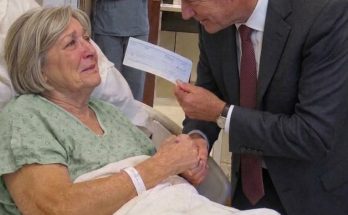
I heard deliberate footsteps outside. A tall stranger in a dark suit appeared, short salt-and-pepper hair above wire-rimmed glasses, briefcase in hand. He stood with quiet authority, and Kayla immediately straightened, pushing a loose strand of hair behind her ear. His voice, when he spoke, was gentle and deep.
“Excuse me,” he said. His tone was low and kind. “Is this Adrienne Davis?”
I wiped my tear-streaked face, conscious of my reddened eyes, flattened hair, and gown.
“Yes,” I said. “That’s me.”
**Chapter Two: The Lunch Card**
Approaching my bed, he softened visibly.
“Mrs. Davis,” he said. “You don’t remember me.” I didn’t recognize him, wondering if he represented the hospital, an insurance company, or a law office. He put his case on an empty chair.
“But you paid for my lunch,” he said, “every day in third grade.” Even my monitor seemed to pause. I searched the successful-looking stranger’s face, his expensive suit and shoes revealing no familiar features.
“I’m sorry,” I said. “I don’t…”
“Malcolm,” he said. “Malcolm Peterson. I became Malcolm Chen after I was adopted. When I was ten.”
Recognition took me to Franklin Elementary in South Seattle, 1978: a thin boy with stubborn dark hair, an oversized plaid shirt folded four times at the cuffs, and sneakers worn through at the toes. His brown eyes lowered as other children unpacked paper sacks or cartoon lunchboxes. With no lunch of his own, he watched silently, pretending to read whenever noticed.
“You were hungry,” I whispered.
Malcolm nodded slowly.
“You noticed.” Memories returned. In 1978 I was sixteen, working at Franklin Elementary in South Seattle because my father’s shipyard back injury left us short of money. Three afternoons each week and every lunch period, I helped teachers and monitored the cafeteria for $1.90 an hour. Lunch cost forty cents, though Malcolm remembered three dollars; to a hungry child either could seem impossible. On my second day I bought tickets myself, thereafter slipping one beneath his elbow daily.
“The cafeteria made extras today,” I told him. “Somebody needs to eat them, or they’ll go in the trash.” Malcolm would look up and join the cafeteria line. Nobody, including him, knew those tickets consumed nearly half my small wages for an entire school year.
He pulled David’s unused chair beside my bed. Kayla cleared her throat.
“Sir,” she said, a little nervously. “I’m sorry, but visiting hours on the cardiac floor are limited right after surgery. Unless you’re immediate family.”
Malcolm replied without irritation.
“I’m Dr. Malcolm Chen,” he said. “I own this hospital.”
Kayla gaped.
I likely did likewise.
“Oh,” Kayla said. “Oh. I’m so sorry, Dr. Chen. I didn’t recognize you. I’ll just… I’ll give you some privacy.” Kayla left us. Malcolm retrieved a worn yellow lunch ticket from his briefcase, playing-card-sized, with FRANKLIN ELEMENTARY in faded blue across the top and frayed cardboard edges.
“I kept the last one you gave me,” he said. “In June. The last day of school. You gave me two that day, and I only used one.”
He placed it in my palm.
Trembling, I marveled that he’d saved that cardboard for forty-six years.
“Why?” I asked.
His gaze fell to his hands.
“That summer, my mother left,” he said. “For good. I went into foster care in August. Three homes in two years. Some of them were fine. One of them wasn’t.”
He hesitated.
“I carried that ticket in my shoe,” he said. “Every day. Under the insole. When I thought nobody in the whole world cared whether I ate or not, I’d take it out and look at it. And it reminded me that one person did.”
This time my tears came from gratitude. Holding the ticket, I heard his story.
At ten, Malcolm was adopted by pharmacist Robert Chen and piano teacher Grace Chen. They gave him a bedroom with a window, regular meals, and a sense of belonging. He attended the University of Washington and medical school, trained in internal medicine, then moved into hospital management. With partners he rescued a struggling Tacoma hospital, followed by facilities in Spokane, Seattle, and Portland.
“Four hospitals,” he said. “Across the Pacific Northwest.”
“Four hospitals,” I repeated. I couldn’t wrap my head around it. The little boy in the plaid shirt.
“And every one of them,” he said, “has a program that makes sure no child who comes through our doors goes hungry. Kids in treatment. Kids whose parents are in treatment. Kids in the emergency room waiting with a sick grandmother. Every one of them gets a meal ticket at the front desk. No questions. No forms.”
“Because of one lunch ticket?” I asked.
He regarded me.
“Because of you.”
I finally felt warmth again.