### **PART 2**
I contacted my former colleague, Margaret, about our shared history and the possibility that her involvement in the case could present an ethical conflict.
She remembered me immediately.
“Dorothy Mitchell? I can’t believe it!”
We spoke briefly about law school and our careers.
Then I explained the lawsuit.
Margaret was astonished.
“Your daughter thinks you don’t understand the law?”
“Apparently.”
“And you’re planning to defend yourself?”
“Yes.”
She reminded me that court procedures had changed considerably since I last practiced.
I assured her that I had kept my knowledge current.
Before ending the conversation, I made one thing clear.
I expected no special treatment.
Any potential conflict involving our previous association would need to be handled through the appropriate judicial process.
I intended to win through evidence, not friendship.
That evening, I reviewed Patricia’s allegations line by line.
Her attorney, James Morrison, had built the case around my supposed lack of education, legal knowledge, and business experience.
He seemed convinced that I would become frightened by the legal process and agree to surrender control.
He had not researched my professional history.
That was his first mistake.
His second was assuming that old age automatically meant incompetence.
And his third was filing serious allegations without sufficient supporting evidence.
I spent hours organizing documents.
Robert’s original estate records.
The properly executed will.
Financial statements.
Communications with Patricia and Michael.
And records showing how much money Robert and I had provided them over the years.
By midnight, I had completed my initial defense strategy.
I looked at Robert’s photograph.
“You always knew this day might come,” I whispered.
Then I turned off the light.
The following morning, I dressed carefully.
Not in an expensive designer suit.
Not in anything intended to intimidate.
I chose an old navy dress, comfortable shoes, and the handbag I’d carried for years.
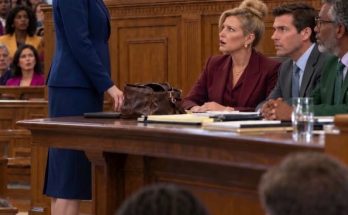
When I entered the courthouse, Patricia and Michael were already waiting.
They looked confident.
Michael whispered something, and Patricia laughed.
I heard him mention how ridiculous it was that I had arrived without an attorney.
I walked past them and took my seat.
They believed they were watching a confused widow prepare to lose everything.
They had no idea what was coming.
When Judge Walsh entered the courtroom, she glanced toward me.
Her expression changed.
“Mrs. Hamilton?”
“Yes, Your Honor.”
She examined me for another moment.
Then recognition appeared in her eyes.
“Dorothy Mitchell?”
I nodded.
For an instant, the courtroom became unusually quiet.
Patricia looked from the judge to me.
She clearly didn’t understand the significance of that name.
The proceedings began.
James Morrison rose to address the court.
“Your Honor, this matter concerns a vulnerable elderly widow who has inherited assets far beyond her capacity to manage.”
He described me as confused, inexperienced, and easily influenced.
He claimed Patricia was merely attempting to protect her mother.
Then he requested a competency evaluation and temporary control over my financial affairs.
I listened without interrupting.
When he finished, the judge turned toward me.
“Mrs. Hamilton, do you understand the allegations?”
“Completely, Your Honor.”
“And do you intend to contest them?”
“Yes.”
Morrison smiled faintly.
He probably expected a confused explanation about how much I loved my husband.
Instead, I opened my folder.
“Your Honor, I would like to clarify several points.”
The judge allowed me to proceed.
“Mr. Morrison claims that I participated in forging my husband’s will. Yet the document was executed with appropriate witnesses and notarization. The signatures have also been examined.”
I paused.
“Does the petitioner have any actual evidence of forgery?”
Morrison shifted uncomfortably.
“We believe further investigation will reveal irregularities.”
“Belief is not evidence,” I replied.
Patricia stopped smiling.
I continued.
“The petition also asserts that I lack the mental capacity to manage my assets. What qualified medical evidence supports that claim?”
Morrison glanced at his notes.
“Family observations indicate concerning behavior.”
“Such as?”
He mentioned my difficulty using a streaming application and an incident involving road directions.
I looked toward the judge.
“Your Honor, if needing technical assistance or taking a wrong turn were sufficient grounds to establish incompetence, a remarkable number of capable adults would be in serious trouble.”
A few people shifted in their seats.
Morrison objected to my tone.
I remained composed.
Then I reached into my handbag.
“Perhaps some background information will help clarify why these assumptions are mistaken.”
I presented my legal credentials.
“My name is Dorothy Mitchell Hamilton. I graduated from Harvard Law School in 1982 and practiced law for fifteen years, primarily handling complex fraud and financial litigation.”
The courtroom fell silent.
“I subsequently stepped away from active practice to raise my daughter, but I maintained my professional credentials and continued studying legal developments.”
Patricia’s mouth fell open.
Michael stared at me.
Morrison looked as though someone had changed the rules halfway through his argument.
The judge examined my documents.
“Mrs. Hamilton, this is certainly relevant background.”
I nodded.
“Thank you, Your Honor.”
Then I looked directly at Patricia.
She was staring at me as though I were a stranger.
“Mom,” she whispered, “you were a lawyer?”
“Yes, sweetheart.”
“Why didn’t you tell me?”
My voice softened.
“You never asked.”
Those three words seemed to affect her more than anything I’d said in court.
For thirty years, she had lived beside me without ever wondering who I had been before becoming her mother.
Morrison attempted to recover.
“Your Honor, a former legal career does not establish present mental competence.”
“That is correct,” I acknowledged. “But neither does my age establish incompetence. The allegations must be supported by relevant evidence.”
The judge agreed that my professional background alone was not decisive and directed the parties to address the actual evidence.
Morrison struggled to identify anything beyond his clients’ suspicions.
Eventually, the hearing recessed.
In the hallway, Patricia and Michael huddled with their lawyer.
Michael paced back and forth, making hurried phone calls.
Patricia repeatedly glanced toward me.
Finally, Morrison approached.
“Mrs. Hamilton, perhaps we could resolve this privately.”
“What do you propose?”
“Your daughter might consider withdrawing the competency petition in exchange for a more equitable distribution of the estate.”
I stared at him.
“So the concern about my mental health disappears if I give Patricia several million dollars?”
He hesitated.
“I’m suggesting a practical solution.”
I closed my handbag.
“Mr. Morrison, my husband made a deliberate decision about his estate. Your clients challenged that decision by questioning my mental capacity. I see no reason to reward those accusations.”
He returned to his clients.
When the hearing resumed, Patricia was called to explain her concerns.
She described my requests for help with online banking and household technology.
Then the judge asked whether she still believed I was incapable of managing my affairs.
Patricia hesitated.
“I don’t know anymore.”
For the first time, she seemed uncertain.
That evening, she called me.
“Mom, why didn’t you ever tell me about your career?”
I sat in Robert’s study.
“Because I chose to focus on raising you. I didn’t think I needed a professional title for you to respect me.”
She began crying.
“I didn’t know.”
“You didn’t ask.”
There was a long silence.
Finally, she asked the question I’d expected.
“Why did Daddy leave everything to you?”
I answered carefully.
“Your father loved you deeply, Patricia. But he was concerned about how you and Michael handled money.”
Over the years, they had borrowed substantial amounts from us.
Money for renovations.
Money for vacations.
Money for investments that never produced returns.
They rarely repaid anything.
Robert had eventually concluded that handing them millions without accountability would encourage the same behavior.
“He wanted me to decide how our family’s wealth should be managed,” I explained.
Patricia began crying again.
“Mom, I’m sorry. Michael told me you couldn’t handle everything.”
“And you chose to believe him.”
“I know.”
I loved my daughter.
But love couldn’t erase what she had done.
“Patricia, if we rebuild our relationship, it must be based on honesty and respect. Not on how much money you expect to receive.”
She quietly agreed.