PART 1
The night I found my fifteen-year-old daughter doubled over on the bathroom floor, vomiting and hugging her stomach, my husband didn’t even get up from the recliner.
“Leave her alone, Paula. She’s overreacting again,” Curtis said, without looking up from his phone. “We’re not throwing money away on the ER over a tantrum.”
I felt something break inside me.
Sadie had been complaining for almost a month. At first it was nausea after breakfast. Then she stopped finishing her meals, started coming home from high school pale, and at night lay on her side with a heating pad on her abdomen. I had pushed three times to take her to a doctor.
Curtis always found a reason to put it off.
“It’s nerves.”
“She’s trying to get out of school.”
“At that age, everything hurts when they want attention.”
But that night Sadie didn’t look like a spoiled teenager. Her lips were dry, her T-shirt was stuck to her back with sweat, and she was breathing in short, ragged gasps.
I crouched beside her.
“Look at me, honey.”
Sadie raised her eyes.
“It feels like something is pulling me from the inside.”
Curtis appeared in the doorway and sighed.
“And now there are two of them.”
I didn’t argue. I waited until Sadie could stand, walked her to her room, and sat beside her until she fell asleep.
The next morning I told Curtis I was taking her to buy sneakers, because hers were falling apart.
“Nothing expensive,” he answered.
As soon as we left our house in Dublin, Ohio, I drove straight to St. Luke’s Regional Medical Center.
Sadie noticed when I took the wrong exit.
“Mom, Dad’s going to be mad.”
“Let him be mad at me.”
“He said it wasn’t necessary.”
“Today a doctor is going to decide that.”
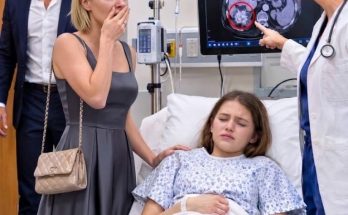
In the emergency room, the triage nurse stopped asking questions the moment she touched Sadie’s abdomen. My daughter curled up in pain.
They drew blood, placed an IV, and ordered an ultrasound. Then, based on what they saw, they ordered a CT scan.
Forty minutes later, a pediatric gynecologist named Dr. Priya Raman came in with another specialist. Neither of them was smiling.
The doctor pulled up a chair.
“Mrs. Dunleavy, we found a large mass in Sadie’s abdomen.”
I froze.
“A tumor?”
“It’s a possibility, but we don’t yet know what kind of lesion it is. It appears to originate near the right ovary. We need to run more tests and consider surgery.”
Sadie squeezed my hand.
“Is it cancer?”
“We can’t say that. There are benign masses that can grow very large. What’s urgent is understanding why it’s causing so much pain.”
The room felt like it was shrinking.
“How long has she been like this?”
The doctor looked at me carefully.
“Judging by the size, it didn’t appear this week.”
Sadie lowered her eyes.
“Dad knew it hurt before that.”
I turned to her.
“Before you told me?”
She nodded.
“When you went to take care of Grandma, he took me to a clinic.”
My heart skipped.
“What clinic?”
“I don’t know. It was out on Highway 33. They examined me and said I needed an ultrasound. Dad got upset.”
Dr. Raman didn’t interrupt.
“And then what happened?”
Sadie began to cry.
“He told me not to tell you, because you’d make a big drama and spend money we didn’t have.”
Before I could process it, my phone buzzed.
Curtis.
Three missed calls.
Then a text.
Where are you?
I typed: At the hospital. Sadie has an abdominal mass.
The reply came almost instantly.
Don’t authorize anything until I get there.
I stared at the screen.
He didn’t ask if she was stable.
He didn’t ask if I was scared.
He didn’t ask what exactly they had found.
He just wanted to stop everything.
Dr. Raman read my expression.
“Is something wrong?”
I showed her the message.
Sadie let go of my hand.
“Mom…”
Her voice was shaking.
“There’s something else.”
“What?”
She glanced at the door, as if expecting her father to appear.
“Dad was giving me pills so the pain would go away.”
“What pills?”
“I don’t know. He said they were for my stomach. Afterward I got really, really sleepy.”
The doctor leaned in.
“Do you still have them?”
Sadie shook her head.
“He gave them to me out of a bottle with no box.”
A brutal chill ran through me.
And then my daughter said, almost without a voice:
“The last time I asked to go back to the doctor, Dad told me that if you found out what was going on, ‘it would sink all of us.’”
At that moment, the door opened.
Curtis was standing there.
And from the way he looked first at the monitor and then at Sadie, I understood that he hadn’t come to find out anything.
He had come to see how much we had discovered.
PART 2
“What did you do to her?” Curtis asked, walking in without a greeting.
He didn’t hug Sadie. He didn’t ask if he could come closer. He looked at the IV line, the chart, and the monitor the way a man inspects damage after a car accident.
Dr. Raman stood up.
“Your daughter is stable. We’re completing her tests.”
“I want everything suspended until I talk to another doctor.”
“The patient has significant pain and a mass that requires surgical evaluation.”
Curtis clenched his jaw.
“I already took her to get checked. It wasn’t urgent.”
The silence was immediate.
I looked at him.
“So you did take her?”
It took him half a second too long to answer.
“To a clinic. As a precaution.”
“And why did you hide it from me?”
“Because you make a tragedy out of everything.”
Sadie shrank beneath the sheet.
The doctor noticed.
“Sir, I need you to wait outside.”
“I’m her father.”
“And she’s asking for space.”
Curtis turned to Sadie.
“Tell them nothing’s wrong.”
My daughter started breathing fast.
“I don’t want you here.”
It was the first time in my life I saw Curtis without an answer.
He stormed out.
The hospital social worker arrived soon after. She didn’t turn the room into an interrogation. She spoke slowly, let Sadie set the pace, and confirmed something that hurt me more than any argument: for weeks, my daughter had learned to measure her pain by her father’s mood.