**Part 3**
The Promise I Made to Toby
Eight months later, I stood in a small backyard outside Chicago.
The grass was freshly cut.
A folding table held paper plates, lemonade, and a chocolate cake decorated with tiny silver stars.
Toby was turning fifteen.
He had insisted on the stars.
“Because planets are too complicated for the bakery,” he explained.
I laughed.
“That sounds like a challenge.”
He grinned.
“You’re not allowed to make the cake, Maya.”
I put a hand over my heart.
“I’m offended.”
He laughed harder.
“You burned the cookies last time.”
“That was one incident.”
“Three incidents.”
I shook my head.
“Unproven allegations.”
He smiled.
And for a moment, he looked like an ordinary fifteen-year-old boy.
Not a child caught in a custody dispute.
Not an heir to a multimillion-dollar trust.
Not the center of a family argument.
Just Toby.
Rebecca had made steady progress.
She could walk short distances with assistance.
Her speech had improved.
And her doctors were cautiously optimistic about her recovery.
The court had approved a gradual transition plan allowing Toby to spend increasing time with her, supported by additional caregivers and regular reviews.
It wasn’t perfect.
But it was stable.
And Toby was happier.
I had also made changes.
With my command’s approval, I pursued an assignment that allowed me to spend more predictable time stateside.
It did not eliminate every absence.
Military life rarely offered that certainty.
But it allowed me to visit Toby more often.
Attend school events.
Help with science projects.
And become a more consistent presence in his daily life.
I didn’t make the decision because I regretted my career.
I made it because priorities can change.
And because service sometimes means recognizing that the people closest to you need your attention too.
My parents had changed more slowly.
Dad had been furious after the hearing.
He blamed the judge.
The attorneys.
The trustee.
Me.
For several months, he refused to speak to me.
Mom sent occasional messages.
Most began with requests that I apologize.
I didn’t.
Not for raising concerns about Toby.
Not for helping him obtain independent representation.
Not for refusing to support financial arrangements I believed required scrutiny.
I did acknowledge my courtroom conduct.
I cooperated with the separate review of that incident and accepted the resulting formal warning and required training.
I did not appeal to my military rank to avoid accountability.
And I did not blame my reaction entirely on Vance.
That mattered to me.
Because I couldn’t teach Toby that adults should take responsibility while refusing to do it myself.
Eventually, Mom asked to meet.
We sat in a quiet café.
She looked tired.
For several minutes, she talked about the weather.
Then she looked at me.
“Maya, I think we’ve made some mistakes.”
I waited.
She swallowed.
“Your father and I became so focused on protecting the family’s assets that we stopped seeing what Toby needed.”
My throat tightened.
I nodded.
She looked down.
“And we treated you terribly.”
I said nothing.
She continued.
“We made fun of your career because we didn’t understand it.”
I took a breath.
“Mom, you didn’t have to understand it to respect it.”
Her eyes filled.
“I know.”
We talked for nearly two hours.
She apologized.
Not perfectly.
Not without excuses.
But sincerely enough that I believed she was beginning to understand.
I told her I wanted Toby to have a relationship with both parents if it could be healthy and safe.
I told her I wasn’t trying to replace them.
And I told her that money could never substitute for attention.
She nodded.
Then whispered, “I wish we’d learned that sooner.”
Dad was harder.
He had spent his life building a business.
Negotiating contracts.
Winning arguments.
Controlling outcomes.
He wasn’t accustomed to hearing no.
Especially from his children.
But eventually, he asked to see me.
We met in his office.
The same office where he’d once told me that joining the Navy was a foolish decision.
The walls were covered with awards.
Business photographs.
Framed magazine covers.
And a large portrait of Grandfather.
Dad sat behind his desk.
I sat across from him.
For a long moment, neither of us spoke.
Then he said, “You cost me a great deal of money.”
I looked at him.
“I didn’t take your money.”
He frowned.
“Legal fees.”
I nodded.
“Those were your decisions.”
His jaw tightened.
I waited.
Then he sighed.
“I suppose they were.”
He looked toward Grandfather’s portrait.
“I thought he trusted me.”
I followed his gaze.
“He did.”
Dad shook his head.
“Then why did he put strangers in charge of Toby’s inheritance?”
I took a breath.
“Because he wanted the money protected from conflicts of interest.”
Dad looked at me.
“You think I would have stolen from my son?”
“No.”
I paused.
“I think you were asking for control that could have benefited your business, and that deserved independent scrutiny.”
He stared at me.
I continued.
“Those aren’t the same accusation.”
He looked away.
For a long time, he said nothing.
Then he whispered, “I wanted to prove I could manage it better.”
I nodded.
“I know.”
He swallowed.
“Your grandfather never thought I was good enough.”
I felt something shift.
For the first time, I saw the frightened son beneath the powerful businessman.
Dad had spent his life trying to earn Arthur Sterling’s approval.
And when Grandfather died, Dad had tried to prove himself by controlling what Grandfather left behind.
I understood the feeling.
I had spent much of my life trying to earn Dad’s approval too.
But understanding wasn’t the same as excusing.
“Dad,” I said quietly, “Toby shouldn’t have to carry that.”
He closed his eyes.
“I know.”
I continued.
“He’s not a business deal.”
Dad nodded.
“He’s your son.”
His voice broke.
“I know.”
We sat quietly.
Then Dad looked at me.
“Maya, I’m sorry.”
I stared at him.
He continued.
“For the way I treated you.”
My throat tightened.
“And for the way I handled Toby.”
I swallowed.
“Thank you.”
He looked down.
“I don’t expect you to forgive me immediately.”
I nodded.
“Good.”
He almost smiled.
I continued.
“Because trust takes time.”
He nodded.
“I understand.”
At Toby’s birthday party, my parents were present.
Not as hosts.
Not as people controlling the guest list.
As guests.
They brought a telescope.
Toby was delighted.
Dad helped him assemble it.
Mom took photographs.
Rebecca sat in a comfortable chair beneath the shade.
I watched from the porch.
For the first time in years, the family wasn’t arguing about money.
Nobody mentioned the trust.
Nobody discussed court orders.
Nobody tried to prove who mattered most.
We were simply celebrating Toby.
Later that evening, after the guests had gone, Toby found me sitting on the back steps.
“Hey, Maya.”
I smiled.
“Hey, birthday boy.”
He sat beside me.
For a while, we watched the sky darken.
Then he said, “Can I ask you something?”
“Of course.”
He hesitated.
“Were you scared in court?”
I looked at him.
“Yes.”
He seemed surprised.
“Really?”
I laughed softly.
“Very.”
He frowned.
“But you’re a Navy SEAL.”
I smiled.
“Being trained doesn’t mean you stop feeling fear.”
He looked down.
“Then how do you do things when you’re scared?”
I thought about it.
Then answered.
“You figure out what matters more than the fear.”
He was quiet.
I continued.
“And you try to make the next good decision.”
He nodded slowly.
“Even if you make a bad one first?”
I looked at him.
“Especially then.”
He leaned against my shoulder.
“I’m glad you came.”
My throat tightened.
“Me too.”
He hesitated.
“Even with the weird helmet?”
I laughed.
“Yes.”
He grinned.
“And the boots?”
“Yes.”
“And the whole courtroom thing?”
I closed my eyes.
“Not my finest moment.”
He laughed.
I nudged him gently.
“Don’t make a habit of learning from that part.”
He smiled.
“I won’t.”
Then he grew serious.
“Maya?”
“Yes?”
“Do you think Granddad knew this would happen?”
I looked toward the house.
Rebecca was laughing at something Mom had said.
Dad was carefully carrying the telescope inside.
I thought about Grandfather’s letter.
His warning.
His concern.
His insistence that Toby be treated as a person rather than a financial asset.
“I think he knew families sometimes forget what’s important,” I said.
Toby nodded.
“And he wanted someone to remember.”
I looked at my brother.
“Yes.”
A few weeks later, Samuel called with an update.
The independent trustee and trust protector had resolved the remaining administrative disputes without transferring control to my father’s company.
Toby’s trust would continue under independent oversight.
The financial safeguards Grandfather established remained in place.
And Toby would receive age-appropriate information about his inheritance as he grew older.
I thanked Samuel.
Then sat quietly for a long time.
It wasn’t about winning millions of dollars.
The trust had never belonged to me.
It wasn’t about punishing Dad.
And it wasn’t about proving that I was stronger than Bradley Vance.
It was about making sure Toby’s future remained his own.
The courtroom incident followed me longer than I wanted.
There were questions.
Reviews.
Uncomfortable conversations.
I answered them.
I learned from them.
And I made sure my brother understood that even people trained for dangerous situations are responsible for controlling their actions.
I had come to court to protect him.
But protecting someone also meant showing him how to take responsibility when you made a mistake.
One afternoon, nearly a year after the hearing, Toby sent me a photograph.
It showed his school science fair project.
A detailed model of a satellite orbiting Earth.
Beside it was a blue ribbon.
Under the photograph, he wrote:
First place. Don’t tell Dad until I get home. I want to surprise him.
I laughed.
Then typed:
Your secret is safe with me.
A second message arrived.
Thanks for always showing up.
I stared at the screen.
Then looked toward the photograph of Grandfather on my desk.
For years, my parents had measured success in money.
Business deals.
Properties.
Influence.
My father believed power meant being able to control a room.
My mother believed respectability meant never embarrassing the family.
And their attorney had believed that an expensive suit and a sharp tongue could make anyone else feel small.
But none of those things mattered to Toby.
He didn’t care how much my uniform cost.
He didn’t care whether I arrived in combat boots or a dress.
He didn’t care how many people saluted me.
He cared that I answered his letter.
That I listened.
That I came when he asked for help.
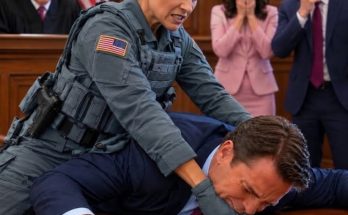
I had entered that courtroom wearing equipment that should have been secured before I crossed its threshold.
I had made a serious mistake when I reacted physically to an attorney’s provocation.
And I had been held accountable.
But the most important thing that happened that day had nothing to do with my uniform or my training.
It happened when Judge Henderson refused to let the adults reduce a fourteen-year-old boy to a dispute over money.
She insisted on hearing what Toby needed.
She insisted on independent oversight.
And she reminded everyone in that courtroom that wealth, status, and family connections did not replace the obligation to act in a child’s best interests.
My parents had expected me to arrive powerless.
Their attorney had expected me to be intimidated.
And I had expected to spend the entire day fighting to be heard.
Instead, I learned that the strongest thing I could do was not to overpower anyone.
It was to tell the truth, accept responsibility, and let the evidence speak.
I still serve in the Navy.
I still wear my uniform with pride.
I still believe in discipline, courage, and duty.
But when people ask me what I’m proudest of, I don’t tell them about my rank.
I don’t describe operations I can’t discuss.
I don’t mention awards.
I tell them about my little brother.
The boy who loved astronomy.
The boy who wrote a letter because he was frightened.
The boy who trusted me to come back.
And the boy who finally got to grow up knowing that his voice mattered.
Because the greatest lesson I learned wasn’t about combat.
It wasn’t about courtrooms.
And it wasn’t about winning.
It was about the difference between power and protection.
Power demands that people obey.
Protection makes sure they are safe enough to speak.
My parents had spent years trying to control Toby’s future.
I only wanted him to have one.
And when he finally stood beneath the stars with his new telescope, laughing as he pointed out Saturn, I knew that the most important victory had already happened.
He was no longer afraid to ask questions.
He was no longer afraid to tell the truth.
And he no longer believed that the adults who loved him had to own his future.
I watched him through the kitchen window that night.
Then smiled.
Because I had once promised Grandfather that I would look after Toby.
And for the first time in a very long time, I knew I had kept that promise.
THE END.