**Part 1**
The Woman in Combat Boots
“Lieutenant Commander Sterling! Release him immediately!”
Judge Margaret Henderson’s voice cut through the courtroom.
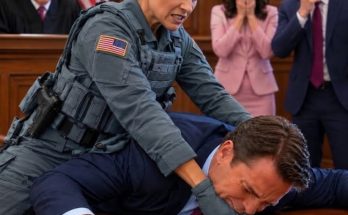
I released Bradley Vance’s wrist.
Immediately.
He stumbled away from the defense table, clutching his arm and staring at me with an expression that had changed from arrogance to disbelief.
For one terrible second, I heard nothing except my own breathing.
Then the courtroom erupted.
“My God!” my mother cried.
My father pointed at me.
“Arrest her! She’s dangerous!”
Bradley Vance straightened his expensive jacket.
“Your Honor, I was assaulted in open court!”
Judge Henderson struck her gavel again.
“Silence!”
Everyone stopped.
Including me.
The judge looked directly at my chest.
“Lieutenant Commander, is that a firearm?”
“Yes, Your Honor.”
“Is it secured?”
“Yes, Your Honor. It is unloaded, with a chamber safety flag.”
Her expression hardened.
“That does not make it permissible inside my courtroom.”
“I understand.”
“Then explain why you entered this building carrying it.”
I swallowed.
The truth sounded absurd even to me.
“Your Honor, I arrived directly from military transport. I was informed that my brother’s hearing had been moved forward, and I believed he might be removed from the jurisdiction before I could testify.”
Judge Henderson stared at me.
“Who authorized you to bring that equipment through courthouse security?”
I hesitated.
“I was escorted through a secured service entrance. I was told arrangements had been made.”
“By whom?”
“A government liaison, Your Honor.”
She turned toward the court officer.
“Verify that immediately.”
Then she looked back at me.
“Whatever arrangements may have been made, they do not authorize an armed appearance in this courtroom. You will remain still while the court officers secure your equipment.”
“Yes, Your Honor.”
Two officers approached.
I carefully followed their instructions.
I did not touch the rifle.
I did not argue.
I did not mention my rank again.
The officers removed the weapon and secured the remaining equipment according to courthouse procedures.
The entire process took several minutes.
My father watched with a triumphant expression.
He believed the hearing was already over.
He believed I had ruined my credibility.
And perhaps I had.
Because the truth was that my reaction to Vance had been unacceptable.
He had invaded my personal space and touched me without permission.
But I had responded with force in a courtroom.
That was not something I could excuse by pointing to my training.
I knew better.
Judge Henderson turned toward Vance.
“Counselor, were you instructed to approach the witness?”
Vance hesitated.
“Your Honor, I was merely attempting to—”
“Did you place your hand on her?”
His expression tightened.
“I touched her equipment briefly.”
“Did she invite you to do so?”
“No, Your Honor.”
The judge’s eyes narrowed.
“Then you will not touch another person in this courtroom again.”
Vance opened his mouth.
“Your Honor—”
“And Lieutenant Commander Sterling,” she continued, turning toward me, “you will not use physical force against anyone in this courtroom unless it is immediately necessary to protect someone from serious harm. Is that understood?”
“Yes, Your Honor.”
“Your military training does not place you above the law.”
“No, Your Honor.”
She studied me.
“Do you understand that your conduct may have consequences outside this hearing?”
“Yes.”
“Good.”
She turned toward the clerk.
“We will take a brief recess.”
The gavel came down.
And the judge rose.
I stood motionless while the courtroom began to empty.
My father walked toward me.
His name was Charles Sterling.
He was sixty-three years old, the founder of Sterling Capital Holdings, and a man who believed that every problem could be solved with enough money and the right attorney.
He stopped three feet away.
“Well,” he said softly, “you’ve finally done it.”
I looked at him.
“Done what?”
“Destroyed whatever credibility you had left.”
My mother, Eleanor, joined him.
She wore a cream-colored designer suit and the diamond earrings she’d received for their thirtieth anniversary.
Her eyes moved over my dusty uniform.
“Maya, honestly. You couldn’t even dress appropriately for your own brother?”
I looked at her.
“I came as quickly as I could.”
She sighed.
“You always have an excuse.”
I felt an old familiar ache.
The same one I’d felt at seventeen when I told them I wanted to join the Navy.
The same one I’d felt at twenty-one when I chose a military career over a position in my father’s company.
The same one I’d felt every time they introduced me as their “difficult daughter.”
I looked past them.
Toward the side door.
“Where’s Toby?”
My father’s expression changed.
“That’s none of your concern.”
I looked back at him.
“He’s my brother.”
“He’s a minor.”
“I know.”
“And this is a legal matter.”
I took a breath.
“That’s why I’m here.”
He smiled coldly.
“No, Maya. You’re here because you think wearing a uniform makes you important.”
I said nothing.
He leaned closer.
“But this is my courtroom battle. My attorneys. My money. And my son.”
I stared at him.
Then answered quietly.
“Toby isn’t something you own.”
His smile disappeared.
I had not seen my brother in person for fourteen months.
Not because I didn’t want to.
Because my parents had gradually made it impossible.
First, they stopped answering my calls.
Then they told Toby I was too busy overseas to visit.
Then they changed his phone number.
Finally, six weeks earlier, I received a handwritten letter forwarded through an old family friend.
The envelope had no return address.
Inside were three pages written in Toby’s careful handwriting.
The first sentence had nearly stopped my heart.
Dear Maya, I don’t know if you’re still allowed to be my sister, but I need help.
I had read those words sitting alone in a temporary office thousands of miles from Chicago.
And I had known immediately that something was wrong.
Toby was fourteen.
Bright.
Quiet.
Obsessed with astronomy.
He loved building model airplanes and could identify more constellations than most adults.
When he was little, he used to wait by the window whenever I came home on leave.
He called me Captain Maya, even before I became an officer.
I never corrected him.
To Toby, I was the person who listened.
The person who remembered his birthday.
The person who didn’t laugh when he asked questions.
And after our grandfather died, I became the only adult in the family who seemed interested in what Toby wanted rather than what he might inherit.
Our grandfather, Arthur Sterling, had built a substantial manufacturing business before selling it.
He died three years earlier.
His estate plan established a trust for Toby.
The trust held investments and property interests worth several million dollars.
It also contained conditions governing distributions, oversight, and the appointment of trustees.
My father had expected to control everything.
But Grandfather had named an independent corporate trustee and a professional trust protector.
He had also included provisions allowing the court to review any proposed changes affecting Toby’s interests.
My father hated those provisions.
He called them insulting.
He said Grandfather had been manipulated by attorneys.
And he spent the next two years trying to gain greater control over the trust.
The custody dispute began after Toby’s longtime guardian, our Aunt Rebecca, suffered a serious stroke.
Rebecca was our mother’s older sister.
She had been Toby’s primary caregiver for several years under a court-approved arrangement, following repeated conflict in our parents’ home.
The original guardianship had been established with the agreement of the parties.
At least on paper.
My parents had told everyone it was temporary.
A practical arrangement while they traveled.
But Toby’s letter told a different story.
He wrote that he had been happiest living with Rebecca.
That she helped with school.
That she listened when he was frightened.
And that he did not want to return to our parents’ house.
Then came the sentence that changed everything.
Dad says if I sign the papers, the judge will let me stay with Aunt Rebecca. But the lawyer says the papers are about my trust. I don’t understand why those things are connected.
I read it three times.
Then called an attorney.
The attorney’s name was Samuel Price.
He specialized in family law and trust litigation.
He was also someone Grandfather had respected.
I asked him to investigate what was happening.
He warned me immediately.
“Maya, we need to separate the custody question from the trust question.”
“I understand.”
“Your parents may have legitimate arguments about custody, regardless of their financial motives.”
“I know.”
“And allegations of misconduct need evidence.”
“I agree.”
He paused.
“Then send me the letter.”
I did.
Over the following weeks, Samuel uncovered troubling inconsistencies.
My parents had petitioned for custody of Toby.
At the same time, they were seeking changes to the trust’s administrative structure.
They argued that the independent trustee was unnecessarily expensive and that family management would be more efficient.
They proposed that my father receive expanded authority over certain assets.
They also submitted statements suggesting that Toby wanted to return home.
But Toby’s handwritten letter said otherwise.
And Samuel discovered that several documents had been prepared for Toby’s signature without clear evidence that he understood them.
Nothing had yet established criminal wrongdoing.
But the situation warranted careful scrutiny.
Then, three days before the hearing, Samuel called me.
“Maya, there’s been a development.”
I was still overseas.
“What happened?”
“The hearing has been moved forward.”
I frowned.
“Why?”
“Your parents’ counsel requested expedited consideration. They’re arguing that Rebecca’s health makes the current arrangement unstable.”
I closed my eyes.
“Can we oppose it?”
“We can. But I need you here.”
I looked at the clock.
“How soon?”
“Immediately, if possible.”
I requested emergency leave.
My command reviewed the circumstances.
Arrangements were made for my return.
Travel delays consumed nearly every hour I had.
And when I reached Chicago, I learned that the hearing had already begun.
I went directly to the courthouse.
That was why I arrived in combat gear.
Not to intimidate anyone.
Not to make a statement.
Because I had been told my brother needed me.
And I was afraid that if I stopped for even an hour, I might lose the chance to help him.
Now, standing in the courtroom during recess, I wondered whether my urgency had made everything worse.
My parents had a team of attorneys.
I had arrived covered in dust and immediately lost control of a confrontation.
I closed my eyes.
Then heard a familiar voice.
“Maya?”
I turned.
Samuel Price stood beside the rear entrance.
He wore a charcoal suit and carried a thick leather briefcase.
His expression was serious.
“Come with me.”
I followed him into a private consultation room.
He closed the door.
Then placed a sealed envelope on the table.
I stared at it.
“What is that?”
Samuel looked at me.
“Something your grandfather left behind.”
My stomach tightened.
He continued.
“And something your parents have been trying very hard to keep out of this hearing.”