**Part 1**
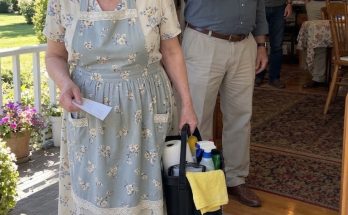
My name is Elnora Ruthanne Whitsett, and I’m seventy-two years old.
I have cleaned houses since I was fourteen. I have scrubbed floors on my knees in Maury County, Tennessee, for fifty-eight years. I have raised a daughter, buried a husband, buried my mama, and buried more friends than I care to count.
And I have never in my life stood in a courthouse and read my own name in a book that big.
Rosella turned that book around to face me.
She put her finger on a line.
“Read it, honey,” she said. “Read it yourself.”
I put on my reading glasses. My hands were shaking so bad I nearly dropped them.
I looked down.
There it was. In type. In black ink. On thick, cream-colored paper that smelled like old dust and lemon oil.
My whole name.
ELNORA RUTHANNE WHITSETT.
And right under it…
But I’m getting ahead of myself.
My mama always said you can’t understand the end of a story if you don’t know where it started. So let me start where it started.
On a porch.
I grew up on the Lockridge place.
It’s out on the Hampshire Pike, eight miles west of Columbia. Three hundred acres of rolling pasture and woods. A big white farmhouse with green shutters and a wraparound porch, sitting up on a little rise so you can see it from the road. Built in 1889.
And at the end of a gravel lane, down past the barn, past the pond, back where the land dips toward the creek, there’s a little white tenant house.
Four rooms. A tin roof. A porch with a swing hanging on chains. And behind it, a pecan grove. Forty-one trees. Big ones. Older than anybody living.
That’s where I learned to walk.
On that porch. Holding on to the swing chain. My mama said I took my first steps from the swing to the screen door and fell flat on my face and laughed.
My mama was Odessa Whitsett.
She cooked and cleaned for the Lockridges from 1946 until 1989. Forty-three years. She started for old Mr. Amos Lockridge, Mrs. Henrietta’s father-in-law, when she was sixteen years old. Then for Mr. Walter Lockridge and Mrs. Henrietta when they married.
She was paid eleven dollars a week in 1950. And the tenant house to live in. Rent free.
That was the arrangement.
That’s what I was told it was, anyway.
My daddy worked the farm. Plowing. Haying. Cattle. Fixing fence. He died in 1961 when a tractor rolled on him on the north slope. I was eight.
Mr. Walter paid for the funeral. Mama cried, she was so grateful.
Mrs. Henrietta brought a ham.
I left the Lockridge place when I married Clarence Whitsett in 1971. Well, I kept my name. Clarence’s name was Whitsett too. No relation. People thought that was the funniest thing. Two Whitsetts marrying. Mama said it saved on stationery.
We had a little house in Columbia, on East End Street. Clarence drove a truck for the phosphate plant. I cleaned houses in town. Doctors’ wives. Lawyers’ wives. A dentist who wanted his baseboards done with a toothbrush.
We had Alfreda in 1974.
In 1989, Mama got sick. Her heart. She couldn’t work anymore.
Mrs. Henrietta called me.
“Elnora,” she said. “Your mama’s been with this family forty-three years. I won’t have her anywhere but that house. I’ll take care of her doctor bills. But I need somebody to help me out here. Will you come?”
I came.
Mama died in 1992. In the tenant house. In her own bed. With the window open so she could smell the pecans.
I kept coming.
Clarence died in 2004. Lung cancer. Phosphate dust, the doctor said.
I kept coming.
Twenty-six years, all told. Since Mama passed.
Mondays, the kitchen and the bathrooms.
Thursdays, the floors.
Fridays…
Fridays she wouldn’t let me touch a mop until I sat down with her for coffee and a biscuit.
At the kitchen table. The long oak one. Under the window that looks out on the pasture.
She’d have the coffee made. Percolator. Maxwell House. She never would get one of those fancy machines. And biscuits from scratch. Every Friday. Even at ninety-three, when her hands were so stiff she had to roll the dough with the heel of her palm.
“Elnora, the dirt will wait,” she’d say. “I won’t.”
So I’d sit.
And we’d talk.
About everything. The weather. Her boys. My Alfreda. The preacher at First Presbyterian, who she said couldn’t preach his way out of a paper sack. The price of eggs. The president. The Titans.
For twenty-six years.
Every Friday.
She was ninety-four when she passed. Sharp as a tack till the last week. She did the crossword in the Columbia Daily Herald every morning in ink.
Mrs. Lockridge had three boys.
Not one of them lived closer than Nashville.
Carlton was the oldest. Sixty-eight. A retired banker in Brentwood. A quiet man. Gray suit. Gray hair. He called his mama every Sunday afternoon at three o’clock. You could set a clock by it.
Thurston was the middle one. Sixty-five. A real estate developer. He builds subdivisions. Big ones. The kind with names like The Reserve at Copper Creek. He drove a Range Rover. He wore boots that had never seen a cow pasture.
Bertram was the youngest. Sixty-one. He’d been a lot of things. A car dealer. A restaurant owner. A man who sold something on the internet. He’d been married three times. He came around when he needed money.
Thurston and Bertram only came when they wanted something.
Christmas. Easter, sometimes. Her birthday, if they remembered.
They’d sit in her front parlor for an hour. Drinking her coffee. Talking about property values. Looking out the window at the pasture like they were measuring it.
Last Christmas, Thurston came through the kitchen while I was washing the turkey platter.
He leaned on the counter.
“Elnora,” he said. “You know my house in town? On West Seventh?”
“Yes, sir.”
“My cleaning lady quit,” he said. “I need somebody Tuesdays and Saturdays. Mother pays you anyway. What’s the difference?”
I didn’t know what to say.
I was standing there with my hands in the dishwater.
Mother pays you anyway. What’s the difference.
Like I was a lawnmower she was letting him borrow.
Mrs. Lockridge heard him.
She was in the next room. The sitting room. In her chair by the fire. With her afghan over her knees.
She didn’t say a word to him.
But I saw her face through the doorway.
I’d known that face for sixty-some years. Since I was a baby on that porch.
It went very still.
That Friday, over coffee, she asked me a strange question.
We were at the oak table. She’d made biscuits. Buttermilk. With sorghum.
She set her cup down.
“Elnora,” she said. “What’s your middle name? I want to get it right.”
I looked at her.
“Ruthanne,” I said. “Why?”
“Ruthanne,” she said. “R-U-T-H-A-N-N-E. One word?”
“One word.”
“After who?”
“My mama’s mama,” I said. “Ruth Anne Whitsett. Mama ran it together when she named me. She said it sounded prettier.”
Mrs. Lockridge nodded slowly.
She pulled a paper napkin out of the holder on the table.
She took a pen out of her housecoat pocket.
And she wrote it down.
Elnora Ruthanne Whitsett.
She looked at it for a long time.
Then she folded the napkin in half and put it in her pocket.
“No reason, honey,” she said.
She went back to her biscuit.
I didn’t think about it again.
Not until the courthouse.
She passed in her sleep in September.
The night nurse found her. A woman from the home health agency named Patrice. She called Carlton at five in the morning. Carlton called me at five-thirty.
“Elnora,” he said. “Mother’s gone.”
His voice was very quiet.
“I’m so sorry, Mr. Carlton.”
“I know you are,” he said. “You were with her more than any of us.”
The funeral was at First Presbyterian on West Seventh. Three days later.
The church was full. Mrs. Lockridge had been in Maury County her whole life. Garden club. Altar guild. The hospital auxiliary for fifty years.
I sat in the back.
Nobody asked me to sit anywhere else.
Afterward, I helped the neighbor ladies lay out the food. At the farmhouse. In the dining room. Ham. Fried chicken. Deviled eggs. Green bean casserole. Six kinds of pound cake.
People came and went all afternoon.
I washed every dish in her kitchen myself.
Every plate. Every glass. Every fork. Every one of her good china cups with the little blue flowers. I dried them with her flour-sack towels and put them back in the cabinet exactly where she kept them.
It took me until nine o’clock at night.
Thurston and Bertram sat in the front parlor with a bottle of Mr. Walter’s bourbon. Laughing.
Carlton stood out on the porch alone. Looking at the pasture.
Before I left, Carlton came into the kitchen.
“Elnora,” he said. “Will you come back tomorrow? To help start packing up her things? The clothes. The kitchen. I don’t know where anything is.”
“Yes, sir,” I said. “Nine o’clock.”
“Thank you,” he said.
He looked at me for a long moment.
Like he wanted to say something else.
He didn’t.
The next morning, I drove back out to the Hampshire Pike.
In my twelve-year-old Buick. With a box of trash bags and a roll of packing tape on the passenger seat.
I parked by the back door. Where I always parked. For twenty-six years.
I walked up the steps.
Carlton met me at the back door.
He didn’t open the screen.
He stood behind it. In a gray sweater. His hands in his pockets.
Behind him in the kitchen, I could see his brothers.
Thurston and Bertram. Leaning on her counter. Drinking her coffee. Out of her good china cups. The ones with the little blue flowers. The ones I’d washed and dried and put away the night before.
Thurston had his boots up on her kitchen chair.
Carlton reached into his pocket.
He held out a check.
Through the crack of that screen door.
I took it.
I looked at it.
Three hundred dollars.
Made out to Elnora Whitsett.
Signed Carlton A. Lockridge.
“Mother’s gone,” he said. “We won’t be needing you.”
That was all.
Twenty-six years.
And he didn’t even ask me in.
I stood on the back steps of the house where I learned to walk.
Holding a check.
Looking through a screen door at two grown men drinking coffee out of a dead woman’s china.
I’d always thought Carlton was the good one.
The son who called his mama every Sunday at three o’clock.
The one who stood alone on the porch at the funeral.
The one who said, You were with her more than any of us.
I’d thought wrong, I told myself.
“Yes, sir,” I said.
I don’t know why I said sir.
I’ve been saying it my whole life. To Lockridges. To doctors’ wives. To lawyers. To the dentist with the toothbrush.
Mama said it. Her mama said it. It comes out of my mouth before I can stop it.
Yes, sir.
I turned around.
I walked back down the steps.
I got in my Buick.
Behind me, through the screen, I heard Bertram laugh.
I cried all the way home.
Eight miles. Down the Hampshire Pike. Past the Dollar General and the Methodist church and the feed store.
With that check on the seat beside me.
Three hundred dollars.
At my age, cleaning that house was my whole income. Besides my Social Security.
Seven hundred and eighty-four dollars a month. It comes on the third. It doesn’t stretch. My rent on East End Street is six-fifty. The light bill is ninety. My blood pressure pills are forty-one dollars a month even with the Medicare.
Mrs. Lockridge paid me two hundred dollars a week. Cash. Every Friday. In an envelope. Under my coffee cup.
That’s what kept me.
I got home at ten-thirty in the morning.
I sat down at my kitchen table.
I put the check in front of me.
I looked at it.
That night, I called my daughter.
Alfreda lives in Murfreesboro. She’s fifty-one. She teaches fourth grade at Black Fox Elementary. She’s married to a man named Dwayne who works at the Nissan plant in Smyrna. They have two boys in high school and a mortgage and a minivan with a transmission problem.
She answered on the fourth ring.
“Mama? It’s late. Are you okay?”
I told her.
The back door. The screen. The china cups. The check.
Mother’s gone. We won’t be needing you.
Alfreda was quiet.
“Mama,” she said finally. “You can’t keep scrubbing floors at seventy-two anyhow.”
“Then what am I supposed to do?” I asked her.
She got quiet.
Real quiet.
I could hear the TV in the background. One of the boys yelling about a video game.
“We can’t take you in, Mama,” she said. “We just can’t right now.”
I sat there with the phone to my ear.
“Dwayne’s hours got cut,” Alfreda said. Fast. Like she’d been practicing. “Marcus needs braces. The roof’s leaking. There’s no room, Mama. The boys share a room already. I’m sorry. I’m so sorry.”
“I understand,” I said.
I did understand.
That was the worst part.
I hung up.
I sat in my kitchen.
And I looked at that three-hundred-dollar check until it got dark.
I didn’t cash it.
I don’t know why.
I put it on the refrigerator. Under a magnet shaped like a peach that Mrs. Lockridge brought me back from a trip to Georgia in 1997.
I looked at it every morning.
Mother’s gone. We won’t be needing you.
I started looking for other work.
I called the doctors’ wives. The ones I used to clean for in the eighties. Most of them were dead. The ones that weren’t had cleaning services now. Young girls with matching T-shirts and a van.
I called the Methodist church about cleaning the fellowship hall. They had a man.
I called the nursing home on Hatcher Lane about the kitchen.
They asked how old I was.
I told them.
They said they’d call me back.
A week later, my phone rang.
It was a Tuesday. Ten in the morning. I was sitting at my kitchen table doing the crossword in the Daily Herald. In pencil. I never could do it in ink like she could.
The phone rang.
A number I didn’t know. A 931 number. Local.
I almost didn’t answer.
I did.
“Is this Elnora Ruthanne Whitsett?” a woman asked.
Nobody calls me by all three names but the doctor’s office.
“Yes, ma’am,” I said.
“This is Rosella,” she said. “At the register of deeds. Over at the courthouse.”
I didn’t say anything.
“I need you to come see me, honey,” she said. “Bring your ID.”
My heart went to pounding.
“Is something wrong?” I said. “Did I do something?”
“No, honey,” Rosella said. “You didn’t do anything. I just need you to come in. When you can. I’m here every day eight to four-thirty.”
“What’s it about?”
Rosella was quiet for a second.
“I’d rather you see it,” she said. “In person.”
She hung up.
I sat there.
I thought somebody had stolen my name.
You hear about that on the news. Old people. Somebody takes your Social Security number and opens credit cards and you end up owing ten thousand dollars to a bank in Delaware.
Or I owed something.
Taxes. A fine. Something from when Clarence died. Some paper I didn’t sign right.
Something I couldn’t pay.
I called Alfreda again.
At school. On her lunch break.
I told her.
“Mama,” she said. “What did she say it was about?”
“She wouldn’t say. She said the register of deeds.”
Alfreda was quiet.
“The register of deeds,” she said slowly. “That’s property. Land. Mama, is this about the Lockridge place?”
“I don’t know.”
“Mama,” Alfreda said. “Don’t you go stirring up those Lockridge boys.”
Her voice was sharp. Scared.
“If this is about their land,” she said, “they’ll eat you alive.”
She was right.
I knew she was right.
Those boys have money. Friends at the courthouse. Lawyers in Nashville. Thurston plays golf with the county commissioner. Bertram’s second wife was the daughter of a circuit judge.
And I have a twelve-year-old Buick and a three-hundred-dollar check on my refrigerator.
“Leave it alone, Mama,” Alfreda said. “Please. Whatever it is. Just leave it alone.”
For a whole day, I didn’t go.
I told myself to leave it alone.
Some things are better not poked at. When you’re old. And by yourself. And Black. In Maury County, Tennessee.
My mama used to say that.
Don’t go poking at white folks’ business, Elnora. Nothing good comes of it.
She said it when I was nine and asked why we didn’t eat at the big table at Thanksgiving.
She said it when I was sixteen and asked why the Lockridge boys went to Columbia Academy and I went to the colored school until they closed it.
She said it when I was thirty and asked why she’d never once been given a raise in twenty years.
Don’t go poking.
So I didn’t.
Tuesday. Wednesday.
I stayed home. I did my crossword. I watered my tomato plants. I looked at the check on the refrigerator.
But Thursday morning, I got up early.
Thursday.
The day I used to do her floors.
For twenty-six years. Every Thursday. On my knees. With a bucket and a brush and Murphy’s Oil Soap. Every room. The parlor. The dining room. The front hall with the black-and-white tile.
She’d follow me from room to room. With her coffee. Talking.
Elnora, did you know the Hendersons sold their farm to a man from California?
Elnora, I think the new preacher wears a toupee.
Elnora, you’re the only person in this world who’s ever gotten that hall floor to shine like my mother-in-law used to.
I woke up at five-thirty.
Same as always.
My body didn’t know she was gone.
I lay there in the dark.
And I thought about her face.
In the sitting room. At Christmas. When Thurston said Mother pays you anyway, what’s the difference.
How still it went.
And I thought about the napkin.
Elnora Ruthanne Whitsett.
I want to get it right.
I got up.
I put on my good dress. The navy blue one with the white collar. The one I wore to Clarence’s funeral and Mama’s funeral and Mrs. Lockridge’s funeral.
I put on my good shoes.
I put my driver’s license in my pocketbook.
I took the check off the refrigerator. I don’t know why. I put it in my pocketbook too.
And I drove to the courthouse.