My parents stuffed my clothes into a pillowcase and left me at Grandpa’s farm while taking my younger sister to Orlando. I was seven. At summer’s end, Grandpa stamped a number into a brass washer and handed it to me. “Keep it. Don’t lose it. Don’t show your mother.” I couldn’t understand why she wasn’t allowed to see it.
**Part 1**
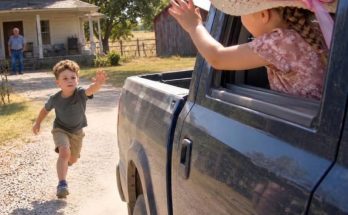
Mom knotted the top of my race-car pillowcase, assuring me I’d stay with Grandpa only a few weeks. Outside, my five-year-old sister Paige waited beside the truck in a brand-new ribboned sun hat. They were leaving for Orlando that afternoon.
I asked if I could have a hat as well.
Mom chuckled. “Where you’re going, buddy, you’ll want a real hat.”
Only then did I realize Orlando wasn’t my destination.
Dad threw my pillowcase into the truck. Watching it fall, I wondered what I’d done to be excluded from a vacation everyone else would enjoy.
I’m Cal. My parents, Rick and Donna, lived near Kansas City. Dad managed a car dealership, while Mom supervised payroll for a hospital system. She preferred predictable schedules and expenses, and leaving me on the farm apparently suited both.
Grandpa Walt, Mom’s father, owned six hundred forty acres in central Kansas, three hours west. His property included wheat, milo, pastureland, barns, and a farmhouse connected by roads I couldn’t distinguish.
Mom had grown up there but seemed unhappy returning. She kept the truck running while giving me my belongings.
“Mind your grandpa. Don’t make me get a phone call.”
She spoke with Grandpa briefly on the porch. Both stood with their arms folded identically, a resemblance I wouldn’t appreciate until years afterward.
Then she drove away.
I remained beside my pillowcase, watching dust drift down. Grandpa offered no promises of wonderful adventures or reassurance that the weeks would pass quickly.
He led me upstairs to a slanted-ceiling bedroom with a cedar-scented quilt. His broad shoulders, sunburned neck, and enormous hands made him seem gigantic.
“Sun comes up at six,” he said. “So do we.”
He turned out the light.
I listened to strange nighttime noises. With no suitcase to open, I untied Mom’s knot and arranged my clothes, trying not to picture Paige boarding an airplane.
Grandpa meant what he’d said about mornings.
Calves needed feeding, and water had to be carried. Even partially filled buckets felt heavy to a seven-year-old. I learned where to step, which gates must remain closed, and how quickly livestock noticed carelessness.
I missed home and the feeling of belonging alongside Mom, Dad, and Paige. Initially, each day seemed another obstacle before someone returned.
But Grandpa stayed beside me.
Whatever job I did, he worked nearby. If chores delayed supper, his meal waited too. He never assigned difficult tasks and retreated indoors while I struggled alone.
Conversation wasn’t his strength. Many questions received brief replies, and compliments were uncommon. Yet knowing where to find him became comforting.
If he promised something after breakfast, it happened. When he instructed me to stay nearby, he made certain I did.
At week’s end, he opened a small notebook secured with a rubber band, made pencil entries, examined them, and handed me pocket money.
I felt disappointed.
“That’s it?”
“That’s pocket money,” he said. “The real pay comes in August.”
I imagined August would bring some impressive prize recognizable to a child.
The promised weeks ended without my parents returning.
I continued learning farm routines. That upstairs bedroom became mine for the summer. I recognized the sounds of Grandpa moving downstairs and knew where the kitchen spoons belonged.
I also knew my parents were traveling with Paige. No amount of praise for fresh country air could make their holiday and my arrangement seem equally desirable.
Near August’s end, Grandpa drove me into town.
After pie at the café, we visited the courthouse for paperwork. Upstairs, Miss Opal offered me peppermint while Grandpa passed an envelope across her counter.
He handled stamped documents and asked me to sign, calling it handwriting practice. At seven, I concentrated on forming neat letters rather than reading the pages.
I assumed everything concerned the farm, like most of Grandpa’s paperwork.
The evening before Mom’s scheduled return, he took me into his machine shop, which smelled of grease, equipment, and the old dog.
From a hardware drawer, he selected a coin-sized brass washer. He positioned it on an anvil, held a punch against it, and struck with a hammer.
The stamped number was slightly crooked.
He dropped it into my palm.
“One for the can.”
He handed me an empty red coffee can. I waited, expecting something more.
“What does the number mean?”
“It means you earned it.”
“What am I supposed to do with it?”
“Keep it. Don’t lose it. Don’t show your mother.”
Apparently, this was the real payment promised for August.
I couldn’t understand why ordinary hardware needed secrecy or why Mom couldn’t see something I’d earned. Grandpa offered no explanation.
Nevertheless, I placed it inside the can.
Mom eventually arrived with a flower lei dangling from the rearview mirror. Paige slept beside a stuffed dolphin. Their Orlando vacation had somehow expanded into an entire summer that finished in Hawaii.
Nobody asked about my summer. I kept the red can hidden beneath my seat.
The same arrangement continued yearly. Each September brought another refrigerator magnet: a sea lion, a cruise destination, or a bison. Those little souvenirs became my only connection to places my family had visited without me.
At eleven, I discovered photographs from Paige’s resort birthday celebration. Relatives I hadn’t seen in years smiled beside the swimming pool. I stared at an empty chair until Grandpa quietly closed the laptop behind me.
“Storm’s coming. Help me get the equipment under cover.”
We worked through the rain until soaked and exhausted. Indoors, he prepared hot chocolate, something he’d never done before. He didn’t demand an explanation for my sadness.
At twelve, we rescued a calf trapped among roots in a flooded creek bed. Grandpa’s bad knees prevented him from climbing down, but he held the rope while I reached the animal and pulled us both to safety.
Afterward, standing in the mud, he placed a hand on my neck.
“That’s a good hand.”
He made another notebook entry. When I asked what he’d written, he answered, “Overtime.”
The following spring, I practiced asking to accompany my family on vacation. At dinner, Dad laughed as though my request was adorable. Mom explained that I loved the farm and Grandpa depended on my assistance.
I suggested Paige could work there instead. Mom claimed her hay allergy made the farm practically dangerous, while Dad insisted other boys would envy my opportunity.
They traveled to Italy.
That August, I again questioned the washer numbers. Grandpa repeated that I’d earned them and would understand when necessary. At thirteen, I felt too embarrassed by the strange ritual to keep asking.
Our courthouse trips continued: café pie, Miss Opal’s peppermints, envelopes, and signatures. I still considered them routine agricultural paperwork and assumed my handwriting simply satisfied Grandpa.
When I was fourteen, my parents overlooked driver’s education while planning another vacation. Grandpa taught me using his aging pickup.
I drove into a ditch.
Instead of shouting, he brought Hollis Rucker and a tractor to pull us out.
That same week, somebody at the feed store asked whether I belonged to Grandpa.
“Near enough,” he said.
Those words stayed with me throughout our drive home.
At fifteen, I made one final request to join a family trip. Mom explained there were only four places. When I pointed out our family had four members, she revealed Paige was bringing a friend.
The girl’s parents were divorcing, Mom said, and taking away the vacation would be cruel.
I packed for the farm without protesting.
That summer, Grandpa admitted Mom had hated growing up there. He’d made her work hard without wages or compliments, despite her remarkable abilities.
“The best I ever had,” he said. “Before you.”
At seventeen, a hailstorm destroyed much of the wheat shortly before harvest. We worked exhausting days saving what remained, sometimes leaving me struggling to stay awake.
One evening, eating cold sandwiches on a truck’s tailgate, Grandpa complimented my work.
“You too,” I answered.
He laughed.
That August, he held the eleventh washer in his palm longer than usual. He told me it was the final one, the important one, because next summer I’d begin my own life.
At the courthouse, Miss Opal shook my hand. Grandpa’s attorney, Mr. Barlow, attended, and this time I signed three pages rather than one.
Outside, Grandpa surveyed Main Street.
“That’s done, then.”
We returned to the café for pie.
I carried my coffee can home, still no closer to understanding those mysterious numbers. But something had changed: leaving the farm now hurt more than going there.