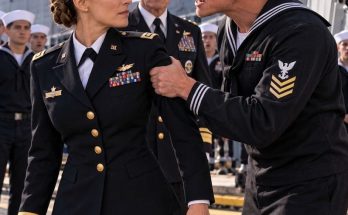
That explanation didn’t change what had happened.
He’d been in uniform, on duty, in front of other sailors.
His behavior wasn’t a private family disagreement.
The command took disciplinary and administrative action after reviewing the evidence and Brandon’s response.
He was removed from his supervisory responsibilities.
His evaluation reflected the documented misconduct.
The incident damaged his prospects for advancement.
But his career didn’t vanish the instant Bell spoke those five words.
That was never how military accountability worked.
The consequences came from the investigation, the evidence, and the decisions made through his chain of command.
Several weeks later, our father called.
I recognized his tone immediately.
“Sandra, I hear you’ve caused trouble for Brandon.”
I was standing in my kitchen.
I set down my coffee.
“Dad, Brandon caused trouble for himself.”
“He says you embarrassed him in front of the crew.”
“He grabbed me while I was performing official duties.”
“You could have handled it privately.”
“The safety-record issue wasn’t private. And I didn’t investigate his conduct.”
Dad sighed.
“Your brother has always been sensitive about you outranking him.”
I’d heard that word for decades.
Sensitive.
It had excused Brandon’s insults at holidays.
It had excused his jokes about my medals.
It had excused the way Dad introduced him as the family’s real military man.
But it couldn’t excuse what happened aboard a warship.
“Dad,” I said, “a junior sailor reported a safety problem. Brandon told him to change the record without a verified repair.”
There was a pause.
“Was anyone hurt?”
“No. And I’m grateful for that.”
“Then why make such a big issue out of it?”
I closed my eyes.
“Because the point of reporting a problem is to fix it before someone gets hurt.”
Dad didn’t answer.
I continued.
“You taught us that responsibility matters more than appearances. That’s what this is about.”
He ended the call soon afterward.
For the first time, I didn’t spend the evening wondering how to explain myself better.
I’d explained enough.
Months passed.
The ship completed its corrective actions and follow-up reviews.
Lewis continued serving.
I later learned that he’d received additional training on reporting concerns and that his willingness to provide an accurate account had been acknowledged.
I hoped he’d remember something important from the experience.
A junior sailor’s honest report could matter more than a supervisor’s confidence.
Brandon remained in the Navy for a time.
He did not receive the advancement he’d been hoping for.
When his enlistment eventually ended, he chose to leave active service rather than pursue another term.
I heard that news from our father.
Dad sounded disappointed.
For once, he didn’t blame me.
“Brandon says he’s trying to figure out what comes next,” he said.
“I hope he does.”
Dad hesitated.
Then he asked a question he’d never asked me before.
“How are things going with your command?”
I almost laughed.
After thirty years, he finally wanted to know.
I told him about the sailors I’d met, the inspections we’d completed, and the challenges ahead.
He listened.
It didn’t erase the past.
But it was a different conversation.
Nearly a year after the inspection, Brandon contacted me directly.
He asked whether we could meet.
We sat at a small café halfway between our homes.
He looked older.
Not defeated.
Just quieter.
For a while, we talked about ordinary things.
Then he set down his cup.
“I thought you were going to destroy me that morning.”
I looked at him.
“I didn’t go there because of you.”
“I know that now.”
He stared at the table.
“I was angry before you even arrived. Dad had told me you were coming to inspect the ship. I thought everyone would assume I got special treatment because of you.”
“So you decided to humiliate me first?”
He nodded slowly.
“It sounds ridiculous when you say it.”
“It was worse than ridiculous, Brandon.”
“I know.”
I waited.
He took a breath.