Then Avery asked whether he’d written the final entry.
Lewis looked toward the doorway.
Brandon was standing there.
“I wrote the original,” Lewis said quietly.
Avery closed the binder.
“What happened to it?”
Lewis swallowed.
“Petty Officer Owens told me to correct it.”
Captain Morgan asked Brandon to wait outside while the inspection team clarified the record.
I stayed silent.
This was precisely why an inspection needed to rely on evidence rather than personal relationships.
Avery asked Lewis to explain what he’d observed.
The previous afternoon, Lewis had checked a fire-boundary door after maintenance work.
The door was supposed to close and latch properly.
It closed.
But it didn’t latch.
Lewis tried again.
The latch still failed to engage.
He recorded the discrepancy and notified his supervisor.
The problem mattered because a door that failed to secure could compromise the intended fire and smoke boundary.
It wasn’t proof that the ship was in immediate danger.
But it was a condition that needed to be reported, evaluated, and corrected.
According to Lewis, Brandon had reviewed the checklist later that afternoon.
He told Lewis the door had already been fixed.
Then he instructed him to replace the failed result with a satisfactory entry.
Lewis said he hadn’t personally witnessed a successful retest.
He’d objected.
Brandon told him the inspection team didn’t need to see a problem that had supposedly been resolved.
Lewis changed the entry.
He regretted it almost immediately.
Fortunately, the ship’s maintenance system retained a separate record.
The technician who’d examined the latch had entered a repair request.
That request was still open.
There was no documented successful retest before the checklist was changed.
Avery compared the records.
Then he requested a physical check of the door.
Captain Morgan arranged for the appropriate personnel to accompany the inspection team.
The door still failed to latch.
I stood in the passageway while the technician demonstrated the problem.
He closed it firmly.
The door moved into position.
But the latch didn’t engage.
He tried again.
Same result.
Avery photographed the condition and recorded the finding.
The original maintenance report was preserved.
The inspection team now had three separate pieces of information: Lewis’s account, the electronic repair record, and the door’s actual condition.
The rewritten checklist contradicted all three.
That was the answer to the question I’d begun asking when I saw the altered handwriting.
The original checklist had reported a failed fire-door inspection.
Brandon had ordered the entry changed to satisfactory without a verified repair.
He’d made an unresolved safety problem appear closed.
And he’d done it just before the inspection.
I asked Captain Morgan whether she had been informed of the discrepancy.
She said she hadn’t.
She immediately directed her staff to assess the affected boundary, establish appropriate interim precautions, and arrange corrective maintenance.
She also initiated a review of the altered documentation.
I told her my inspection team would preserve its findings and allow the ship’s command to address the personnel matter through the proper process.
Because Brandon was my brother, I made sure another senior officer handled the fact-finding concerning his conduct.
I wasn’t going to be his investigator, judge, or advocate.
That afternoon, Bell met with me in the temporary office assigned to our team.
“Your brother is in a difficult position,” he said.
“Yes.”
“You handled the confrontation appropriately.”
“I brought him into the Navy as my brother,” I said. “But I didn’t bring him aboard that ship as his commanding officer.”
Bell nodded.
I looked at the inspection notes.
“What matters now is whether the ship’s safety reporting can be trusted.”
The review continued.
Inspectors found no evidence that the commanding officer had directed anyone to falsify the checklist.
But the incident exposed a weakness in how local supervisors verified that reported corrections had actually been completed.
Captain Morgan ordered a broader check of similar maintenance entries.
The defective door was repaired and retested.
The crew documented the correction.
The inspection team recorded the original discrepancy, the inaccurate checklist entry, and the corrective actions.
Brandon’s conduct was reviewed separately.
Investigators interviewed Lewis, the maintenance technician, and sailors who’d witnessed the confrontation on the pier.
They also interviewed Brandon.
He acknowledged instructing Lewis to change the checklist.
His explanation was that he’d believed the repair had been completed.
But he couldn’t identify a verified retest.
And the maintenance system showed the repair request remained open.
The investigators also examined his conduct toward me.
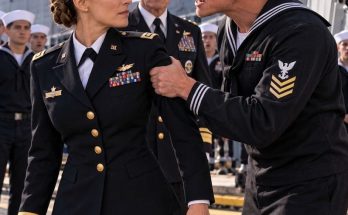
Several sailors confirmed that he’d grabbed my sleeve and refused my instruction to release it.
Brandon said he’d been joking with his sister.