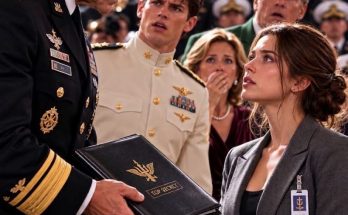
“You’ve embarrassed him.”
I stared at the wall.
“Mom, I haven’t done anything dishonorable.”
She sighed.
“Then why are you leaving?”
I explained again.
She listened for less than a minute.
“Well, I suppose some people aren’t meant for military life.”
That sentence followed me for years.
Daniel was still a teenager.
When he learned I’d left, he laughed.
“So you quit?”
“I changed my career path.”
“Sounds like quitting.”
I tried to explain.
He repeated Dad’s words.
“You couldn’t take the pressure.”
Eventually, the family stopped asking questions.
At Thanksgiving, I was the daughter who’d failed.
At Christmas, I was the example Dad used when warning Daniel about giving up.
At birthday dinners, my mother introduced me as someone who worked in government administration.
No one seemed interested in learning anything more.
I built my career anyway.
My first position involved analytical support.
The work was demanding but unglamorous.
I reviewed reports.
Compared conflicting information.
Prepared assessments.
And learned how quickly a confident assumption could become dangerous when nobody questioned it.
I made mistakes.
Learned from them.
And gradually earned greater responsibility.
Over time, I worked with civilian specialists and military personnel across several organizations.
I learned that the most effective teams weren’t always led by the loudest person.
They were led by people willing to listen.
Five years before Daniel’s graduation, I joined an interagency planning group supporting personnel recovery and crisis response.
Some assignments were classified.
Others involved information that could be discussed only within strict limits.
I traveled occasionally.
Worked long hours.
And spent weeks on projects I couldn’t explain to my family.
My mother assumed I handled paperwork in an office outside Arlington.
My father thought I’d settled for a minor government job.
Daniel joked that I probably spent my days processing insurance claims.
I corrected him once.
“That’s not what I do.”
He laughed.
“Then what do you do?”
“I work in national security.”
“Sure you do.”
I stopped trying.
It wasn’t worth violating professional boundaries to impress someone who had already decided I was a failure.
And despite everything, I remained proud of Daniel.
When he joined the Navy, I sent him a letter.
When he began difficult training, I encouraged him.
When he struggled, I reminded him that asking for help wasn’t weakness.
He rarely thanked me.
But I knew he was working toward something important.
Three weeks before his trident ceremony, he called.
“You’re coming, right?”
“Of course.”
“Just don’t make it weird.”
I frowned.
“What do you mean?”
“Don’t start talking about the Academy or making excuses.”
“Daniel, I’m coming to celebrate you.”
“Good. Then act like it.”
He hung up.
I sat quietly for several minutes.
Then I returned to work.
The days before the ceremony were exhausting.
Our group was supporting a personnel recovery effort connected to a crisis in Eastern Europe.
Six people had become isolated after their planned route was compromised.
Communications were unreliable.
The situation was changing rapidly.
And several proposed options carried serious risks.
Our job was to help senior decision-makers understand the available information and evaluate alternatives.
I coordinated the civilian planning cell.
We worked with specialists who understood the operational environment, communications limitations, logistics, and medical concerns.
We reviewed the risks.
Challenged assumptions.
And developed a revised recovery framework for consideration by the responsible authorities.
I wasn’t commanding the people who would execute the operation.
I wasn’t on the ground.
The greatest danger belonged to the teams carrying out the recovery.
My responsibility was to help ensure that the decision-makers had sound information.
After a long night, the revised plan was accepted for further action.
I received permission to attend Daniel’s ceremony while remaining available for urgent communications.
The morning of the event, I arrived in Coronado wearing a gray blazer and dark trousers.
The auditorium was filled with families.
American flags hung above the stage.
Children waved miniature flags.
Cameras flashed.
My parents sat near the front.
Dad wore a dark suit with his retired captain’s pin.
Mom wore a cream-colored dress.
Neither looked toward the rear entrance.
I remained near the wall.
When Daniel’s name was called, Dad stood immediately.
“That’s my son!”
The audience applauded.
Daniel stepped forward in his white uniform.
An instructor presented his trident.
For a moment, his confident expression disappeared.
He looked overwhelmed.
I felt tears rising.
He’d worked hard.
He’d earned that moment.
I applauded with everyone else.
Then my secure phone vibrated.
I checked the screen discreetly.
EXTRACTION CONFIRMED.
ALL PERSONNEL ACCOUNTED FOR.
I read the message twice.
Then closed the secure application.
Six people were safe.
The planning effort had contributed to an outcome that mattered.
I felt an enormous wave of relief.
Then I heard Daniel’s voice.
“Well, look who actually showed up.”
I turned.
He stood with several teammates.
His new trident reflected the overhead lights.
“Congratulations,” I said.
He looked at my visitor badge.
“Must feel weird being here.”
“Why?”
He smirked.
“Watching someone actually finish what they started.”
One of his teammates shifted uncomfortably.
Another looked away.
I said nothing.
Daniel continued.
“Guess not everyone is cut out for this.”
Then I saw Dad standing nearby.
He had heard everything.
I looked directly at him.
For one second, I hoped he’d intervene.
He adjusted his jacket.
Then turned toward another guest.
I felt something inside me go quiet.
“Enjoy your day, Daniel,” I said.
He laughed.
“Don’t worry. I will.”
I began moving toward the rear exit.
Then the band stopped.
Senior officers turned toward the entrance.
A four-star Army general entered the auditorium.
General Thomas Carter.
He served in a senior joint assignment and had been invited to speak to the graduates.
I recognized him immediately.
We’d worked together on several crisis-response planning efforts.
He was demanding.
Careful.
And unusually willing to listen when someone presented evidence that challenged his assumptions.
I hadn’t expected him to arrive at that moment.
Dad immediately straightened.
He guided Daniel forward.
“General Carter, Captain Robert Hayes, retired. This is my son Daniel. He just earned his trident.”
The general acknowledged them politely.
Then his gaze moved past Daniel.
Toward me.
He stopped.
“Samantha Hayes.”
The entire section went quiet.
I stood straighter.
“Good morning, General.”
He approached.
“Did Washington confirm the extraction?”
I glanced toward the people around us.