Three hours later, a stranger found me unconscious on the roadside. When the police called my father, he repeated the same accusation—until the officer told him they had my backpack and asked him one question that made everything change.
PART 1
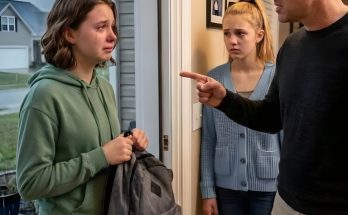
My father threw me out of our house during a freezing October storm because my older sister accused me of hiding drugs. I was only fifteen, wearing a thin sweatshirt and sneakers, when he pointed toward the front door and shouted, “Get out! I don’t need a daughter who’s on drugs!”
Three hours later, the police called him. By then, I was lying unconscious beside a deserted road, almost four miles from home, and the truth about my sister’s accusation was beginning to unravel.
My name is Josie Merrick, and I grew up in a small town in Pennsylvania with my father, Gordon, and my seventeen-year-old sister, Brenna. Our mother had passed away several years earlier, leaving Dad to raise us while working long shifts at a manufacturing plant.
Brenna had always been better at convincing him that she was telling the truth. Whenever something went missing or an argument started, she somehow managed to make me responsible, and Dad usually accepted her explanation before hearing mine.
That Friday evening, Brenna claimed she’d discovered a small packet of drugs among my belongings. I had never seen the packet before, but she insisted she’d found it in my school backpack and accused me of secretly using drugs.
Dad didn’t search my room or ask where the packet had come from. He simply believed Brenna, and when I denied her accusation, he interpreted my refusal to confess as another reason to be angry.
“Stop lying to me, Josie. Your sister wouldn’t make something like this up.”
I begged him to check my backpack and call my teachers if he didn’t believe me. Instead, he opened the front door and ordered me to leave, declaring that I wasn’t welcome until I admitted what I’d supposedly done.
I stood on the porch, hoping he would reconsider. But the door slammed behind me, and the unmistakable sound of the deadbolt told me that he had made his decision.
I had no coat, no phone, and no money. My backpack contained a half-finished algebra assignment and a few school supplies, nothing that could help me find shelter from the icy rain.
At first, anger kept me moving down the dark road. I kept glancing behind me, expecting Dad’s headlights to appear because surely he wouldn’t leave his fifteen-year-old daughter outside in weather this dangerous.
But every passing car belonged to someone else. After the first mile, my clothes were soaked, and my fingers had begun trembling so badly that I could barely close my hands.
By the third mile, I could no longer feel my toes. My thoughts became confused, and I struggled to remember whether I was walking toward town or farther into the countryside.
Eventually, my knees gave way near the gravel shoulder. I tried to stand, but my arms wouldn’t support me, and I collapsed against my backpack as the rain continued falling.
I don’t remember losing consciousness. I only remember the strange relief of no longer having to walk.
Back at home, Dad apparently expected me to return and apologize. Instead, nearly three hours after he’d locked me outside, his phone rang.
The caller introduced himself as Officer Whitaker from the county police department. He asked Dad when he’d last seen his fifteen-year-old daughter and whether she’d been wearing a coat.
Dad tried to explain that we’d had a family disagreement and that I’d left the house. But his voice faltered when the officer asked whether he knew I had no phone or money.
Then Officer Whitaker told him where emergency responders had found me. As Dad listened, he learned that a passing driver had discovered me unconscious beside the road and called 911, and that I had been rushed to the hospital in dangerously cold condition.
PART 2
The Police Found Me Unconscious, and My Father Finally Questioned My Sister’s Story
Officer Whitaker told my father that a passing driver had discovered me unconscious beside a rural road, almost four miles from our house. My clothes were soaked, my body temperature had fallen dangerously low, and paramedics had rushed me to the emergency department.
Dad reportedly stood motionless in our kitchen, struggling to understand what the officer was telling him. Only three hours earlier, he’d been certain that throwing me outside would teach me a lesson, but now he was being asked to explain why his fifteen-year-old daughter had been abandoned in freezing rain.
“Sir, did you know Josie had no coat, no phone, and no money when she left?”
Dad’s grip tightened on the phone. He told me later that his first instinct was to defend himself, because defending himself was easier than admitting he’d been wrong.
“She was caught with drugs,” he said. “My older daughter found them in her backpack. I told her to leave until she was ready to tell the truth.”
There was a pause on the line.
“Mr. Merrick, we have Josie’s backpack. It was lying right beside her.” Officer Whitaker’s voice stayed level. “Inside are an algebra worksheet, three pencils, a library book, and a lunch container. There’s nothing else in it. I’m going to ask you directly: what did you actually see?”
“What do you mean, what I saw?”
“Did you personally find drugs in your daughter’s bag? Did you see them in her hands, or in her room?”
Dad opened his mouth. Nothing came out.
“Brenna told me,” he said finally. “She showed me a little bag. She said it came from Josie’s backpack.”
“So you saw a packet. But you didn’t see where it came from.”
“No. I guess not.”
“Sir, your daughter is being treated for severe hypothermia. The doctors are warming her now, and she hasn’t woken up. I need you to come to the hospital. And I need you to bring that packet with you.”
Dad hung up and stood in the kitchen with the rain still hammering the windows. Then he walked upstairs and knocked on Brenna’s door.
She opened it with her earbuds in, looking annoyed. Dad asked her where the packet was. She hesitated half a second too long before she said she’d thrown it out.
“You told me you found it in Josie’s bag. Where is it, Brenna?”
“I don’t know. Dad, why are you looking at me like that?”
“Because Josie is in the hospital,” he said. “Because I locked her out in a storm over something I never verified.”
Brenna’s face changed. She went pale, and for the first time all evening she looked her age.
“What do you mean, the hospital?”
He didn’t answer. He took his keys from the counter, and a minute later she grabbed her coat and followed him to the truck. Neither of them spoke on the drive.
PART 3
I woke up under a heated blanket with an IV in my arm and a monitor beeping steadily beside me. My hands were wrapped in gauze because the skin on my fingertips had been damaged by the cold. A nurse named Patricia was adjusting a warm pack against my side.
“There she is,” she said gently. “You gave everyone a scare, sweetheart.”