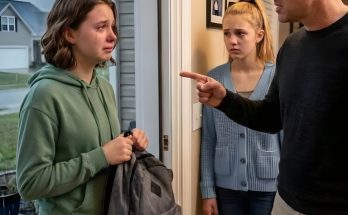
Whitney’s knees gave, and I caught her elbow before she could hit the floor. She stood there shaking, clutching my arm, and I realized this was the closest we’d stood in months.
“I didn’t know,” she whispered. “I swear to God, I didn’t know about the freezer.”
“Did you know about the punishments?”
She closed her eyes.
“She told me she was using time-outs. She said Piper was acting out because of the divorce, that she’d handle it. I was working doubles. I was so tired, and I wanted to believe her.” She wiped her face with both hands. “Piper started flinching when I put her in the car. She stopped sleeping. I thought it was us. I thought it was the divorce.”
I didn’t answer. I didn’t know how to hold her guilt and my anger in the same hand.
“I should have asked more questions,” she said.
“Yes,” I said. “You should have.”
She nodded, tears running down her face, and didn’t defend herself. That was the first thing she’d done in a year that made me think she might be able to fix any of it.
FINAL PART
Dolores Whitaker was arrested at 2:40 that morning.
She was charged with child abuse resulting in injury, false imprisonment, and reckless endangerment. Her attorney argued that she was an elderly woman from a different era whose methods had been misunderstood. The prosecutor in Adams County put the green notebook into evidence, and then read the entries aloud, one after another, until the argument stopped sounding like a defense.
Dolores accepted a plea agreement four months later. She was sentenced to prison, with a permanent protection order forbidding any contact with Piper.
Whitney’s case was handled separately. Child protective services found no evidence that she’d known about the freezer, but they documented her failure to act on warning signs, and a judge awarded me temporary primary custody while the family court evaluated the situation.
I braced for a fight. Whitney didn’t give me one.
“I don’t want to take her from you,” she told me at the first mediation, her hands twisted in her lap. “I want her safe. I want to deserve her back. Tell me what to do.”
I had been angry at her for a long time, long before the garage. But anger was a luxury I couldn’t afford when Piper needed us both to be better than we had been.
We agreed on a plan: Whitney would complete a parenting course and begin her own therapy, and she would see Piper in supervised visits that would loosen over time as the counselors judged it safe. It wasn’t forgiveness, and it wasn’t a reconciliation. It was a path.
Piper started trauma therapy in November with a play therapist named Dr. Linden, who kept a basket of puppets in the corner of her office and never once told my daughter to hurry.
The early months were hard. Piper wouldn’t go near our apartment’s freezer. She asked me to check the closets before bed, and then the closets again. She woke at night with her hands pressed over her mouth, silent, as if even crying were something that could get her punished.
“Is Grandma coming back?” she asked one evening.
“No, sweetheart. Grandma isn’t allowed near you ever again.”
“What if she tells me I’m bad?”
I knelt in front of her.
“Then you’ll remember what Daddy says. You’re not bad. You were never bad. What Grandma did was wrong, and it was never your fault.”
She studied my face for a long time.
“Okay,” she said.
It wasn’t belief yet. But it was the first step toward it.
Dr. Linden suggested something small. We brought Piper’s confiscated toys home from the evidence room once the case closed, and I let her decide what to do with them. She laid them on the living room rug in a row: the stuffed rabbit, the tea set, the doll with the missing arm.
“They didn’t come back,” she said.
“They did,” I said. “You brought them back.”
She hugged the rabbit for an hour.
By spring, she was sleeping through most nights. By summer, she was laughing again, the loud, unguarded laugh I’d feared I would never hear after that October. She took swim lessons at the community pool, and I stood at the edge with a towel while she screamed with delight and splashed me, and I thought, this is what I almost lost.
Whitney’s visits went well. She showed up on time, every time. She brought coloring books, and she listened. Piper was wary at first, then curious, then, slowly, glad. At one session, I watched through the observation window as Whitney knelt down and said something quietly. Piper threw her arms around her mother’s neck.
By the following autumn, the court granted shared custody with a gradual schedule. Whitney and I didn’t become friends, exactly. But we spoke to each other with a careful respect we’d never managed during the marriage, and we both knew why.
On the one-year anniversary of that night, I drove past the house on Juniper Ridge Lane. It had been sold the previous spring. The garage door was closed, a swing set stood in the yard, and a different family’s minivan sat in the driveway.
I didn’t stop. I just looked, the way you look at a place where something terrible happened and then stopped happening.
When I got back to the apartment, Piper was at the kitchen table, drawing.
“What’s that?” I asked.
She held it up. It was a picture of the two of us standing outside a house with a bright yellow door, holding hands under a huge sun.
“That’s our new house,” she said.
“We don’t have a new house, bug.”
“We will.” She said it with total certainty. “It’ll have a big garage, and no freezer, and the door will always be open.”
I knelt down and wrapped my arms around her, and she patted my back like I was the one who needed comforting.
Maybe I was.
I still think about the sound that reached me through the freezer lid, that thin, desperate Daddy, help. I think about how close I came to arriving an hour later, or on Friday as instructed, or not at all.
But I don’t let myself stay there long. Piper taught me that, in her small, stubborn way. You can remember the worst night of your life without living inside it.
So I turn the memory over, put it away, and get on with the business of being her father: checking the closets, answering the questions, and showing up when she calls.
Every single time.
THE END