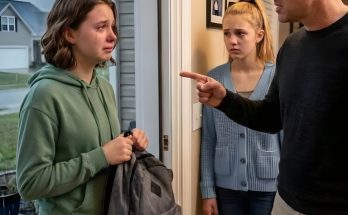
“Grandma says I’m always in trouble.”
I pressed my cheek against her hair and made myself breathe. “Grandma is wrong.”
I heard the front door of the house open.
Through the window, I saw Dolores step onto the porch in her quilted vest, a dish towel in one hand. She looked toward the open garage, then toward my truck. She didn’t hurry. She didn’t look frightened. She looked annoyed, like a woman who’d found a stranger in her kitchen.
I laid Piper across the seat, tucked the blankets around her, and told her to stay down. Then I got out and shut the door behind me.
“Grant,” Dolores said, because that was my name, and she’d always said it like a verdict. “You’re early. Whitney said Friday.”
“Where is she?”
“At work. Night shift.” She looked past me at the truck. “Why is Piper in your vehicle?”
“Why was she in your freezer?”
She didn’t flinch. That was what I remember most, that she didn’t flinch.
“Don’t be dramatic. It was a few minutes. The child’s been impossible all week. Lying, hitting, screaming at bedtime. Someone has to teach her to settle down.”
“A few minutes.”
“The freezer wasn’t even running that high.” She folded the towel over her wrist. “Your generation doesn’t understand discipline. That girl needs a firm hand, and her mother is too soft to give her one. I’m trying to help.”
I took one step toward her, and she stepped back onto the porch. I stopped, because I didn’t trust what my hands would do if I kept going.
“You’re not going to touch her again,” I said. “You’re not going to go near her. The police are on their way.”
For the first time, something moved across her face. It wasn’t guilt. It was calculation.
“Whitney will tell them it was a game,” she said. “Piper climbs into things. You know she does.”
“Piper was locked in. The lid was latched from the outside.”
“You can’t prove that.”
“I don’t have to.” I could hear sirens now, distant but climbing. “I only have to stand here.”
She went back inside and shut the door. I heard the deadbolt turn. I didn’t follow her. I stayed between the house, the garage, and my daughter until the first patrol car swung onto the street, followed a minute later by an ambulance, red and blue light washing over the snow-crusted lawns.
PART 3
Piper’s core temperature was 94.1 degrees when the paramedics got her into the ambulance.
“That’s mild hypothermia,” the paramedic told me, wrapping a heated blanket around her. “She’s lucky you came when you did. Another hour in there, and we’d be talking about a very different night.”
I rode in the back with her. She held my thumb the whole way and watched the ceiling lights slide past.
At Children’s Hospital Colorado, they warmed her gradually and checked her skin, her heart rhythm, and her lungs. A pediatrician named Dr. Okafor examined her with the patience of someone who had learned to talk to frightened kids. Afterward, a hospital social worker named Ms. Reyes asked if she could speak to me in the hallway.
“Mr. Halvorsen, I’m required to call Adams County child protective services, and the police have already asked to interview Piper. We’ll do it gently, with a forensic interviewer, and you can stay close by.”
“Do whatever you need to do.”
Detective Maribel Cruz arrived just after midnight. She was in her forties, with her hair pulled back and a steady, unhurried way of speaking. She told me they had secured the house and the garage, and that Dolores Whitaker was being questioned.
“There’s something else,” she said. “The second freezer. I’d like to explain what we found before you hear it from anyone else.”
My stomach dropped. “Tell me.”
“Officers opened it under a warrant about an hour ago.” She paused. “It wasn’t what your daughter led you to believe. But it’s still significant.”
She showed me photographs on her tablet. The old freezer was lined with towels, and stacked inside were stuffed animals, a pink plastic tea set, a doll with a missing arm, and a child’s scooter folded in half. In the corner sat a battered green notebook sealed in a gallon bag.
“Those are Piper’s things,” I said slowly. “Her toys.”
“Your daughter has been told that toys that are ‘bad’ go in there, along with children who misbehave,” Detective Cruz said. “We believe Mrs. Whitaker confiscated the items as punishments and told Piper they were gone for good. The padlock may have been part of the story, a way to make the threat seem real.”
“The ones who don’t come back,” I said.
“Yes.”
I pressed the heel of my hand against my eyes. I’d spent three weeks imagining the worst thing a person could find inside a freezer, and the truth wasn’t that. But it told me exactly what kind of mind had built the rest of it: a woman who had turned a six-year-old’s fear into a system.
“What about the notebook?”
Cruz turned the tablet. The pages were lined, filled with neat cursive in blue ink. Dates ran down the left margin. Beside each one were short entries.
Sept. 4. Screamed at bedtime. Freezer, 8 min.
Sept. 11. Refused vegetables. Freezer, 12 min.
Sept. 19. Hit Whitney’s phone out of my hand. Freezer, 15 min. Cried less. Progress.
There were more than forty entries. The last one was dated that night: Oct. 17. Told lies about Grant. Freezer, 20 min.
“She kept records,” Cruz said quietly. “She thought of it as a program.”
I read the final line three times. Told lies about Grant. My daughter hadn’t lied. She had probably said she missed me.
“The times are short,” I said. My voice shook. “She says eight minutes, twelve minutes.”
“Mrs. Whitaker’s account of the timing doesn’t match what we’ve observed. The freezer was unplugged, which she may have believed made it safe, but the lid seals and the interior is rigid plastic. Your daughter’s temperature suggests she’d been inside much longer than twenty minutes.” Cruz set the tablet down. “The medical team will document that.”
At 1:15, Whitney walked into the pediatric wing.
She was still in her scrubs, her face stripped of color. A uniformed officer had met her at the hospital entrance, and she looked like someone who had been told only half a sentence and filled in the rest.
“Grant.” She stopped five feet from me. “Where is she?”
“She’s asleep. She’s okay.”