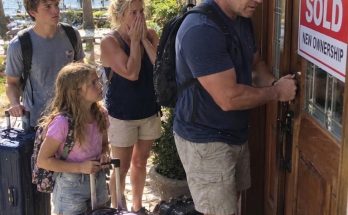
**Part 1**
Patrick put his key in the front door of the lake house and turned it.
The lock didn’t move.
He tried again, harder. He jiggled the key the way his father used to when the door swelled in the summer heat. He pulled it out, checked it was the right one, and pushed it back in.
Nothing.
That was when he noticed the small white sign that had been put up in the front window.
PRIVATE PROPERTY.
Underneath, in smaller letters:
Please do not disturb the residents.
Behind him, his wife, Megan, took off her sunglasses.
“Why is that there?”
Patrick looked toward the driveway. Their SUV was parked where he always parked it, under the old maple tree. The back was packed to the roof with luggage from the cruise. Their son, Owen, was asleep in the back seat with his cheek pressed against the window. Their daughter, Sophie, was already out of the car, hopping from foot to foot on the gravel, asking if she could go swim.
Patrick took out his phone and called me.
I know all of this because he told me later, and because I know that porch and that driveway and that maple tree better than I know my own face. I can see every second of it.
But at that moment, I was twenty minutes away, sitting at the kitchen counter of a small apartment in town.
I watched his name light up my screen.
For several seconds, I just stared at it.
Through the apartment window, I could see a thin sliver of the lake between two brick buildings. It wasn’t the same view I’d had for forty years. But it was peaceful. It was mine.
My moving boxes were still stacked against the wall. I hadn’t decided yet where to hang George’s fishing photographs.
The phone stopped ringing. Then it started again.
I answered.
“Mom, the lock’s been changed.”
His voice was tense. Not angry yet. Just confused.
“I know,” I said.
“What do you mean, you know?”
“I sold the house.”
There was silence on the line.
Not the stunned silence I had imagined while I was signing the papers. This was something different. It was the silence of someone waiting for the other person to laugh and admit it was all a joke.
“You sold the lake house?”
“Yes.”
“To who?”
“The new owners moved in this morning.”
In the background, I heard Megan’s voice rise.
“Put me on speaker.”
Patrick didn’t.
“Mom, what are you talking about? We’re here. We’re standing on the porch.”
“I understand.”
“You knew we were coming back today.”
“Yes.”
“And you didn’t tell us?”
“You didn’t ask.”
I heard his breath catch.
For a moment, I wondered whether he was remembering the last message he’d sent me from the ship. The excursion desk had declined my credit card, and he’d written to me like I’d made some silly clerical mistake that I needed to fix right away.
I’d answered him with four words.
Use your own card.
He hadn’t spoken to me since.
To understand how I ended up selling my home out from under my own son, you have to know about the lake house.
And about George.
My name is Eleanor Henderson. I’m seventy-one years old. George and I bought that house on Wren Lake when Patrick was four. It was a wreck back then. A sagging cabin with a leaking roof and a dock that tilted into the water like a sinking ship.
We were young and broke and stubborn. We fixed it ourselves, one room at a time, over twenty years. George built the stone fireplace with rocks he pulled out of the lake. He built the boathouse. He built a workshop out back that smelled like cedar shavings and motor oil, and he spent his Saturdays out there making things. Bird feeders. Bookshelves. A little wooden box with a compass rose carved on the lid, which he gave me our first winter there.
“So you always know which way is home,” he said.
Patrick grew up in that house. His father taught him to swim off the end of that dock. His first dog, a golden retriever named Biscuit, is buried under the willow tree by the water. There are still marks on the kitchen doorframe where we measured him every birthday.
I loved that house with my whole heart.
But it was always ours. George’s and mine. That’s important. Remember that.
George died six years ago.
He got sick in the fall. Pancreatic cancer. By the time they found it, it had already spread. He was gone in four months.
I remember every day of those four months. The hospital corridors. The plastic cups of ice chips. His hand searching for mine in the dark at three in the morning.
I remember Patrick visiting. Not as often as I wanted, but he came. He’d stand at the foot of the bed with his hands in his pockets. Sometimes he’d ask his father questions about the house. The boathouse roof. The well pump. Whether the dock needed new pilings.
At the time, I thought he was trying to distract his father. Give him something normal to talk about.
I didn’t know then what those conversations really were.
After George died, Patrick started needing help.
It began small. His business, a landscaping company he’d started a few years before, had failed. He was behind on a few things. Could I help with the car payment, just this once?
Of course I could. He was my son. He was grieving too.
Then it was Sophie’s preschool tuition. Then a business credit line he said was temporary, just until he got a new venture off the ground. Then their rent.
Then, four years ago, their landlord sold the building, and Patrick called me on a Sunday night.
“Mom, it would just be for a few months. Until we find something. The kids love the lake. And honestly, you shouldn’t be out there alone anyway. What if you fall?”
I wasn’t going to fall. I was sixty-seven and swam a mile in that lake every summer morning.
But the house was very quiet without George. And I missed the sound of children.
“A few months,” I said.
They moved in two weeks later.
They never moved out.
At first, it was wonderful.
I’m not going to pretend it wasn’t. Sophie was four and Owen was a baby. The house was full of noise again. Toys on the stairs. Sticky fingerprints on the windows. Sophie followed me around the garden asking the names of every flower.
Megan was polite. A little cool, maybe. She was a careful, organized woman who worked part-time in marketing and came from a family that had always had money. Her parents, Richard and Diane, lived in a big house in the suburbs and came to visit twice a year. They always brought expensive gifts for the children and looked at my furniture like it might give them a disease.
I didn’t mind. Not then.
But slowly, without anyone ever saying it out loud, things changed.
They stopped paying for groceries. I’d notice it at the checkout, my total getting bigger every month. Patrick’s truck payment started coming out of my account “just for now.” Then the kids’ swim lessons. Then their phone bill. Then, somehow, the payment on the SUV Megan bought when Owen turned three. A big white luxury one with leather seats.
“We needed something safer for the kids,” she said.
I paid it.
I never got a thank you for most of it. Not because they were cruel. Because the payments had become invisible. They were just how things worked. Like electricity. You don’t thank the light switch.
I tried to talk to Patrick about it. More than once.
I’d say, “Honey, I’m a little worried about money this year.”
He’d say, “You’re fine, Mom. Dad left you plenty.”
I’d say, “I’ve always wanted to travel. Before I’m too old.”
He’d say, “You should. Someday.”
I’d say, “The roof on the boathouse is really bad. I need to get it done.”
That last time, he was sitting at the kitchen table, looking over a contractor’s estimate for the boathouse. He’d asked to see it. He frowned at the number. Then he looked up at me and smiled.
“Don’t worry about it, Mom,” he said. “It’s all going to be mine someday anyway. I’ll deal with it then.”
He said it so easily. With such confidence.
Not someday, maybe. Not if you want.
Just eventually. Like it was already decided. Like I was just keeping his seat warm.
I remember that sentence better than almost anything he’s ever said to me.
I found the folder last spring.
I was looking for a pen in the drawer of the hallway desk. The one by the stairs. It had always been my desk. My bills, my checkbook, my stamps.
There was a red folder in there that I’d never seen before.
I opened it, thinking it was mail.
It was a remodeling plan.
For my house.
There were printouts of kitchen designs. White cabinets. A big marble island where my old butcher-block table was. Paint swatches stapled to the corner of one page. Pale Oak. Agreeable Gray. Swiss Coffee. Someone had circled Swiss Coffee twice and written kitchen beside it.
There was a contractor’s estimate. For taking down the wall between the kitchen and dining room. For replacing the old stone fireplace George built with “a modern linear gas insert.”
And there was a floor plan of the second floor. My bedroom was labeled PRIMARY — P & M.
The little sewing room at the end of the hall was labeled OFFICE (or Mom?).
I sat down on the stairs with the folder in my lap.
Or Mom?
With a question mark.
I sat there for a long time. Long enough that the light changed on the floor. Then I put the folder back in the drawer, exactly where I’d found it.
I didn’t say anything to anyone.
I just started thinking.
Two weeks before the cruise, I called a realtor.
I want to be honest about that. I didn’t sell the house because of the cruise. I’d already decided. The cruise was just the moment I stopped pretending I hadn’t.
The realtor was a kind, brisk woman named Pam who’d sold half the houses on Wren Lake. She walked through the whole place with me on a Tuesday morning while Patrick was at a meeting and Megan had the kids at a birthday party.
“It’ll sell fast,” Pam said. “Lake houses always do. Are you sure, Eleanor?”
I looked out at the dock. At the willow tree.
“No,” I said. “But I’m doing it anyway.”
She had a couple in mind already. People who’d been looking on the lake for two years. Claire and Daniel Hart. Schoolteachers from the city who wanted to live somewhere quiet. Pam showed them the house privately on a Thursday when the family was out.
I met them on the porch.
Claire was in her early forties, with short brown hair and paint on her sweatshirt. Daniel was quiet and tall and kept running his hand along George’s porch railing like he was checking the joinery.
“Who built this?” he asked.
“My husband.”
“It’s beautiful work. Really beautiful.”
Claire stood at the end of the dock for a long time, looking out at the water. When she came back, her eyes were wet.
“I’m sorry,” she said, laughing a little. “We’ve been looking for so long. I just— I can see us here.”
I liked her. I liked them both.
Not because they were going to pay a good price, though they did. Because they looked at the house the way George and I had looked at it forty years ago.
Like a home.
Not an inheritance.
The cruise was for Patrick and Megan’s tenth wedding anniversary.
I paid for it.
I know how that sounds. But it had been planned for almost a year, long before the folder, long before I called Pam. A seven-day Caribbean cruise. Patrick and Megan, the two kids, and me.
“It’ll be so good for you, Mom,” Patrick said when he first suggested it. “You never go anywhere.”
Then, a month before we left, Megan sat down across from me at the kitchen table.
“I need to talk to you about the cabin situation,” she said.
The cabin situation was this. Megan’s parents wanted to come.
“They’ve never been on a cruise with the kids,” she said. “And they’re getting older. And the suite only sleeps six. So I was thinking. Maybe you could sit this one out? And come next time?”
I looked at her.
“I’m paying for it, Megan.”
“I know. And we’re so grateful. Honestly. But Mom and Dad are paying for their own flights. And you’ve had the kids all year. You see them every day. My parents barely see them at all.”
I didn’t say anything.
“It’s just one trip,” she said. “You understand, right?”
I did understand. That was the problem.
I said yes. I gave up my spot. I told myself it was generous. I told myself grandparents should share.
I paid the deposit anyway, the balance, and the onboard credit, because it had already been booked on my card months before. Patrick hugged me and said, “You’re the best, Mom.”
On the second day of the cruise, Megan posted a picture.
The whole group on the deck of the ship. Patrick and Megan in the middle. The kids in front, in matching sun hats. Richard and Diane on either side, tanned and smiling, holding cocktails with little umbrellas.
The caption said:
Finally, a vacation with the WHOLE family! Ten years and counting!
I read it on my phone, sitting alone on the porch of the lake house, with a cup of coffee going cold in my hand.
The whole family.
I read it five times.
Then I put the phone face-down on the table, and I called Pam.
“Let’s move up the closing,” I said.
Three days later, my phone buzzed with a message from Patrick.
Mom, the excursion desk declined your card. We’re trying to book the dolphin swim for the kids. Can you call the bank and fix it? Need it in the next hour.
I’d called the bank the day before. Not to fix the card. To cancel the onboard charges. Every charge after the cruise fare itself. The excursions. The spa. The specialty dinners. The drinks package Richard and Diane had apparently been enjoying on my account.
I looked at Patrick’s message for a long time.
Then I wrote back.
Use your own card.
An hour later, a message came from Megan instead.
I can’t believe you would do this to us in the middle of our anniversary trip. The kids were so excited for the dolphins. Whatever your feelings are about not coming, the children shouldn’t have to be affected by them.
I read it twice.
She didn’t ask whether my feelings had been affected by being left behind. She didn’t ask whether I was hurt by the post. She only objected when the bills stopped being paid.
I didn’t answer.
Neither of them wrote to me again for the rest of the trip.
The sale closed the day before they came home.
I’d moved everything I wanted into the apartment in town. Pam had found it for me. Two bedrooms, third floor, with an elevator and a little balcony and that small sliver of lake between the buildings.
Everything else was sold or donated or left for the Harts, who’d asked if they could keep George’s workbench.
“We’d be honored,” Daniel said.
Patrick’s family’s things I had packed carefully, every box labeled, and moved into a storage unit in town. I paid the first three months. The key was in an envelope at the realtor’s office with Patrick’s name on it.
I wasn’t trying to throw my grandchildren into the street.
I just wasn’t going to keep pretending.
So that’s where we were when Patrick called me from the porch.
“What do you mean, the new owners moved in?” he asked.
“I mean the sale closed yesterday.”
“Yesterday?”
“Yes.”
“Mom, you can’t do that.”
“I already did.”
Megan finally got close enough for me to hear her clearly.
“Patrick, give me the phone.”
He hesitated. Then her voice came through, sharp and controlled.
“You had no right to sell that house without telling us.”
“I was the owner.”
“That doesn’t mean you could make a decision like this without considering the family.”
“I considered the family for years.”
“That house was supposed to stay with Patrick.”
“No,” I said. “It was supposed to stay mine until I decided otherwise.”
“You knew we were planning our future there.”
I looked at the boxes stacked around me in that little apartment. The words sounded different now that I wasn’t standing in the lake house, surrounded by their expectations.
“You were planning a future in a home you didn’t own,” I said.
“We assumed you understood that.”
“I understood that you had started choosing paint colors for my kitchen.”
Megan went quiet.
In the background, Patrick said, “What are you talking about?”
“I found your remodeling folder,” I said.
“That was private,” Megan said.
“In my house?”
“It was just an estimate,” she said quickly. “We were thinking ahead.”
“You were thinking ahead to a life that depended on me disappearing.”
“That’s not fair.”
“No,” I said softly. “It isn’t.”
Behind them, one of the children started asking where they were going to sleep.
I heard Sophie say she wanted the blue room. The blue room was hers. It had been her room since she was four. Her voice had that ordinary, tired impatience of a ten-year-old who’d been in a car for three hours and had no idea that the adults’ whole world had just collapsed on the porch.
I closed my eyes.
“I don’t want the children standing outside this conversation,” I said. “Take them somewhere safe and comfortable. Your things are in a storage unit on Mill Street. The key is at Pam Wheeler’s office. Then call me tonight.”
“Mom—”
“I’m not discussing this while everyone is upset.”
“You can’t just sell our home and hang up.”
“It was never your home,” I said.
And I ended the call.
My hands were trembling.
Not because I regretted it. Because saying those words out loud made the truth impossible to soften.
It had never been their home.
I sat at the counter for a long time with the phone in my hand. Then I got up and started unpacking. One box at a time. Slowly.
George’s winter coats went into the hall closet. I couldn’t give them away. I’d tried three times.
My good china, which had sat untouched in the lake house dining room for years, went onto the little shelves above the sink. I’d never used it. I was always saving it for a special occasion. That night I took down one of the teacups and drank chamomile out of it.
I hung George’s fishing photographs by the window, where the late afternoon light touched the frames. George holding up a bass on the dock. George and Patrick, maybe seven years old, both of them grinning, Patrick holding a fishing rod with a big stick hooked on the end of it.
The apartment was small. No wide porch. No stone fireplace. No lake stretching out past the back lawn.
But every single thing in it was there because I had chosen it.