**Part 1**
My son laughed while I rented a one-bedroom apartment behind a laundromat.
Eight months later, he walked into my beautiful new villa, looked at his wife, and announced, “It’s perfect. Kendra will love living here.”
Then he pointed toward my guesthouse and told me I could move in there while his family took the main house.
I smiled, but not because I agreed.
I was sixty-one years old, newly divorced, and finally living in a home I had purchased with my own money.
My son had no idea how much I had sacrificed to get there, and he certainly didn’t know what I was prepared to do to keep it.
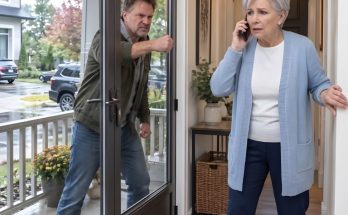
A few hours later, he would call the police on his own mother.
My name is Evelyn Hale, and I live in Sarasota, Florida.
For thirty-four years, I was married to Richard Hale, a man everyone believed was a brilliant businessman and generous provider.
When our marriage ended, he kept the lake house, the boat, the expensive lifestyle, and most of our friends.
I walked away with my sewing machine, my grandmother’s china, and the determination to build a peaceful life.
The first place I found was a small apartment behind a laundromat.
The kitchen cabinets were peeling, the bathroom fan rattled, and my bedroom window faced a brick wall.
But the rent was manageable, the neighborhood was quiet, and nobody could tell me what to do inside those walls.
For the first time in decades, I could make decisions without hearing Richard criticize them.
My only son, Preston, didn’t see it that way.
He visited twice during those eight months, and both visits left me feeling smaller than the apartment itself.
The first time, he brought his wife, Kendra, and stood in my kitchen looking around with an expression of disgust.
Then he laughed as though my new living situation proved something he had always suspected about me.
“Mom, you’re sixty-one,” he said. “You should be thinking practically, not pretending you’re going to start over.”
Kendra smiled into her coffee and added, “Renting is fine for some people.”
I looked at the two of them and wondered when my own family had started speaking to me like I was a disappointing stranger.
Preston was thirty-five, married, and the father of a beautiful baby girl named Lila.
I adored my granddaughter, and I would have done almost anything to make her happy.
But Preston had inherited his father’s habit of confusing confidence with wisdom.
Like Richard, he believed that a woman who didn’t advertise her accomplishments probably didn’t have any.
During his second visit, Preston inspected my apartment like he was touring a warning about bad decisions.
“You should have let Dad handle the divorce finances,” he said.
I folded a towel and tried not to react, although his words hurt more than I wanted to admit.
My son had no idea that I had been handling the complicated financial details of our household for decades.
While Richard entertained clients and accepted compliments, I maintained the books, watched our investments, and managed financial paperwork.
My grandmother had also left me two small commercial properties, which I had carefully maintained throughout my marriage.
After the divorce, I sold those properties and reviewed my finances with professionals I trusted.
The money gave me an opportunity nobody in my family expected.
I found a white Mediterranean villa near Sarasota Bay, surrounded by palm trees and lemon trees.
It had arched windows, beautiful stone floors, a marble fireplace, and a courtyard filled with sunlight.
Behind the main house stood a separate guesthouse with tall windows, perfect for my sewing machine and painting supplies.
I walked through the property once and knew I had found the place where I wanted to spend the next chapter of my life.
I purchased it without a mortgage, and every important document carried my name.
The deed was mine, the accounts were mine, and the decision had been mine from the beginning.
I didn’t tell Preston because I wanted to enjoy something beautiful before anyone had the chance to criticize it.
For three wonderful weeks, I lived quietly among my books, flowers, and grandmother’s china.
Then a neighbor posted photographs from my housewarming dinner.
By Saturday morning, Preston’s black SUV was rolling through my gate without an invitation.
Kendra climbed out carrying Lila, and both adults stared at the villa as if they had discovered an unexpected prize.
Preston walked through my front door before I could even welcome him.
“Mom, how did you afford this?” he demanded, looking up at the vaulted ceiling.
I told him I had purchased the home with money I had managed over the years.
He laughed and suggested his father must have been more generous during the divorce than anyone realized.
I didn’t correct him because I was beginning to recognize that he preferred his own explanations to the truth.
Kendra wandered toward the French doors, admiring the courtyard and the pool.
She mentioned how wonderful the property would be for Lila, and Preston immediately agreed.
Then he looked around my living room, grinned at his wife, and said, “My wife will love living here.”
I thought I had misunderstood him until he casually explained his plan.
“We’ll move into the main house,” he said. “You can take the guesthouse. This place is too big for you anyway.”
Kendra nodded and added that the smaller building would be easier for someone my age to maintain.
Neither of them asked whether I wanted this arrangement.
I looked at the son who had laughed when I rented a tiny apartment.
Now that I owned something beautiful, he had decided it should belong to his family instead.
I folded my hands and asked one simple question:
“Preston, when exactly did I invite you to move into my house?”
His smile disappeared, and the answer he gave me revealed just how far he intended to push.
“You don’t have to invite us, Mom.”
For a moment, I thought I had misheard him.
He continued speaking with the same casual confidence Richard once used when announcing decisions that affected my entire life.
“We’re family. That’s how this works.”
Kendra shifted Lila against her shoulder.
My granddaughter was sleeping, one tiny hand resting against the collar of her mother’s blouse.
I looked at that little hand.
Then I looked at my son.
“That’s not how ownership works, Preston.”
He gave an irritated sigh.
“Don’t make this difficult.”
“I’m asking you to respect my home.”
“Your home?”
He laughed again.
“Come on, Mom. Seriously?”
Something inside me became very still.
“Yes,” I said. “My home.”
Preston gestured toward the marble fireplace.
“You couldn’t afford this without Dad.”
“I already told you how I purchased it.”
“Dad says you were always terrible with money.”
Those words should have surprised me.
They didn’t.
For thirty-four years, Richard had told the world that I was fortunate to have him.
Whenever a financial decision succeeded, he accepted the praise.
Whenever something went wrong, he found a way to make it my responsibility.
Apparently, our son had believed every word.
“Your father doesn’t know my finances anymore.”
Preston crossed his arms.
“Then show me.”
“Show you what?”
“Your bank statements. The purchase documents. Whatever inheritance you supposedly received.”
I stared at him.
He was standing in my living room, demanding proof that I deserved the house I had purchased.
Not because he worried about fraud.
Not because he feared I was vulnerable.
He wanted to decide whether my success was legitimate enough for him to respect.
“No,” I said.
He blinked.
“What?”
“I won’t show you my private finances.”
His expression hardened.
“That’s suspicious.”
“No, Preston. That’s privacy.”
Kendra finally spoke.
“Evelyn, I think everybody’s getting emotional.”
I turned toward her.
“Then perhaps we should end this visit.”
Her mouth tightened.
“We’re only trying to help.”
“Help whom?”
She looked briefly at Preston.
Then she adjusted Lila’s blanket.
“This place would be wonderful for children.”
“I’m sure it would.”
“You don’t even use half these rooms.”
“I’ve lived here three weeks.”
She frowned.
“Well, we’re thinking about the future.”
“So am I.”
That silenced her.
Preston reached into his jacket.
He removed a folded sheet of paper.
Then he placed it on my grandmother’s mahogany coffee table.
“We’ve already worked everything out.”
I didn’t touch it.
“What is that?”
“A family living arrangement.”
I looked down.
The heading read: Family Occupancy Agreement.
Underneath were paragraphs describing how Preston, Kendra, and Lila would occupy the main residence.
I would retain permission to use the detached guesthouse.
Permission.
In my own property.
At the bottom was a line waiting for my signature.
I felt the room tilt slightly.
Not from fear.
From recognition.
Richard used to prepare documents like this.
He would make decisions without consulting me.
Then he would put papers in front of my dinner plate.
He called it being organized.
I had called it marriage.
Now I knew better.
“Who prepared this?”
Preston shrugged.
“Dad helped.”
Of course he had.
I picked up the paper.
One paragraph caught my attention.
The proposed arrangement would continue for an indefinite period.
Another authorized Preston to manage household expenditures.
A third allowed him to approve structural changes.
I read that sentence twice.
“You intend to renovate my house?”
“Kendra wants a bigger nursery.”
Kendra looked toward the courtyard.
“And the guesthouse could use some updating.”
I folded the paper.
Carefully.
Then I handed it back.
“I won’t sign this.”
Preston didn’t move.
“Mom, we’ve already made arrangements.”
“What arrangements?”
“Our furniture is going into storage.”
“Why?”
“Because we’re moving.”
I studied his face.
“Moving from where?”
He hesitated.
“Our house.”
“What happened to your house?”
“That’s not relevant.”
“It certainly seems relevant.”
He glanced at Kendra.
She looked suddenly uncomfortable.
“Preston,” she said quietly. “Tell her.”
He ignored her.
“We’ve got a moving company booked.”
“For when?”
“Monday morning.”
It was Saturday.
My son had arranged to move his family into my house without asking my permission.
And he had done it before I even knew he needed somewhere to live.
I felt an old familiar instinct.
The instinct to fix everything.
To make calls.
To open my checkbook.
To rearrange my life until everyone else felt comfortable again.
That instinct had once kept my marriage alive.
It had also nearly destroyed me.
I looked at Lila.
Then at Preston.
“Whatever is happening with your home, we can discuss it honestly.”
His expression relaxed slightly.
“But you are not moving into mine.”
The relief vanished.
“Unbelievable.”
“I’m sorry you’re disappointed.”
“Disappointed?”
His voice rose.
“I’m your only son!”
“And I am your mother.”
“Exactly!”
He pointed toward the guesthouse.
“You should want to help your family.”
“I do.”
“Then what’s the problem?”
“The problem is that you decided my home belonged to you.”
Kendra stepped closer.
“Evelyn, think about Lila.”
I felt that sentence more deeply than anything else.
Because Lila was innocent.
Because she deserved safety.
Because loving her was the easiest thing in my world.
But I understood something important.
If I surrendered my home today, I would teach Preston that he could use his daughter to take anything he wanted.
I would also teach Lila that older women were expected to disappear when younger families needed space.
I wasn’t going to teach her that.
“I am thinking about Lila.”
“Then let us live here.”
“No.”
The word landed between us.
Plain.
Uncomplicated.
Final.
Preston stared.
“You’re really doing this?”
“Yes.”
He shook his head.
“Dad was right about you.”
That hurt.
Even after everything, it hurt.
I remembered him at six years old.
Barefoot in our old kitchen.
Asking me to make pancakes shaped like dinosaurs.
I remembered sitting beside his hospital bed during a terrible childhood fever.
I remembered teaching him to ride his first bicycle.
And here he stood, a grown man treating my home like a prize he had won.
“What did your father say?”
Preston gave me a cold smile.
“That you’ve become selfish.”
I took a breath.
“And what do you think?”
“I think you’re embarrassing yourself.”
There it was.
The same accusation Richard used whenever I refused to obey.
I looked toward the front door.
“I think this visit is over.”
Preston laughed sharply.
“You can’t throw us out.”
“You are guests.”
“I’m your son.”
“Being my son doesn’t make you the owner.”
He stepped toward me.
Not close enough to touch.
But close enough to remind me how much taller he had become.
“You’re not thinking clearly, Mom.”
My stomach tightened.
“Be careful what you say next.”
He lowered his voice.
“People your age make strange decisions.”
“I’m sixty-one, Preston.”
“Exactly.”
I almost laughed.
At sixty-one, I had survived a difficult divorce.
Managed investments.
Purchased a beautiful house.
Moved an entire lifetime of possessions without asking anyone’s permission.
And my son thought sixty-one meant I couldn’t make decisions.
“I am thinking perfectly clearly.”
He stared at me.
Then he reached for his phone.
“Fine.”
“What are you doing?”
“Getting someone involved who can straighten this out.”
I watched him dial.
His thumb moved rapidly.
He turned away.
Then I heard him say, “I need officers sent to this address.”
Kendra’s eyes widened.
“Preston!”
He raised one hand.
“My mother’s behaving irrationally. I’m concerned she’s not mentally well.”
For several seconds, I couldn’t understand what I was hearing.
He gave the dispatcher my address.
Then he said something worse.
“She’s refusing access to family members who have a right to be here.”
Kendra whispered his name again.
He ignored her.
I stood in my own living room while my son called the police because I wouldn’t give him my house.
And strangely, the feeling that came over me wasn’t panic.
It was clarity.
I walked to the kitchen counter.
Picked up my phone.
And called my attorney.
Her name was Sabrina Ortiz.
She had represented me during the divorce.
More importantly, she knew exactly how much I had endured before leaving Richard.
She answered on the fourth ring.
“Evelyn? Is everything all right?”
“My son is in my house.”
“Okay.”
“He says he’s moving in.”
A pause.
“Did you invite him?”
“No.”
“Did you sign anything?”
“Absolutely not.”
“Whose name is on the deed?”
“Mine. Only mine.”
Another pause.
Then Sabrina said, “Good. Tell me what’s happening.”
I explained everything.
The proposed agreement.
Richard’s involvement.
The moving truck.
The call to police.
She listened without interrupting.
When I finished, her voice became very calm.
“Don’t argue about family history.”
“I’m trying not to.”
“Show the officers your ownership documents. Explain that no permission was granted.”
“I have everything in my office.”
“And Evelyn?”
“Yes?”
“Do not sign anything today.”
“I won’t.”
“I’m serious.”
“So am I.”
There was a brief silence.
Then she said, “I’m proud of you.”
I nearly cried.
Not because I needed praise.
But because someone finally understood what standing my ground was costing me.
When I returned, Preston was pacing near the fireplace.
Kendra sat on the sofa.
Lila had awakened and was playing with her mother’s necklace.
Nobody spoke.
We waited nearly twenty minutes.
I used that time to retrieve my deed, closing statement, and identification.
I placed everything in a neat blue folder.
Preston watched me.
“Making yourself look organized doesn’t prove you’re competent.”
I looked at him.
“No,” I said. “But it does prove I’m prepared.”
His jaw tightened.
Then the doorbell rang.
Two officers stood outside.
One was a middle-aged woman with a steady expression.
The other was younger, carrying a small notebook.
I invited them inside.
“I’m Officer Ramirez,” the woman said. “We received a call about a family dispute.”
Preston stepped forward immediately.
“Thank God you’re here.”
Ramirez glanced at him.
“Are you the caller?”
“Yes. My mother’s acting irrationally.”
She looked toward me.
“Ma’am, can you tell me what’s happening?”
I nodded.
“This is my home. My son wants to move in. I have refused permission.”
Preston interrupted.
“She’s leaving out important details.”
Ramirez raised her hand.
“I’ll speak with everyone.”
I handed her the folder.
“These are my ownership documents.”
She examined them.
The younger officer took notes.
Then Ramirez asked, “Mr. Hale, do you own this property?”
Preston hesitated.
“Not technically.”
“Are you on the deed?”
“No, but—”
“Do you have a lease?”
“It’s a family arrangement.”
“Has your mother agreed to it?”
He looked at me.
I answered clearly.
“No.”
He threw up his hands.
“She’s being unreasonable!”
Ramirez remained calm.
“Being unreasonable and being legally entitled to exclude someone are different matters.”
Preston’s face reddened.
“Dad helped pay for this house.”
I spoke before Ramirez could respond.
“That is not true.”
He turned toward me.
“You don’t know that!”
I almost smiled.
“I attended my own closing, Preston.”
Kendra lowered her eyes.
Ramirez examined the documents again.
“Mr. Hale, you haven’t shown us any basis for a right to occupy.”
He stared at her.
Then he tried another approach.
“I’m worried about my mother’s judgment.”
“Has she threatened anyone?”
“No.”
“Has she harmed herself?”
“No.”
“Is there an immediate medical emergency?”
“That’s not the point.”
Ramirez folded her notebook.
“Then that concern doesn’t give you possession of her residence.”
Preston looked astonished.
As though nobody had ever explained that his wishes were not laws.
Kendra stood.
“Preston, let’s just go.”
He ignored her.
“I’m not leaving my mother in this huge house alone.”
I looked straight at Ramirez.
“I would like my visitors to leave.”
The officer nodded.
Then she faced Preston.
“Your mother has withdrawn her invitation. You need to leave the property.”
Silence.
Preston looked at the second officer.
Then back at Ramirez.
“You’re taking her side?”
“We’re explaining the situation.”
He gave a harsh laugh.
“This is unbelievable.”
Ramirez’s expression didn’t change.
“Sir, collect your belongings.”
For the first time since entering my house, my son had nothing to say.
He grabbed his jacket.
Kendra picked up Lila’s diaper bag.
I walked them to the front entrance.
The afternoon sunlight had turned the courtyard walls golden.
Lemon blossoms moved in the breeze.
It should have been peaceful.
Instead, I heard Preston whisper, “You’ll regret humiliating me.”
I met his eyes.
“I didn’t humiliate you.”
He waited.
“You humiliated yourself.”
Kendra gasped softly.
Preston opened his mouth.
But Officer Ramirez was standing behind us.
So he said nothing.
He walked to his SUV.
Kendra followed.
Just before she climbed inside, she turned toward me.
For an instant, I thought she might apologize.
Instead, she said, “I hope you’re happy.”
I looked at my granddaughter.
Lila smiled when she saw me.
That innocent little smile nearly broke my heart.
“I hope one day all of us can be.”
Kendra looked away.
The SUV rolled down the driveway.
The gate closed.
And suddenly, my beautiful house was silent again.
I stood beneath the archway.
My hands began trembling.
Only then.
After everything was over.
I walked inside, sat on the bottom stair, and cried.
Not because I regretted my decision.
I didn’t.
I cried because I had spent thirty-five years raising a son who believed love meant surrender.
I cried for the little boy who once brought me wildflowers from the yard.
I cried for the man who had replaced those flowers with a document demanding my signature.
And I cried because I finally understood that protecting myself might mean disappointing him.
For a very long time.
A soft knock interrupted me.
It came from the front door.
I wiped my cheeks.
When I opened it, my neighbor Celia stood outside.
She was seventy, with warm brown eyes and an enormous plate of lemon cookies.
Celia had taken the photographs that revealed my new home.
She looked past me.
Then at my face.
“Oh, sweetheart.”
I tried to smile.
“Apparently you’ve missed quite a show.”
Her expression tightened.
“I saw the police cars.”
“Family disagreement.”
She glanced toward the driveway.
“Was that your son?”
I nodded.
She looked deeply troubled.
“Evelyn, I’m so sorry.”
“For what?”
“The photographs.”
I blinked.
“I never imagined they’d cause something like this.”
I reached for her hand.
“Celia, you didn’t cause anything.”
“But if I hadn’t posted them—”
“He would have found out eventually.”
She studied me.
“Would you like some company?”
I thought about saying no.
The old Evelyn would have pretended everything was fine.
She would have smiled, accepted the cookies, and cried alone afterward.
But I was learning.
“Yes,” I said. “I would.”
Celia came inside.
We sat at the kitchen island.
She poured tea while I told her everything.
When I finished, she was silent for several seconds.
Then she said, “My daughter tried something similar.”
I looked up.
“Really?”
She nodded.
“After my husband died, she decided I shouldn’t drive anymore.”
“Were you having difficulty driving?”
“Not at all.”
Celia smiled sadly.
“She wanted my car.”
I stared at her.
“She said it would be safer for me to give it to her.”
“What happened?”
“I told her no.”
“And?”
“She didn’t speak to me for months.”
“That must have been painful.”
“It was.”
She reached across the table.
“But then something interesting happened.”
“What?”
“She eventually needed me for something money couldn’t purchase.”
I waited.
“She needed a mother who could tell her the truth.”
Celia squeezed my hand.
“So don’t confuse silence with failure.”
Those words stayed with me long after she went home.
That evening, I walked through every room.
Not because I was checking for damage.
I needed to remember why I had chosen the house.
The kitchen with its wide windows.
The library overlooking the courtyard.
The upstairs bedroom where moonlight crossed the pale stone floor.
The little balcony facing the bay.
And finally, the guesthouse.
I opened its blue wooden door.
Inside stood my grandmother’s sewing machine, a wooden easel, and shelves filled with fabric.
My unfinished paintings leaned against the wall.
A half-completed quilt rested on the table.
It was for Lila.
Soft pink squares.
Tiny embroidered stars.
And one corner where I had stitched her name.
I sat beside the quilt.
Then I remembered something my grandmother used to say.
“Never make your life smaller to accommodate somebody else’s greed.”
I had been seventeen when she first told me that.
At the time, I thought she was talking about business.
Now I understood.
She had been talking about freedom.