**Part 1**
My name is Sable Rowan Vale, and for most of my adult life, I learned how to disappear in rooms full of people trained to notice everything.
That was the strange part.
In military intelligence, invisibility can be a skill.
It can be protection.
It can be the difference between a convoy taking the safe road or rolling straight into a sentence no family ever recovers from.
I had sat behind dark glass in command centers so cold my hands went stiff around paper cups of burnt coffee.
I had slept upright on cargo planes with my boots still laced and my jacket rolled against my shoulder like a pillow.
I had stared at satellite feeds at 3:14 a.m. until the tiny lights on a screen began to feel more real than the people waiting back home.
I had postponed routes.
I had redirected teams.
I had written reports that never made headlines because success, in my line of work, often meant nobody ever knew how close the worst thing had come.
But at home, none of it seemed to count.
To my family, I was not an officer with twenty years of service.
I was not someone trusted with rooms my brother would never even be allowed to enter.
I was simply the daughter who left and did not explain enough.
The sister who missed baby showers and backyard cookouts.
The absent chair at Thanksgiving when the football game was on and the family SUV was packed crookedly in the driveway.
The blurred name at the bottom of Christmas cards.
The one who made everyone uncomfortable because nobody could decide whether to pity me, resent me, or pretend I had chosen distance for no reason at all.
My father made that choice easier for them.
Lieutenant General Harlan Vale had spent forty years becoming the kind of man rooms rose for.
He believed in polished shoes, clean lines, and silence from people below him.
He believed a program should be folded precisely and a flag should hang straight.
He believed a family should look good from a distance.
Up close was where we failed him.
Especially me.
My mother, Marion, learned years ago that the easiest way to survive my father was to agree with the weather he created.
If he was warm, she smiled.
If he was cold, she reached for a sweater and called it wisdom.
My brother Penn was different.
Penn did not survive my father.
He studied him.
He copied the lift of his chin, the clipped tone, the way he could turn disappointment into a room temperature.
By the time Penn commissioned, he had learned the family language perfectly.
Praise belonged to him.
Excuses belonged to me.
For years, I let that stand because silence was easier than trying to explain classified work to people who had already decided ignorance was proof.
I missed Penn’s promotion dinner because I was in an operations center when a storm system changed a route window by eleven minutes.
I missed my mother’s birthday because a liaison briefing ran through midnight.
I missed one Christmas because I was overseas and called from a hallway with bad reception, listening to my father say, “Your brother managed to make it.”
He did not ask where I was.
He did not ask whether I was safe.
He simply let the sentence do what he wanted it to do.
That was my family’s gift.
They rarely had to say the cruel thing plainly.
They placed it on the table and waited for you to pick it up yourself.
So when I received the formal notice for my father’s retirement ceremony at Fort Halder, I read it twice before setting it beside my coffee.
The invitation had come through official channels, not family ones.
Protocol office letterhead.
Ceremony start time, 0900.
Recommended arrival, 0815.
Dress uniform.
Family seating reserved.
I stared at that last line longer than I should have.
Family seating reserved.
It had the clean confidence of a lie that had not yet met a witness.
On the morning of the ceremony, April air cut through the base roads with a damp cold that settled in the seams of my uniform.
The grass had just been cut, and the smell mixed with engine exhaust near the gate.
New flags snapped hard along the drive.
Somewhere beyond the auditorium, the brass band struck a trumpet note too sharp, paused, then tried again.
I remember thinking the day sounded nervous.
I pulled to the gate at 0815.
The young corporal on duty looked barely old enough to have learned how heavy a name can become.
He took my military ID, scanned it, and frowned.
Then he scanned it again.
His thumb hovered over the tablet.
His eyes lifted to my uniform, dropped to the screen, lifted again.
“I’m sorry, ma’am,” he said. “Your name isn’t showing up.”
Behind me, a horn tapped once.
Short.
Impatient.
“My name is Sable Vale,” I said.
He swallowed and looked down again.
“I have Marion Vale. Penn Vale. Liora Hensley, listed as Penn Vale’s guest. But there’s no Sable Vale.”
The words landed cleanly.
No Sable Vale.
Not misspelled.
Not misplaced.
Removed.
I looked past him toward the auditorium.
The white tent beside it rippled in the wind.
Families stepped out of black SUVs and polished sedans, smoothing jackets, checking programs, holding paper coffee cups, laughing like the day belonged to them.
My father’s retirement was supposed to be a celebration.
I was supposed to be an administrative inconvenience.
“My father is Lieutenant General Harlan Vale,” I said.
That changed the corporal’s posture.
He looked back at my identification, and this time he actually read what was on it.
SABLE R. VALE.
Rank.
Clearance designation.
Assignment code.
The kind of code nobody at a gate argues with unless they want a phone call from someone who does not repeat themselves.
His lips parted.
Then the black SUV rolled into the lane beside us.
Of course they arrived that way.
My mother had always preferred vehicles that made everyone else adjust.
The rear window lowered, and Penn leaned forward from the back seat in a dress uniform arranged so perfectly it looked less worn than displayed.
Beside him sat Liora Hensley, his fiancée, with pearl earrings at her neck and a smile so polished it seemed issued with the invitation.
My mother sat up front, one hand resting on her necklace.
She stared straight ahead.
Penn saw me.
For one second, something hard passed through his face.
Then he shrugged.
“Clearance problem,” he called to the corporal. “She understands how these things work.”
Liora laughed under her breath.
My mother did not turn.
The window rose.
The SUV moved through.
That was when I understood the guest list had not failed.
It had obeyed.
For one ugly heartbeat, I pictured stepping out of my car and walking to Penn’s window.
I pictured making him say my name in front of the guard.
I pictured using my record, my rank, and twenty years of swallowed explanations to strip that casual little shrug from his body.
I did none of it.
Military intelligence teaches discipline in places where rage would feel righteous.
The first person who needs to shout has already given away the room.
I lowered my window another inch.
“Corporal,” I said, “contact your operations desk. Have them compare the guest list with today’s protocol arrivals.”
His face went pale enough to tell me he had heard the difference in my voice.
He made the call.
At 0817, his radio crackled.
At 0819, he stood straighter.
At 0821, he returned my ID with both hands.
“Ma’am,” he said, and the word had changed shape completely. “You are authorized to enter. They’ve requested that you proceed directly to the auditorium’s side entrance.”
I thanked him.
Then I drove through the gate my own family had tried to close.
<!–nextpage–>
**Part 2**
Fort Halder looked like every ceremonial base looks when powerful men want memory to behave.
The sidewalks were swept.
The grass was trimmed.
The flags were new.
Everything that could shine had been made to shine.
Inside the auditorium, the air smelled faintly of floor polish, wool, and coffee from the reception table outside.
Every row had been aligned.
Every program sat folded on every reserved chair.
A blue carpet runner stretched toward the stage.
My father’s medals had been arranged under bright lights near the podium, each one catching a thin edge of gold.
He would have loved that.
My family occupied the front row.
Marion Vale sat with her purse on her knees.
Penn sat beside her, shoulders squared, chin lifted.
Liora sat at the end, already looking like she belonged in every photograph.
There was no empty seat for me.
No coat draped over a chair.
No program held back.
No space even pretended to exist.
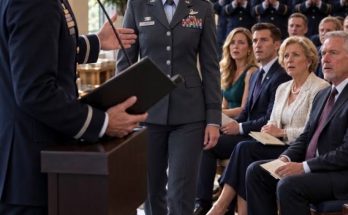
I stayed beside the side doors while the ceremony began.
The cold from outside still clung to the wool of my uniform.
The band played, properly this time.
Officers rose.
My father walked onto the stage to a wave of applause and smiled the way he always did in public.
Calm.
Gracious.
Certain.
He looked like a man who had never misplaced anything valuable in his life.
The base commander welcomed the room.
He spoke about duty, service, command, sacrifice, and institutional memory.
My father nodded at each phrase as if he had personally invented it.
Penn watched him with the reverence of a man studying his own future.
Liora held her program delicately in both hands.
My mother smiled at all the proper moments.
Then the commander glanced toward the side entrance.
His expression changed.
It was not surprise.
It was relief.
He stepped away from the podium and lifted one hand toward me.
At first, only the people near the aisle noticed.
Then a chair scraped.
Then another.
Heads turned.
A colonel in the third row stood so quickly his program fell to the floor.
Someone near the back began clapping before half the room understood why.
My father’s head snapped toward me.
I saw the moment recognition hit him.
Not recognition of his daughter.
Recognition of a problem.
His mouth moved before discipline could stop it.
“What the hell is she doing here?”
He muttered it, but not quietly enough.
The microphone did not catch it.
The front row did.
Penn heard it.
Liora heard it.
My mother’s fingers tightened on her program.
The commander reached the microphone again.
He opened a black protocol folder and smiled with the controlled patience of a man who had been waiting all morning to correct the room.
“Sable Rowan Vale,” he said.
My name moved through the speakers.
Not as a question.
Not as an inconvenience.
As a fact.
The applause spread fast.
First the officers at the back.
Then the rows along the aisle.
Then men and women who had spent their lives knowing the difference between rank and performance stood on their feet.
I walked forward because the commander had asked me to, and because the room had finally made space.
My family did not stand.
Penn remained seated, jaw locked.
My mother looked down at her program as if she might find instructions there.
Liora’s smile held for one second longer than it should have, then broke around the edges.
My father stood on the stage beside his medals, and for once, the lights did not flatter him.
The commander continued.
“Brigadier General Sable Rowan Vale.”
The room rose higher.
The applause became a wall.
My father blinked.
Penn’s face changed in small stages.
First disbelief.
Then calculation.
Then fear.
Because he knew enough to understand what the title meant.
He knew enough to understand what it made of every joke, every absence, every family story told at my expense.
Liora turned toward him as if waiting for an explanation that could still save the seating chart.
There was none.
The commander placed one hand on the folder.
“Our highest honor today,” he said, “belongs not to the loudest record in this room, but to the one that could not be publicly named until now.”
That was when my mother finally looked at me.
Not fully.
Not warmly.
But she looked.
I had imagined that moment more times than I wanted to admit.
In some versions, I was angry.
In some versions, I was triumphant.
In the real one, I mostly felt tired.
Recognition is strange when it arrives late.
It does not repair the years.
It only proves you were not imagining the wound.
The commander read from the citation.
He spoke carefully, leaving out what had to remain classified.
He named operations only by date range.
He referred to intelligence coordination, route preservation, risk mitigation, interagency briefings, and personnel saved through decisions made under extreme constraint.
To most civilians, it would have sounded polished and vague.
To the officers in that room, it was not vague at all.
They heard what could not be said.
They understood the spaces between the words.
At 0908, the commander turned a page.
At 0909, my father’s face lost the last of its ceremonial warmth.
At 0910, Penn leaned toward my mother and whispered, “Did you know?”
She did not answer.
The commander paused.
Then he looked directly at the front row.
“Before we proceed with Lieutenant General Vale’s retirement honors,” he said, “there is one correction to the official family record that must be made in this room.”
The auditorium shifted.
Not loudly.
A room full of disciplined people does not gasp the way a theater does.
It tightens.
Shoulders still.
Hands stop moving.
Programs stop rustling.
Even the coughs disappear.
The commander lifted a sealed page from the folder.
The header was from the protocol office.
The timestamp was 0819 that morning.
The same minute the gate had corrected itself.
My mother’s program slipped from her lap and landed near her shoes.
Penn looked at the page and went pale.
Liora’s eyes moved from Penn to me, and I saw her understand that she had laughed at the wrong woman.
My father took half a step forward.
The commander did not yield the microphone.
“The omission of Brigadier General Vale from the family guest list,” he said, “has been documented and corrected.”
Every word was clean.
Every word was public.
Every word landed exactly where my father’s pride had been standing.
Then the commander did something I did not expect.
He turned slightly toward me and lowered his voice, but the microphone still carried it.
“General Vale,” he said, “would you like your family seated for the remainder of this honor, or would you prefer they stand with the rest of the room?”
Nobody moved.
It would have been easy then to punish them.
It would have been easy to make Penn stand, make my mother look up, make Liora swallow that laugh in front of every officer she had hoped to impress.
It would have been easy to do what my father had done for years.
Use the room.
Use the title.
Use silence as a weapon.
I looked at my father.
His face had gone still in a way I knew too well.
He was waiting to see whether I had learned cruelty from him.
Maybe I had.
But I had also learned restraint from rooms where lives depended on it.
“Let them remain seated,” I said.
The commander nodded once.
My father’s eyes flickered.
Not relief.
Something worse.
Shame.
The ceremony continued, but it was no longer his ceremony alone.
When they placed the honor in my hands, the applause came again.
This time, it did not shock me.
I held the case against my palm and felt the weight of metal, velvet, and every year I had let them call absence failure.
<!–nextpage–>
**Part 3**
Afterward, during the reception, people approached me with careful respect.
Some knew my work only by rumor.
Some knew enough to say very little.
One retired colonel shook my hand with both of his and said, “We lost fewer people because of you.”
That sentence did more than any medal could have.
Across the room, my family stood near the coffee table like guests at the wrong event.
Penn kept adjusting his cuffs.
Liora had stopped smiling.
My mother held a paper cup she never drank from.
My father finally came toward me after twenty-three minutes.
I knew the exact time because I checked the wall clock when he started walking.
Old habits do not disappear just because the threat is familiar.
He stopped two feet away.
For a moment, he looked older than he had on stage.
“Sable,” he said.
Just my name.
No rank.
No apology.
No explanation.
But he said it where people could hear.
I waited.
His eyes moved to the honor case in my hand, then to the officers behind me, then back to my face.
“I wasn’t informed,” he said.
That was the closest he could come to admitting he had been wrong.
It was also a lie.
Maybe not about the promotion.
Maybe not about the ceremony.
But about the rest of it.
He had been informed every time he chose not to ask.
Every missed holiday had informed him.
Every clipped phone call had informed him.
Every moment I stood quietly while Penn took credit for being the dependable child had informed him.
I looked at him and said, “You didn’t need to be informed to leave me a seat.”
Penn heard it.
So did my mother.
So did Liora.
My father’s mouth tightened.
For years, my family had treated silence like proof that I had nothing to say.
They had never considered that silence might be discipline.
The commander saved him from answering by stepping beside us with another officer.
But the damage had already been done.
Not to me.
To the story they had kept about me.
Stories like that are fragile once witnesses enter the room.
After the ceremony, I walked outside alone.
The wind had softened.
The flags still snapped, but not as sharply.
Near the parking lot, the black SUV waited with its tinted windows and polished doors.
My own car sat farther down the row, ordinary and cold in the morning light.
I stood between them for a moment.
Not because I did not know where to go.
Because for the first time in years, I did.
My mother called my name from behind me.
I turned.
She had my dropped program in her hand.
Not hers.
Mine.
Someone from the protocol office must have set it aside after the correction.
Across the front, in clean print, it read: Brigadier General Sable Rowan Vale, Special Recognition.
My mother held it like it might burn her.
“I didn’t know,” she said.
I believed her less than I wanted to.
So I answered carefully.
“You knew I was your daughter.”
Her face folded, but no tears came.
Maybe they would later.
Maybe they would not.
Penn stood several steps behind her, looking smaller without an audience that belonged to him.
Liora would not meet my eyes.
My father remained near the auditorium doors, one hand on the frame, watching all of us as if command had become a language nobody was speaking anymore.
I took the program from my mother.
The paper was creased where her fingers had gripped it too tightly.
Then I walked to my car.
Nobody stopped me.
Nobody ordered me back.
Nobody asked me to explain.
That was the quietest victory of the day.
Not the applause.
Not the honor.
Not my father’s pride vanishing under the lights.
The victory was leaving without needing one more person in that family to decide whether I mattered.
They had spent years teaching me how to disappear.
That morning, an entire room taught them they had been looking away from the wrong woman.