**PART 3**
The restraining order was granted on a Thursday afternoon by Judge Patricia Ren, Circuit Court of Norfolk, who reviewed the documentation Marcus Stein submitted and issued a two-year protective order requiring Eduardo Flores to maintain a minimum distance of five hundred feet from my person, my residence, and my place of duty.
The false report filing resulted in a formal citation from Norfolk PD and a notation in their system. Marcus Stein submitted a copy of the citation to the circuit court as supporting evidence for the restraining order.
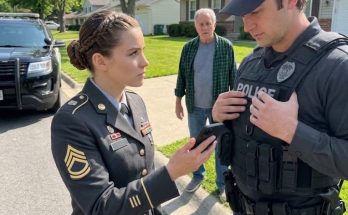
Officer McCann, who had filed a detailed incident report of his own following the encounter, including a summary of the banking evidence shown on camera and my father’s behavior when confronted with it, was listed as a supporting witness. Lieutenant Commander Okafor’s incident report from the gate-four security breach was also submitted. Nineteen pages.
The notation that my father had been asking about the movements and building assignment of a commissioned officer created, per Okafor’s assessment, a record that could be pursued under federal law if the behavior continued.
My father’s attorney, a man in Lexington named Garrett Wells, who handled family matters and had presumably not anticipated being involved in a security breach documentation, called Marcus Stein the week after the restraining order was issued and asked about a path to resolution.
Marcus called me. “He wants to apologize,” Marcus said.
I looked out the window, the front yard, back to normal. No lights, no neighbors at their doors.
“Tell his attorney the restraining order stands for its full term,” I said. “Tell him I wish him well. Tell him I’m not interested in a conversation right now.”
Marcus passed the message. Wells did not call back.
I found out three weeks later from my cousin Adriana, one of the two who had sent the gift card and the card that said we love you, that my brother Marco’s wedding had been called off. The venue deposit had apparently never been paid because the $8,400 my father had asked me for had not materialized from any source.
And Marco’s girlfriend had decided in the intervening weeks that she was not ready to get married to a man whose family was involved in a federal harassment matter involving a military officer.
Adriana told me this on the phone with the slightly guilty tone of someone who knows they’re delivering information the other person is going to have complicated feelings about.
I thanked her. I told her the gift card had been spent on champagne at the reception and that David and I had toasted her and her husband specifically.
She laughed. The laugh of someone who needed permission to find something funny and had just received it.
“Is there anything you need?” she asked.
“I’m good,” I said.
And I was. That was the honest answer. Not because everything was resolved. Some things don’t resolve. They just settle into a shape you can live around. Not because the grief was gone. The grief of having a father who is capable of love and incapable of being a father is a specific and durable kind of grief that doesn’t go away because you won a legal filing.
But I was good.
David and I spent the following Memorial Day weekend at home. Not traveling, not celebrating, not performing anything for anyone. We ordered takeout on Saturday night and ate it on the back porch and watched the sky do what the sky does in late May, which is turn colors you don’t have names for.
In the half hour before dark, I had my coffee. David had his. The Ring cameras blinked their quiet green at the corners of the yard.
Somewhere, my father was living his life, telling his version of events to the people at his church, at his dinner parties, at whatever gathering was next on his calendar. I didn’t know what his version was. I didn’t need to.
I had the banking app. I had the body camera footage. I had the restraining order. I had nineteen pages of federal security documentation.
And I had this: a quiet yard, a husband who asks what I find hardest, a sky going colors I can’t name.
My father used to say that the medals didn’t matter. That service didn’t make you anything. That what made a person was family.
He wasn’t entirely wrong about that last part. He just had the wrong idea about what family means.