**PART 1**
There were two officers on my front lawn when I pulled up. Red and blue lights strobing across the faces of neighbors standing in their doorways. My husband’s car in the driveway at an angle like he’d parked in a hurry.
And there, standing in the grass I mowed two Saturdays ago, gesturing with both hands at Officer McCann like a man explaining a great injustice, was my father, Eduardo Flores, sixty-one years old, former high school principal, the most respected man in his zip code.
According to Eduardo Flores, he saw me step out of the car. He smirked that smirk. I had been looking at that smirk my entire life, and I had finally, at thirty-eight years old, learned to read exactly what it meant.
I’ve got you now.
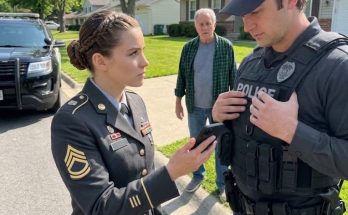
Officer McCann walked toward me with the careful posture of a man who had already heard one side of a story and wasn’t sure what to do with it.
“Ma’am, your father is claiming you wire-transferred funds from his account without authorization. We’re looking at a potential felony.”
Felony. My security clearance, fourteen years of service, commander rank, every classified briefing, every operation, everything I had built from nothing while my father told his friends his daughter was just playing soldier. All of it balanced on two syllables.
I took one breath. The kind we practice, actually, the kind designed to bring your heart rate down in situations where your heart rate going up will get you killed.
“Officer,” I said, “is your body camera on?”
“Yes, ma’am.”
Good.
I opened my banking app and held my phone directly in front of the lens.
“Show me the theft.”
I have been in the United States Navy for fourteen years. I am a commander, naval special warfare, one of a small number of women to have reached this position. A fact that newspapers occasionally find interesting and that I find neither interesting nor worth discussing. What I find worth discussing is the work, the training, the 4 a.m. water entries in January, the years of proving over and over again, in rooms full of people who were certain I couldn’t, that I could.
My father never came to a single promotion ceremony. Not because he wasn’t proud. He would tell you, if you asked, that he was very proud. That his daughter, the Navy commander, was a point of great pride for the family. He said this at church, at dinner parties, at his retirement celebration two years ago, where he made a speech about family values and strong children. He said it to rooms full of people.
He never said it to me.
I met David Reyes at a conference in San Diego seven years ago. He was a civilian contractor, aerospace, the kind of quiet, precise man who notices things other people miss and says very little about it until the moment when what he’s noticed becomes important. He had dark eyes and a handshake that lasted exactly the right amount of time. And he asked me three minutes into our conversation what I found hardest about my job. Not what I did. What I found hard.
Nobody asks that.
I told him the truth, which surprised both of us.
We were engaged eleven months later. I called my father the evening after David proposed. I sat on the back porch of our rental in Virginia Beach, watching the sky go orange over the water. And I told him we had set a date and that we wanted the whole family there and that nothing would mean more to me than having him walk me down the aisle.
He said he’d have to check his calendar.
I should have understood everything right then. I didn’t. I understood it later. The way you understand things that were obvious all along, all at once, from a distance, with the specific ache of someone who let hope do too much of their thinking.
My family is five people. My father, Eduardo. My mother, Rosario, who does whatever Eduardo decides and always has, which is not cruelty on her part so much as a forty-year habit she has never had reason to examine.
My brother Marco, the youngest, the son, the one who got the college fund and the new car at sixteen, and the constant stream of financial support that flowed from my father’s account to Marco’s lifestyle like a river finding its natural course downhill.
Marco and I had been close when we were young. He had a good heart underneath the entitlement. The entitlement wasn’t his fault, or not entirely. It had been built into him by parents who believed that boys needed different things than girls, that boys were the future of the family, that a girl who joined the military was admirable, but a boy who followed his own path was a visionary.
Marco’s path had involved three failed businesses, a divorce, and a series of financial emergencies that my father funded and that my father sometimes called me about when the emergencies exceeded his capacity. I had contributed over the years to the stability of Marco’s life without ever being asked whether I wanted to. The contributions were phrased as family obligation. Repayment was never discussed, because repayment was not the point.
The point was that I was the reliable one. The one who had made something of herself. The one who could be counted on.
This is a role that sounds like a compliment. It isn’t.
The invitations went out in January. The wedding was May 14th, a Saturday late-afternoon ceremony, dinner reception at a venue in Norfolk that David’s mother had helped us find, and that made David’s mother cry the first time she walked through it, which told me it was the right place.
We reserved three pews for family, mine and his. White ribbons, printed placards, reserved family of the bride.
By March, I had received RSVPs from David’s entire family and two cousins on my mother’s side whom I hadn’t seen in six years but who sent a gift card and a card that said, “We’re so sorry we can’t make it, but we love you.”
From my immediate family, nothing.
I called my mother in April. She said they were planning to come. She said my father had been having some trouble with his knee and the drive was long. She said Marco and his girlfriend were going through something.
I said, “I understand. Please just let me know.”
She said, “Of course, mija.”
The morning of May 14th, I put on my dress blues and stood in front of the mirror in the bridal suite at the venue and called my father.
He didn’t answer.
I called my mother. She answered on the fourth ring. Voice slightly too careful, slightly too warm. The warmth of a woman managing a conversation she doesn’t want to be having.
“We’re so sorry, Elena. Your father’s knee.”
“Mom.”
My voice was even. The training is useful for this, too.
“Are you coming?”
Silence. The specific silence that contains an answer the person isn’t willing to say out loud.
“We love you,” she said.
I said, “Thank you.”
I hung up.
I looked at myself in the mirror for thirty seconds. Full dress uniform, every decoration in its correct position, hair pinned the way I’d practiced six times the night before. A woman who had earned everything she wore and was about to walk down an aisle alone.
I picked up my bouquet. I walked out of the bridal suite. I walked down that aisle with 142 people watching and three empty pews on my left.
I made it through the ceremony. I made it through the dinner. I danced with David, with his father, with his three sisters, with his mother, who held my face in her hands at the end of the night and said, “You are ours now. Do you understand? You are completely ours.”
I made it to the hotel bathroom at midnight before I slid down the wall and sobbed until I couldn’t breathe.
The text came at 8:14 the next morning. I was still in the hotel. David was asleep. I had been awake for an hour watching the ceiling, running the previous day through my mind the way you debrief an operation, cataloging every decision, checking for what could have been done differently.
My phone was in my hand. I had it in my hand because I kept checking it, because some part of me, the seven-year-old part, the part that still believed my father was the man he told other people he was, kept expecting an apology.
The notification showed his name. My chest did something involuntary. The specific physical sensation of hope arriving without permission.
I opened the message.
“Elena, we need $8,400 for your brother’s venue deposit. They’ve been struggling and the deadline is Tuesday. You’ve always been the responsible one. Let me know.”
No congratulations. No acknowledgement. No sorry. No explanation. Just a bill. The morning after my wedding, for his favorite son’s party.
David stirred beside me. Read it over my shoulder. I felt his jaw tighten. Not dramatically, not with heat. The quiet tension of a man who has reached the end of a very long rope.
“Delete it,” he said. “Don’t engage.”
I took the phone, opened my banking app, pulled up the transfer function, entered my father’s account number, the one I had memorized from years of sending money I didn’t track and didn’t demand back.
Entered the amount. One. Promemo: best of luck.
Sent. Blocked his number. Put the phone down. Picked up my coffee.
It was the first thing I had tasted properly in two days.