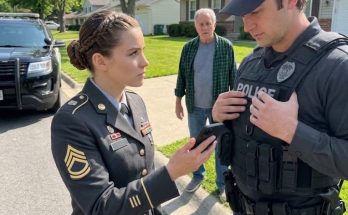
**PART 2**
Peace lasted exactly one week. I unblocked him. Old reflex, older than I want to admit. Military training overrides a lot of instincts. It has never fully overridden the instinct that says, what if there’s an emergency, what if something is wrong?
The messages came in a wall. Forty-one of them, stacked up from the week of silence like water behind a dam. The first five were pleading. The middle twenty were accusatory. The last sixteen were something else.
“Petty little girl. After everything I gave you, you are an embarrassment to this family. You think those medals make you something? You are nothing without us. You have always been nothing.”
I read them the way I read intelligence assessments, without flinching, cataloging. Then I closed the app and called my executive officer, Commander Patricia Hughes, fourteen years in naval intelligence, the person in my chain of command I most trusted to give me an assessment that had no personal investment in the outcome.
I told her about the messages. I did not tell her about the wedding. I told her I had a family member making escalating contact and I wanted her to know in case it became relevant.
She thanked me for telling her. She said, “Keep documenting. Let me know if anything changes.”
It changed three days later.
The call came at 9:47 a.m. on a Wednesday.
“Commander Hughes.”
Her voice was in a register I recognized, the one she used when something had happened and she was managing the information before delivering it.
“Ma’am, your father was outside gate four this morning. He was speaking with personnel there. He was asking about your schedule, your building assignment, your daily arrival times.”
A Navy commander’s location is not public information. There are people whose job it is to ensure that it stays that way. What my father had done was not a family dispute. It was a security threat.
I reported it formally that afternoon. Lieutenant Commander James Okafor, base security, Naval Station Norfolk, fifteen years in military law enforcement. He listened to the account, reviewed the messages I had documented, and opened a formal incident report. He was methodical and direct and completely without sentiment, which was exactly what I needed.
“Commander Flores,” he said, using my rank in the precise way that means the rank is the point. “This is being documented as a potential threat to the security of a service member. I want you to understand that means this is no longer a personal matter.”
“I understand.”
“Do you have a current residence address that would be accessible to this individual?”
David and I had a house in Norfolk. It was not secret. My father had been there once, four years ago. A visit that had lasted forty minutes and consisted mostly of Eduardo walking through each room making assessments out loud.
“Yes,” I said. “He’s been there.”
“Change your locks if you haven’t already. I’m recommending you consider a security camera system if you don’t have one. And I want daily contact with me until this situation is resolved.”
That evening, David installed a Ring system front and back and on the side gate while I sat at the kitchen table and read the letter that had arrived that afternoon. Delivered to the base, handwritten, addressed to my rank and name, which meant he had researched that. Left-slanting cursive, the handwriting he had when he was angry.
“You will die alone with those medals.”
I did not burn it. I put it in a Ziploc bag and put it under my service pistol in the top drawer and called Commander Hughes. Then I called a lawyer.
Marcus Stein had been practicing family and harassment law in Virginia for nineteen years. He had handled eleven cases involving military service members and family harassment and had, according to his firm’s website, a particular specialty in cases where civilian harassment intersected with military security concerns. He answered my call himself, which told me he took referrals from JAG offices seriously.
I told him everything chronologically, with dates and amounts and the documentation I had been keeping since the first wave of messages arrived. He listened without interrupting, which is a discipline that most people don’t have and that lawyers develop over years of understanding that the client who talks uninterrupted will tell you things the client who is constantly asked questions never will.
When I finished, he was quiet for a moment.
“Commander, you have several things working simultaneously. You have documented financial harassment — the text requesting money the morning after your wedding. You have documented threatening communication — the letter. You have documented security breach activity — the visit to gate four. These are not the same legal matter, but they’re connected, and connecting them is what makes a restraining order viable.”
“I want the restraining order.”
“I’ll have a draft to you by Thursday. I also want to flag something. The security breach at the base may trigger JAG involvement. That’s not a bad thing. It means the military legal apparatus is on your side, but it’s another party at the table.”
“I know how to manage parties at a table.”
He paused. I think he was deciding whether that was a joke. It wasn’t.
“I’ll have the draft Thursday,” he said.
The Tuesday it happened, I was in a high-level briefing. Lights down, monitors glowing, the kind of room where phones are supposed to be off. Mine was on silent, face down on the table beside my notes. There are situations where I need to be reachable regardless of what room I’m in.
It started buzzing at 2:31 p.m. and did not stop. I picked it up under the table.
NORFOLK PD. NORFOLK PD. DAVID. NORFOLK PD.
David’s text. “He called the cops. They’re at the house. Come home now.”
I excused myself. The room was too important for excuses, and I made one anyway, because David had never sent a message in all capital letters in seven years, and that was more important than the room.
I drove the fourteen minutes from base to home in nine.
I have described what I found when I pulled up. The lights, the neighbors, my father in my grass, performing for Officer McCann. What I haven’t described is what it felt like to step out of that car and feel forty-two years of family mythology collapse into a single image. A man who had never once showed up for me, standing in my yard, trying to use the system I had served for fourteen years to destroy me.
McCann had walked toward me with the word felony in his mouth, and I had taken one breath, and I had asked about the body camera.
I held my phone directly in front of the lens. The banking app was open. Transaction history visible. I scrolled to the relevant date. May fifteenth, morning after my wedding. Recipient, Eduardo A. Flores. Account ending in the last four digits I had memorized from years of sending money. Amount: one dollar. Memo: best of luck.
McCann looked at the screen. He was a careful man, mid-forties, the look of someone who had been doing this long enough to recognize when he’s been handed a story that doesn’t hold together. He looked at the date. He looked at the amount. He looked at the recipient, which was the account my father had given him as the source of the alleged unauthorized transfer. He looked at my father.
My father’s face had gone the color of old concrete.
“This isn’t theft,” I said. “This is a dollar I sent to my own father’s account, with his account number, from my account, with my authorization. That is the definition of the opposite of theft.” I paused. “What this is, is harassment, and I’m filing a report.”
Officer McCann’s voice when he turned to my father had a different quality than the voice he’d used with me. Colder. The specific cold of a law enforcement professional who has just realized he has been used.
“Mr. Flores, you filed a false report and wasted department resources. This is a civil matter, and the report you filed is not supported by the evidence you provided.”
My father’s mask cracked in stages. First the confidence, then the composure, then something underneath both of them. Something raw and unidentified that I had never seen on his face before. And I had been looking at his face for forty-two years.
“She’s lying.” He stepped forward. “After everything I paid for, everything I gave her, she sends me a dollar. Like I’m nothing. Like I’m—”
“Dad.”
Command voice. The one we develop over years of training. The one that cuts through helicopter noise at three hundred feet.
“Stop.”
He stopped. Not because he wanted to. Because the voice was the voice. And the voice is not something you can ignore when it comes from the right place.
“Get off my property.”
The officers moved. One on each side of my father. Not grabbing, just present, which is often enough. My father allowed himself to be walked to his car.
At the curb, he turned back, one hand on the door, and looked at me with the particular expression of a man who has lost a battle he was certain he would win and hasn’t yet figured out how to make it someone else’s fault.
“You think those medals make you better than me?”
I stood on my porch. The neighbors were still in their doorways. The lights were still strobing.
“No, Dad. They just mean I earned this.”
He got in the car. As he pulled away, I saw him pick up his phone.
I went inside, sat down at the kitchen table. David made coffee. Neither of us spoke for a few minutes, which is one of the things I love about David. He understands the value of silence that isn’t empty.
Then I called Marcus Stein and told him to file the restraining order immediately. Then I called Lieutenant Commander Okafor and told him what had happened. Then I picked up my phone and called my mother.
She answered on the second ring. I had not spoken to her since the morning of my wedding, when she told me they loved me instead of telling me they were coming.
“Elena.”
Her voice was careful, managing, already aware that something had happened.
“Mom,” I said, “Dad just filed a false police report at my house claiming I committed felony theft. He drove three hours to do it. Before that, he came to my military base and asked personnel about my schedule and my location.”
Silence.
“He sent me a threatening letter. I have it in an evidence bag.” I paused. “I am filing for a restraining order tomorrow. I want you to know before it happens.”
My mother’s voice when it came was very quiet. “Elena, he loves you. He just—”
“Mom.”
I stopped her. Not harshly, carefully. The way you stop someone who is about to step off a curb without looking.
“I know he loves me in the way that he loves me. I’m not disputing that. I’m telling you what he has done, which is separate from love. They can both be true.”
Another silence, longer.
“He was so hurt,” she said. “About the dollar.”
I thought about what I could say in response to that. All the possible responses. I thought about the three empty pews with white ribbons. The hotel bathroom at midnight. The text at 8:14 a.m. the morning after the most important day of my life, asking me for $8,400 for my brother’s party.
“Goodbye, Mom,” I said. “I love you.”
I hung up.