**PART 1**
Chapter 1: THE CALL BEFORE DAWN
I had never revealed to my self-important son-in-law that I was a former federal prosecutor, now retired. At 5:00 AM on Thanksgiving morning, he phoned and commanded, “Come get your daughter from the bus terminal.” When I arrived, I discovered her trembling on a bench in the bitter cold, weak, shivering, and hardly able to speak. “Mom,” she whispered, “they injured me… so his mistress could have my seat at the table.” As they laughed with their guests and carved the Thanksgiving turkey, I opened an old lockbox, took out my badge, and made the phone call that would stop their whole Thanksgiving dinner.
The digital clock next to my bed showed 5:02 AM.
Thanksgiving Day.
My kitchen still smelled of pumpkin pie, freshly made black coffee, and cinnamon I’d inadvertently spilled beside the stove. Ice rattled against the windows, and the little American flag hanging from my porch whipped in the wind.
Then my phone began to ring.
Marcus.
My son-in-law only ever called when he needed something moved, signed, concealed, or excused. He was thirty-two, recently promoted, and had started treating every conversation as though he were running a meeting.
His mother, Sylvia, was worse still. She had a talent for turning compliments into demands and making silence feel like a judgment.
In their eyes, I was merely Eleanor—a quiet widow who drove a ten-year-old SUV, carried grocery coupons in her purse, and slipped cash into birthday cards.
Neither had ever thought to ask what I’d done before retirement.
I picked up.
“Come collect your garbage,” Marcus said.
My hand tightened around the counter. “Where’s Chloe?”
“Downtown bus terminal. Your daughter picked last night to have one of her hysterical breakdowns. My CEO is coming for Thanksgiving dinner, and I’m not keeping trash in my house.”
Chloe was twenty-eight, worked as an engineer, and was one of the most composed people I’d ever known. She created spreadsheets to organize camping trips and marked moving boxes according to their rooms and weight. I’d once watched her replace a tire in freezing rain, scraping her knuckles without raising her voice.
Chloe wasn’t someone who had hysterical breakdowns.
I could hear Sylvia laughing behind him.
“Tell her to take that pathetic girl back where she belongs. And make sure she knows I want five thousand dollars for my Persian rug. That brat ruined it.”
“Pick her up, Eleanor,” Marcus ordered. “The caterers arrive in four hours. Don’t bring her back here.”
The call ended.
For the past three years, I’d let things pass that I should have confronted long ago. A part of me wanted to call him back and explain that the harmless elderly woman he looked down on had spent years facing men in federal courtrooms who employed expensive attorneys and had influential friends.
Yet I did not call back.
There would be a time for anger.
For now, I needed to establish the facts.
I put on my coat, picked up my keys, and headed for the hall closet. From the shelf, I retrieved a small lockbox that had remained unopened for years.
At 5:19 AM, I pulled my SUV out of the driveway.
I arrived at the bus terminal at 5:43.
Inside, fluorescent fixtures buzzed above fractured floor tiles. Every time the automatic doors slid open, a brief gust of warm air escaped into the frigid morning. Behind a scratched glass window, a security guard sat near a paper coffee cup and the holiday bus schedule.
Chloe was outside at Bay 6.
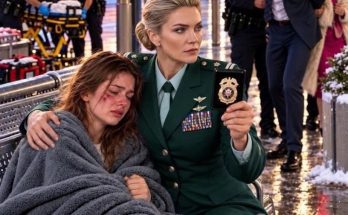
She sat huddled on a metal bench under a broken streetlamp, wearing no coat and missing one shoe. Her fingertips had turned blue from the cold. She shook so uncontrollably that she couldn’t even manage to say my name at first.
“Mom.”
I dropped to my knees beside her.
“Sweetheart, look at me. Stay with me.”
Her one open eye moved toward my face, trying to focus. She reached for my coat and clutched it with the little strength she could summon.
“They hurt me,” she whispered. “Marcus… and Sylvia…”
“Tell me what happened.”
“They trapped me. He’s seeing another woman. Sylvia told me I had to go so his mistress could take my seat at the table. She said I was making him look bad.”
The terminal doors slid open behind us, letting out another brief wave of warmth that did nothing against the cold.
“Who left you here?”
“Marcus. Sylvia cleaned it all up. They said nobody would believe me.”
Chloe had difficulty swallowing.
“They said you were just… an old woman.”
Then her eyes rolled backward.
Her body slackened in my arms.
At 5:47 AM, I called 911.
“I need Advanced Life Support at the downtown bus terminal, Bay 6,” I said. “Adult woman, unconscious following extended exposure to freezing temperatures. Possible serious injuries. Send officers too. I also need to report a domestic incident.”
The dispatcher wanted to know whether I was somewhere safe.
“That is not the immediate issue,” I answered.
Behind the glass, the security guard got up from his chair. Nearby, a bus driver stopped with his coffee cup halfway to his lips.
I unlocked the small box.
Inside was the badge Marcus had never known I possessed.
I lifted it out.
“My name is Eleanor,” I told the dispatcher. “I’m a former federal prosecutor, now retired.”
The dispatcher’s tone shifted immediately.
Then I gave her the instruction Marcus never would have expected from the woman he thought was nothing more than harmless and old…
“Please have the responding officers request preservation of every security recording covering Bay 6 between midnight and now. And tell them the victim’s mother has information about the people who left her here.”
The dispatcher paused.
“Ma’am, are you currently employed by the Department of Justice?”
“Retired,” I said. “I have no power to direct an investigation. But I understand how quickly evidence disappears, and I want the responding officers to understand what they’re walking into.”
“Understood.”
“And please tell the paramedics to hurry. My daughter isn’t responding.”
I placed my old badge back into its case.
For a moment, I gazed at the faded gold lettering.
Assistant United States Attorney.
Twenty-seven years of my life had passed under that title.
I had prosecuted organized crime, financial fraud, public corruption, and violent offenders who believed their bank accounts could purchase immunity from consequences. I had listened to witnesses who were terrified to testify against powerful men. I had watched victims struggle to explain what had happened to them while defense attorneys questioned every detail of their lives.
But nothing in those courtrooms had prepared me for the sight of my daughter unconscious on a frozen bus terminal bench.
I had devoted years protecting strangers.
And in some way, I had failed to recognize how badly my own child needed protection.
“Chloe,” I whispered, rubbing her icy hands between mine. “You stay with me, sweetheart. Do you hear me?”
Her eyelids flickered.
I took off my coat and draped it around her.
The security guard stepped outside with a blanket.
“I heard you call for help,” he said, kneeling beside us. “Ambulance is coming?”
“Yes.”
He looked at Chloe’s swollen face, then toward the street.
“I saw a black SUV drop her off earlier.”
I looked up sharply.
“What time?”
“Little after four-thirty. Man was driving. Older woman in the passenger seat.”
“Did you see either of their faces?”
“Not clearly. But the driver got out. Opened the back door and pulled her onto the sidewalk.”
My stomach clenched.
“Was she walking?”
“Barely. She fell once. He picked her up by the arm and put her on that bench.”
The guard’s face grew stern.
“I thought maybe she was drunk. Then the SUV left. I went out to check on her, but she told me her mother was coming.”
“Did you speak to anyone about it?”
“My supervisor. He told me to keep an eye on her until somebody arrived.”
I went for the business card I still carried in my wallet.
“What’s your name?”
“Anthony Reed.”
“Anthony, I’m going to ask you to tell the police exactly what you just told me. Leave nothing out, even if it seems unimportant.”
He nodded in agreement.
I then asked the question that mattered most.
“Does this terminal have cameras facing the passenger bays?”
“Yes, ma’am. Four of them.”
“Please tell your supervisor to preserve the recordings. The officers will need them.”
He turned and rushed back indoors.
At 5:56 AM, the ambulance arrived.
Two paramedics hurried toward us with a stretcher and medical equipment. One checked Chloe’s pulse while the other examined her injuries.
“Twenty-eight-year-old female,” I told them. “Found outdoors in freezing temperatures. Loss of consciousness. Possible assault. I don’t know how long she was exposed.”
The younger paramedic lifted Chloe’s eyelid.
“Ma’am, can you hear me?”
No response.
He looked at his partner.
“Let’s get her inside.”
They worked fast.
I stepped back as they lifted my daughter onto the stretcher.
For the very first time since Marcus called, my hands started trembling.
Not because I was afraid of him.
I was frightened because Chloe might never open her eyes again.
A police cruiser pulled up as the ambulance doors closed.
A pair of officers approached.
The older one introduced himself as Sergeant Daniel Brooks.
I gave him a brief, precise account of Marcus’s phone call, Chloe’s statements, and the security guard’s observations.
When he wanted to know whether Chloe had identified her attackers, I repeated her exact words.
I added nothing.
I knew too well than to improve a witness’s statement.
“Do you believe her husband assaulted her?” Brooks asked.
“I believe my daughter reported that her husband and mother-in-law hurt her. I want the evidence to establish what happened.”
He examined me for a second.
“You said you were a prosecutor?”
“Federal. Retired six years ago.”
Brooks nodded.
“Then you know how this works.”
“I do.”
He glanced toward the ambulance.
“And you also know you’re her mother.”
I peered through the rear window at Chloe lying motionless beneath a thermal blanket.
“Yes, Sergeant. That’s the part I’m having trouble with.”
His expression softened.
“We’ll take it from here. You go with your daughter.”
At 6:04 AM, I climbed into the ambulance.
At 6:19, we were inside the emergency department at St. Catherine’s Medical Center.
The television in the waiting room was showing a cheerful Thanksgiving cooking segment.
A woman in a bright red sweater was demonstrating how to carve a turkey.
I stared at her smiling face for several seconds before realizing how absurdly normal the world still seemed.
A nurse escorted me to a private consultation room.
Dr. Rebecca Collins arrived twenty minutes later.
She appeared to be in her early forties, with dark hair pulled into a tight bun and the exhausted expression of someone nearing the end of a long shift.
“Your daughter is conscious,” she said.
My legs almost buckled.
“Thank God.”
“But she has significant injuries.”
I held tightly to the back of a chair.
“Tell me.”
“She’s hypothermic and dehydrated. She has facial bruising, a likely concussion, bruising around both wrists, and injuries to her ribs. We’re still waiting on imaging to rule out fractures and internal damage.”
I swallowed hard.
“Is she going to survive?”
“Her vital signs are improving. We’re monitoring her closely, but I’m cautiously optimistic.”
I shut my eyes.
For the very first time that morning, I allowed myself one full breath.
Dr. Collins continued.
“Some of her injuries suggest she may have been physically restrained. We’re documenting everything, but determining exactly how they occurred will require further investigation.”
“I understand.”
“She has asked for you.”
I went with her down the corridor.
Chloe was lying beneath several blankets, an IV line taped to her arm. Her face looked painfully small against the white pillow.
One side of her cheek was swollen. Purple bruises marked her jaw. There was a shallow cut near her eyebrow.
When she saw me, her eyes filled with tears.
“Mom.”
I hurried across the room and took her uninjured hand.
“I’m here.”
“I’m sorry.”
Those two words almost broke me.
“For what?”
She looked away.
“For ruining Thanksgiving.”
I settled beside her.
“Chloe, look at me.”
She did, slowly.
“You could never ruin Thanksgiving by needing your mother.”
Her mouth trembled.
“I didn’t want you to know.”
“Know what?”
She stared down at the blanket.
“How bad it got.”
I waited without speaking.
For twenty-seven years, I’d learned that frightened witnesses sometimes needed silence more than questions.
My daughter was no different.
At last, she began to speak.
“It started after Marcus got promoted.”
I swept a stray strand of hair away from her forehead.
“He started coming home late. He said there were client dinners and meetings. I believed him because I wanted to.”
Her eyes welled up once more.
“Then I found messages.”
“From another woman?”
She nodded faintly.
“Her name is Vanessa Cole. She works in corporate development at his company. They’ve been together almost a year.”
A cold anger settled inside me.
“What happened when you confronted him?”
“He said I was paranoid. Sylvia told me successful men need understanding wives. She said I should be grateful Marcus still came home.”
Chloe paused to catch her breath.
“Yesterday, Vanessa came to the house.”
I furrowed my brow.
“Your house?”
“She walked right into the kitchen. Sylvia hugged her like she was family.”
Chloe pressed her lips together.
“Marcus told me Vanessa would be joining us for Thanksgiving. I said I wouldn’t sit through dinner pretending she was just a coworker.”
“What did he say?”
“He told me I could either behave like a wife or leave.”
I felt my hand tighten around hers.
“And you refused.”
“Yes.”
Her breathing grew uneven.
“I told him I wanted a divorce.”
She closed her eyes.
“That’s when he hit me.”
I remained still.
It took everything I had.
“He slapped me so hard I fell against the kitchen counter. I tried to get my phone, but Sylvia grabbed it.”
“Did she hurt you?”
Chloe nodded.
“She twisted my arm behind my back. Marcus kept telling me to apologize.”
“Did you?”
“At first, no. Then he pushed me into the dining room, and I fell against the table.”
She started to cry.
“I finally apologized because I wanted them to stop.”
I leaned forward and held her carefully.
“You did what you had to do to survive.”
She clung to me.
For several minutes, we said nothing.
Then she whispered something that changed the entire shape of the case.
“Mom, they made me sign papers.”
I drew back.
“What papers?”
“I don’t know. Marcus said they were related to refinancing the house. He’d been trying to get me to sign for weeks, but I wanted our attorney to review them first.”
“When did this happen?”
“Last night. After he hurt me.”
My thoughts instinctively moved through possibilities.
“What did he threaten?”
“He said if I didn’t sign, he’d leave me outside and tell everyone I attacked him.”
“Did you read the documents?”
“I tried. Sylvia kept turning the pages and pointing at the signature lines.”
“How many?”
“Six. Maybe seven.”
“Did anyone witness the signatures?”
“Vanessa came in near the end. She had her phone out.”
My eyes narrowed.
“Was she recording?”
“I think so.”
“Do you remember where the papers went?”
“Marcus put them in his office.”
I drew a breath.
“And what happened afterward?”
“They locked me in the guest room. I could hear them laughing downstairs.”
She shuddered.
“Before sunrise, Marcus woke me up. He said he’d take me somewhere safe.”
Her voice broke.
“He drove me to the terminal instead.”
I went for a tissue and gently wiped her tears.
“Did he give you your phone?”
“No.”
“Your wallet?”
“No.”
“Your coat?”
She shook her head.
“Just one shoe. I kept asking for the other one. Sylvia told him to stop wasting time.”
I looked at the bruises around her wrists.
My daughter had been abandoned in freezing weather after being assaulted, with no reliable means of getting herself to safety.
And Marcus had gone home to prepare for Thanksgiving dinner.