**PART 1**
“After my husband passed away,
I kept the $28 million inheritance
and the penthouse in New York City hidden.
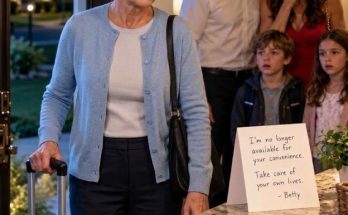
That same week, my daughter-in-law shouted,
“Now that he’s gone, just cry,
pack your things,
and go live on the streets.”
I simply answered, “Okay.”
Three months later,
a notice was delivered to their house.
Five days after we buried my husband,
the house still smelled of sympathy flowers
and warmed-over casseroles.
The March cold in White Plains
clung to the windows,
and every room on Maple Avenue
felt too quiet in the way
a home does when the person
who filled it is suddenly gone.
I had spent forty years in that house.
I had polished those floors,
sewn those curtains,
and stood at that same kitchen counter
at 4:30 every morning
while the coffee brewed before my shift
at Saint Vincent’s Hospital.
By the time we returned from the cemetery,
my daughter-in-law was already moving
through the living room
like she had been waiting for that moment.
She did not lower her voice.
She did not even pretend to be kind
for one more day.
She looked at me,
still wearing the black dress from the funeral,
and said,
“Now that he’s gone,
cry it out, pack your things,
and go live on the streets.”
My son stood behind her
and said nothing.
That was the part I remembered most.
Not the cruelty in her voice.
Not the yellow sticky notes
she had already begun placing on furniture
that had belonged to me for decades.
Not even the way our wedding photo
had been removed from the mantel
and leaned against the wall
like it no longer belonged in the room.
It was my son’s silence.
I thought about all the years
that had led to that moment.
The double shifts.
The holidays missed at the hospital.
The money quietly stretched and saved
and handed over whenever he fell short.
The small humiliations I had explained away
because he was my only child
and I kept telling myself
that family has seasons,
that grief makes people strange,
that decency eventually returns
if you give it enough time.
So I said the one word
neither of them expected.
“Okay.”
No tears.
No scene.
No begging to stay in the house
I had helped build.
I simply slipped my hand
into the pocket of my coat
and wrapped my fingers around
the small brass key
my husband had pressed into my palm
three weeks before he died.
“Keep this safe,”
he had whispered in the hospital.
“And don’t tell anyone.”
At the time,
I thought it was the medication talking.
By that afternoon,
standing in my bedroom
with a stack of legal papers
laid neatly across my bedspread,
I understood he had been trying
to tell me something
I had failed to hear in time.
The papers were ready for my signature.
A voluntary transfer.
The house, the property,
everything pushed neatly toward my son
while I was still wearing mourning black.
So I packed one small suitcase.
Two sweaters.
My nursing shoes.
My Bible.
My mother’s quilt.
The framed photo from my wedding day.
In the kitchen,
I left the signed papers on the table,
picked up my old purse,
and checked for three things:
my wallet,
my flip phone,
and that brass key.
That night,
I sat alone in a cheap motel
off Route 119,
staring at a lamp with a cracked shade
and a vending machine dinner
I could not make myself touch.
Somewhere between the sound of traffic outside
and the hum of the ice machine
down the hall,
I remembered the business card
my husband had slipped into my purse
months earlier.
An estate lawyer.
A Manhattan address.
47th Street.
I called.
The man answered
as though he had been waiting for me.
The next morning,
before sunrise,
I took the bus into Manhattan
carrying everything I still owned
in one suitcase and one purse.
At 9:07 the next morning,
inside a quiet bank on 47th Street,
a woman in a gray suit
took the brass key from my hand,
looked at the number stamped into it,
and stopped calling me ma’am.
She picked up the phone,
said four words in a lower voice,
and everything about the room changed.
“Mrs. Brooks is here.”
I heard her clearly.
Then she put down the receiver
and looked at me differently.
Not with pity.
Not with the embarrassed politeness
people reserve for elderly women
carrying worn suitcases into expensive buildings.
With recognition.
“My name is Priya Patel,” she said.
“Please come with me.”
I followed her through a glass doorway
into a private conference room.
There was a polished walnut table,
six leather chairs,
and a silver pitcher of water.
She pulled out a chair.
“Would you like some tea?”
“No, thank you.”
I kept my suitcase beside my feet.
She glanced at it.
Then she looked away.
“Mr. Whitaker will be joining us.”
“Who is he?”
“Your husband’s estate attorney.”
I felt my stomach tighten.
“My husband is dead.”
Her expression softened.
“I know, Mrs. Brooks.”
For several seconds,
neither of us spoke.
Then she placed a folder before me.
My husband’s name appeared
on the first page.
Edward James Brooks.
The letters blurred.
I had spent forty-three years
being married to that man.
I knew the sound of his footsteps.
I knew how he folded his newspaper.
I knew he hated cold coffee
and always pretended
he had forgotten our anniversary
before producing some little surprise.
But I had never seen
this folder before.
A man entered the room.
He was perhaps sixty,
with silver hair,
wire-rimmed glasses,
and a dark blue suit.
“Eleanor,” he said gently.
“I’m Samuel Whitaker.”
He extended his hand.
I shook it.
“Your husband spoke about you often.”
I stared at him.
“Then you knew him better than I did.”
He hesitated.
I had not meant to sound bitter.
But the bitterness was there.
He sat across from me.
“Edward asked me to explain everything.”
“Then explain.”
Mr. Whitaker opened the folder.
“First, I need you to understand something.”
He leaned forward.
“You are not homeless.”
I looked down at my shoes.
The soles were wearing thin.
My nursing shoes
had carried me through thousands of hospital corridors.
Now they rested
beneath a table worth more
than the furniture in my motel room.
“I slept beside a vending machine,” I whispered.
“I understand.”
“No,” I answered.
“I don’t believe you do.”
He accepted that without argument.
Then he turned a page.
“Your husband established a trust.”
He showed me the document.
“You are its sole current beneficiary.”
I blinked.
“What kind of trust?”
“One containing considerable assets.”
“How considerable?”
He turned the folder toward me.
I saw several columns of numbers.
Investment accounts.
Government securities.
Business holdings.
Cash reserves.
I studied the final figure.
Then I studied it again.
Twenty-eight million dollars.
At first,
I thought there was a printing mistake.
I reached for my glasses.
My hands were trembling.
“That cannot be right.”
“It is correct.”
“Twenty-eight thousand?”
“Twenty-eight million.”
My mouth went dry.
I looked toward Mrs. Patel.
She nodded.
I turned back to the lawyer.
“Edward worked in medical supply distribution.”
“Yes.”
“He drove a twelve-year-old Buick.”
“I know.”
“He repaired our washing machine with wire.”
Mr. Whitaker smiled sadly.
“That sounds like him.”
I pushed the folder away.
“Then somebody has made a terrible mistake.”
Nobody answered immediately.
Finally, Mr. Whitaker said,
“Your husband owned part of that business.”
“He told me that.”
“A substantial part.”
He explained slowly.
Edward had helped build
a small regional medical distribution company
almost thirty years earlier.
His original partner handled sales.
Edward managed warehouses,
contracts,
and supplier relationships.
For years,
they reinvested nearly everything.
The business expanded.
Then expanded again.
When a national company acquired it,
Edward received a significant payment.
He continued receiving distributions
from investments made afterward.
The money had grown quietly.
Carefully.
Patiently.
Just like the man himself.
I remembered evenings
when Edward sat at our kitchen table
with invoices spread around him.
I remembered asking
whether the business was doing well.
He always gave the same answer.
“Well enough to keep us comfortable.”
I covered my mouth.
He had not lied completely.
But he had hidden an entire life
behind those ordinary words.
“Why didn’t he tell me?”
Mr. Whitaker looked uncomfortable.
“He planned to.”
“When?”
He glanced at the papers.
“Before his illness became serious.”
My eyes filled.
“He had two years.”
“I know.”
“He watched me worry about grocery prices.”
The lawyer lowered his eyes.
“He watched me cut coupons.”
My voice broke.
“He watched me take extra hospital shifts.”
Mr. Whitaker spoke quietly.
“Edward knew you were angry about that.”
“How could he know?”
“Because he was angry with himself.”
He opened another envelope.
But he did not hand it over.
“Before you read this,
there is something else.”
I laughed bitterly.
“Of course there is.”
He looked directly at me.
“The trust also owns a Manhattan penthouse.”
I stared.
“A what?”
“A residential apartment.”
“Where?”
“East Forty-seventh Street.”
I looked toward the window.
The morning sunlight
was beginning to strike the neighboring buildings.
“How large?”
“Three bedrooms,
a private terrace,
and an office.”
I shook my head slowly.
“Edward hated elevators.”
Mr. Whitaker almost smiled.
“He apparently made an exception.”
I pressed my palms against the table.
All those years.
All those sacrifices.
All those mornings at 4:30.
The money should have made me happy.
Instead,
I wanted my husband alive
so I could ask him
why he had kept me outside
such an important part of our marriage.
I wanted one more argument.
One more conversation.
One more ordinary Tuesday.
Instead,
I had twenty-eight million dollars
and a room full of strangers.
Mrs. Patel placed a tissue box nearby.
I did not reach for it.
“Does my son know?”
Mr. Whitaker shook his head.
“Not about these assets.”
“Does Claire?”
“No.”
Claire.
My daughter-in-law.
I could still hear her voice.
Go live on the streets.
The words had followed me
from Maple Avenue
to the motel
to that beautiful bank.
“What about my house?”
Mr. Whitaker opened another folder.
“The property on Maple Avenue?”
“Yes.”
He studied me carefully.
“Tell me exactly what happened.”
So I told him.
Everything.
The funeral.
The sticky notes.
The wedding photograph.
The transfer papers.
Claire’s voice.
Michael’s silence.
And the single suitcase
I carried out of my own bedroom.
Mr. Whitaker listened without interrupting.
When I finished,
he asked one question.
“Did anyone notarize those papers?”
“No.”
“Did anyone explain their legal effect?”
“No.”
“Were you given time to review them?”
I shook my head.
He leaned back.
“Then we have several issues to address.”
“What do you mean?”
“The papers you signed
did not complete a property transfer.”
I stared at him.
“Michael and Claire believe otherwise.”
“They may believe whatever they wish.”
He tapped the folder.
“Belief does not establish ownership.”
Then he showed me the deed.
The original house deed.
My name appeared beside Edward’s.
Joint ownership with survivorship rights.
When Edward died,
ownership passed entirely to me.
There was no automatic share
for Michael to inherit.
And no authority
for Claire to decide where I lived.
I stared at the document.
Forty years.
I had spent forty years
calling that place our home.
Now somebody had to show me paperwork
proving I belonged there.
“Can they sell it?”
“Not lawfully without your authorization.”
“Can they change the locks?”
“They cannot lawfully dispossess you.”
“Can they take my furniture?”
“We will address that immediately.”
He closed the folder.
“Eleanor, listen carefully.”
I looked up.
“You have options.”
Options.
Such a small word.
Yet I had forgotten what it felt like
to possess even one.
For the first time
since Edward’s funeral,
I straightened my shoulders.
“What do you recommend?”
“First, we protect your property.”
He counted on his fingers.
“Then we review those transfer papers.”
“Then?”
“We investigate the financial records.”
“Why?”
His expression changed.
“Because Edward anticipated a problem.”
Something cold moved through me.
“What kind of problem?”
He hesitated.
“Possible misuse of financial authority.”
I shook my head.
“I don’t understand.”
“Michael held a limited power of attorney
during part of Edward’s illness.”
“Yes.”
“He helped pay medical bills.”
“That was the arrangement.”
Mr. Whitaker nodded.
“But several transactions require explanation.”
My heart began pounding.
“How many?”
“We are still reviewing them.”
“Samuel.”
It was the first time
I had used his first name.
He understood my tone.
“There may have been unauthorized withdrawals.”
I closed my eyes.
My son.
My only child.
The boy I had carried
through the emergency room
when he broke his arm at nine.
The young man
who cried against my shoulder
when his first serious girlfriend left him.
The father
who held his newborn daughter
like she was made of glass.
I wanted the lawyer to be wrong.
I wanted everything to be wrong.
But then I remembered
the yellow sticky notes.
The prepared transfer papers.
And Michael standing silently
while his wife told me
to sleep on the streets.
“Find out,” I said.
Mr. Whitaker nodded.
“We will.”
Then he slid a business card
across the table.
“Until this is resolved,
please let my office handle communications.”
“With Michael?”
“With anyone discussing the property.”
I picked up the card.
“And where am I supposed to stay?”
Mrs. Patel looked toward the lawyer.
He smiled faintly.
“I believe your husband anticipated that question.”
An hour later,
I stood outside a residential building
where a uniformed doorman
opened the entrance for me.
My suitcase rolled badly
over the polished marble floor.
One wheel kept catching.
I apologized for the noise.
The doorman shook his head.
“No need, Mrs. Brooks.”
He was a broad-shouldered man
with a warm voice
and a small scar beside his eyebrow.
“My name is Anthony.”
He smiled.
“Mr. Brooks spoke very highly of you.”
I stared at him.
“You knew my husband?”
“Yes, ma’am.”
“How often did he come here?”
“Not very often during his illness.”
Anthony hesitated.
“But he always asked
whether everything was ready for you.”
My throat tightened.
“Ready for me?”
He nodded.
I looked toward the elevators.
Suddenly,
I was frightened.
Not of the building.
Not of the money.
Of opening another door
into a marriage
I thought I had understood.
Anthony accompanied me upstairs.
The elevator opened
into a quiet private hallway.
He handed me a slim leather case.
“Your keys, Mrs. Brooks.”
I opened it.
There were two silver keys
and a small security card.
The brass key
still rested inside my coat pocket.
I held both sets
for a long moment.
One had opened a bank box.
The other opened a new life.
Neither could bring Edward back.
The penthouse door swung inward.
Sunlight poured across pale wooden floors.
Beyond enormous windows,
Manhattan stretched into the distance.
Buildings.
Rooftops.
A narrow glittering view of the river.
The apartment was beautiful.
Not flashy.
Not filled with gold furniture
or enormous chandeliers.
It was quiet.
Cream walls.
Warm lamps.
Bookshelves.
A blue sofa.
Fresh flowers on the dining table.
And beside one window
stood a rocking chair.
I stopped breathing.
It was the same kind
my mother had owned.
Edward knew I loved those chairs.
He knew I preferred
a comfortable place to sit
over the finest furniture money could buy.
I walked toward it.
On the seat
lay a folded blue blanket.
A handwritten card rested on top.
The handwriting was unmistakable.
My husband’s.
Eleanor,
I hope you like the view.
That was all.
Five ordinary words.
I sat down
and began to cry.
Not gracefully.
Not quietly.
I cried until my chest hurt.
For Edward.
For our life.
For the secrets.
For the house.
For the humiliation.
For the little boy Michael had once been.
And for the old woman
who had spent the previous night
wondering whether she could afford
another week in a motel.
When I finally stopped,
the afternoon light had shifted.
I found the kitchen.
There were clean dishes.
A stocked pantry.
A kettle.
Coffee.
Real coffee.
Not a vending machine.
I filled the kettle.
Then I caught myself
reaching for a second cup.
The habit was so powerful
that my hand
had already opened the cupboard.
I stood there
holding two mugs.
One blue.
One white.
I put the white one back.
That hurt more than the bank balance.
That evening,
I ate toast at the kitchen counter.
My phone rang eleven times.
Michael.
Then Claire.
Then Michael again.
I watched their names appear.
I did not answer.
At 8:16,
a message arrived.
Mom, where are you?
At 8:23,
another appeared.
Claire says you took important papers.
At 8:41,
he wrote again.
We need to finish the house transfer.
I stared at those words.
Not one question about my health.
Not one apology.
Not one acknowledgment
that I had buried his father
less than two weeks earlier.
Just paperwork.
I turned off the phone.
For the first time in decades,
I slept without setting an alarm.