**PART 1**
the first time my parents tried
to move into my lake house,
they didn’t ask whether they could come.
They arrived with a U-Haul.
Three weeks earlier, at 7:12
on a Thursday morning, Dad texted:
Your vacation house is perfect
for the family reunion.
We’re coming next month.
No question.
Just a statement, as if the
$680,000 Lake Norman house I had bought
somehow belonged to everyone.
Then Mom called.
“Your dad told you, right?”
“He texted.”
“Good. Melissa’s boys will probably stay
most of the summer.
You hardly use the place anyway.”
“Most of the summer?”
“You know how cramped Melissa’s place gets.”
I did.
Melissa was my younger sister,
and her emergencies had always
somehow become mine.
She borrowed my car.
Mom stored boxes in my guest room.
My apartments became free lodging.
In my family, anything I owned
was considered flexible
as long as I was the owner.
The lake house was supposed
to be different.
I had bought it after twelve years
in medical device sales—flights, quotas,
missed holidays, and years of hard work.
My family had always teased me
for working too much.
Funny how the rewards became “ours”
once they wanted them.
The house had cedar siding,
four bedrooms, a fireplace,
and a private dock.
I bought it because I wanted
one place nobody else could casually claim.
Mom waited for me to object.
Instead, I said:
“Sure.”
She immediately called to Dad:
“I told you she’d be reasonable.”
Reasonable.
That was always their favorite word
whenever I gave in.
Over the next three weeks,
the reunion kept expanding.
A weekend became ten days.
Then two weeks.
Uncle Ron was bringing his boat.
Three cousins were invited.
Melissa texted:
Can the boys leave clothes
and fishing stuff there all summer?
Then Mom said:
“There’ll be enough beds
if people bring air mattresses.
We have plenty of room.”
We.
That word did it.
That night, I called Wade,
my property manager.
“I need you to change everything.”
“Everything?”
“Locks. Garage access. Gate code.
Wi-Fi admin.
Anything that opens remotely.”
“You expecting trouble?”
“I’m expecting family.”
He laughed.
“Say no more.”
By Sunday, every lock and code
had been changed.
The security system was reset,
and I saved the deed
showing my name—and only my name—
on the property.
Not because I wanted a fight.
Because my family had taught me
that people remember things differently
when property is involved.
Then the first Friday in June arrived.
I was working in Charlotte
when my phone buzzed.
Motion detected.
Lake Norman — Front Gate.
I opened the camera.
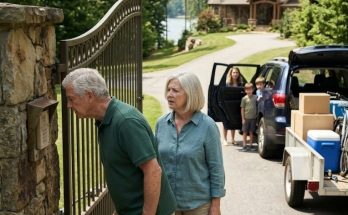
Dad’s SUV was sitting at the keypad.
Behind him was Melissa’s minivan.
Behind that was a rented U-Haul trailer.
Storage bins.
Bikes.
Coolers.
Fishing rods.
Patio chairs.
Luggage.
This wasn’t a reunion.
It was an occupation.
Dad entered the old code.
Red light.
Again.
Red light.
Melissa opened the van.
“I get the upstairs room!”
one of her boys yelled.
My upstairs room.
Mom stepped out of the SUV
and stared at the locked gate.
My phone started ringing.
Dad.
Mom.
Melissa.
Dad again.
I ignored them.
On camera, Dad punched in
the code once more.
Failed entry.
Then again.
Another alert.
Finally, he looked directly at the camera.
“Open it!”
Mom followed his gaze.
She slowly took off her sunglasses.
And I saw the exact moment
she understood.
I was watching everything.
The U-Haul.
The bins.
The luggage.
The plan they had never bothered
to tell me about.
For one second,
I wanted to answer
and list every borrowed car,
hijacked guest room, unpaid favor,
and every time my success
had been treated like family property.
Instead, I leaned back
in my office chair.
Muted my desk phone.
Opened the live security intercom.
Dad turned toward the speaker.
Melissa froze beside the minivan.
Mom held her sunglasses loosely
in one hand.
Then I pressed the button and said:
“Before any of you unload
one more thing,
you need to know what I found
out about that U-Haul.”
“That trailer was rented in my name.”
Nobody moved.
Even Melissa’s boys stopped arguing.
Dad stared into the camera.
“What are you talking about?”
“The contract has my birth date.”
I opened the emailed document again.
“It has my driver’s license number.”
Mom’s hand dropped toward her side.
“And someone copied my signature.”
Melissa shut the van door.
Too quickly.
The sound cracked across the driveway.
Dad glanced at her.
That single glance told me plenty.
I had enlarged the trailer’s
orange contract sticker,
called the rental branch,
and answered their security questions.
Their fraud supervisor found the reservation.
It identified me as the renter.
The agreement listed the lake house
as my primary residence.
It also specified a ninety-day rental.
Not ten days.
Not two weeks.
Ninety days.
The payment card had already declined.
The backup card belonged to Dad.
The email address belonged to Melissa.
“I reported the contract as fraudulent.”
Dad’s face hardened.
“You reported your own family?”
“I reported identity theft.”
“That isn’t what this is.”
“Then explain my signature.”
“We needed a larger trailer.”
Dad stepped closer to the gate.
“You said we could come.”
“I agreed to a reunion.”
My voice remained quiet.
“I never agreed to residency.”
Mom finally spoke.
“It was probably a misunderstanding.”
“The application says permanent relocation.”
Her lips parted.
Nothing emerged.
“It lists Melissa as an authorized driver.”
Melissa folded her arms.
“I handled the paperwork for everyone.”
“By pretending to be me?”
“I knew you wouldn’t mind.”
“You knew I would.”
“That’s why you never asked.”
Dad struck the metal gate
with his open palm.
“Enough.”
The clang startled the younger boy.
He turned toward his mother.
Dad pointed at the camera.
“You will open this gate.”
“No.”
“We sold our house.”
The words landed without warning.
Mom closed her eyes.
Melissa looked toward the road.
I leaned nearer the monitor.
“You did what?”
“We closed this morning.”
Dad said it almost triumphantly.
“Everything we own is in these vehicles.”
The boxes suddenly made sense.
So did the bicycles.
The patio chairs.
The filing cabinets beneath blue tarps.
This was not reunion luggage.
This was an entire household.
“You planned to move here permanently.”
“We planned to stay temporarily.”
“How long?”
Dad looked away.
Mom answered instead.
“Until we figured something out.”
“How long, Mom?”
Her mouth trembled.
“Maybe through Christmas.”
It was June.
Melissa stepped forward.
“The boys need stability.”
“So you uprooted them secretly?”
“They’re enrolled nearby.”
My stomach tightened.
“Enrolled where?”
“The middle school near the lake.”
“You used my address?”
“We needed proof of residency.”
Every sentence uncovered another violation.
“You submitted documents in my name.”
Melissa’s chin lifted.
“We did what families do.”
“No.”
I heard my own breathing.
“You did what people do
when they expect forgiveness
before they commit the offense.”
A patrol car appeared behind them.
Blue lights flashed silently.
Mom turned toward the road.
Dad’s anger faltered.
“You called the police?”
“The rental company did.”
That was only partly true.
Their fraud supervisor had advised me
to make an immediate report.
I had.
Deputy Hall stepped from the cruiser.
Wade’s pickup arrived seconds later.
He stopped inside the property,
behind the locked gate.
Dad waved toward him.
“Tell him to open it.”
Wade remained beside his truck.
“I work for the owner.”
“I’m her father.”
“I know who you are.”
“Then open the gate.”
“No, sir.”
Deputy Hall approached slowly.
He asked everyone to remain calm.
Then he looked toward the camera.
“Ma’am, are you the property owner?”
“Yes.”
“Did you authorize these people
to enter or occupy this residence?”
“No.”
Dad raised both hands.
“She invited us.”
“For a temporary family gathering.”
I kept my voice steady.
“That permission has been revoked.”
“You can’t revoke it
after we sold our house.”
Dad sounded almost offended.
“I didn’t tell you to sell it.”
“You knew we were coming.”
“I knew about a reunion.”
I let the silence settle.
“I knew nothing about a move.”
Deputy Hall asked for identification.
Melissa hesitated before surrendering hers.
He compared it against information
on his tablet.
Then he walked toward the trailer.
“Who signed the rental agreement?”
Nobody answered.
He repeated the question.
Dad pointed toward me,
though I was miles away.
“She did.”
Deputy Hall looked at the camera.
“Did you?”
“No.”
Melissa exhaled sharply.
“It was an electronic signature.”
“That wasn’t the question,” he said.
Her older son watched her.
His face had changed.
The excitement was gone.
Deputy Hall asked again.
“Who completed the agreement?”
Melissa stared at the gravel.
“I did.”
Mom whispered her name.
Melissa snapped toward her.
“What?”
“You said the company approved it.”
“They did approve it.”
“Because you used her identity.”
Dad interrupted them.
“Nobody stole anything.”
Deputy Hall’s expression stayed neutral.
“The equipment company disagrees.”
He instructed Melissa
not to move the trailer.
A branch representative was coming.
The contract had been frozen.
The trailer would be collected
until ownership of its contents
could be properly documented.
Dad took another step forward.
“You’re leaving elderly people homeless.”
“You have your SUV,” I said.
“And more than enough money
for a hotel tonight.”
His eyes narrowed.
“You don’t know what we have.”
“Then this is your opportunity
to explain it honestly.”
The younger boy began crying.
Not loudly.
He pressed his face
against the side of the van.
That sound nearly broke me.
Children had always been
the sharpest tool in Melissa’s hand.
She knew I could withstand accusations.
She knew I struggled with frightened children.
I pressed the intercom again.
“Ben? Luke?”
Both boys looked toward the speaker.
“This is not your fault.”
Melissa’s face tightened.
“Don’t involve them.”
“You brought them here.”
I swallowed the anger.
“You’re safe.
The adults will arrange somewhere comfortable.”
Dad gestured toward the house.
“They already have somewhere comfortable.”
“No.”
One word.
No explanation.
No bargaining.
No opening for negotiation.
Wade walked to the pedestrian gate.
He placed bottled water
on the pavement outside.
Then he stepped back inside.
Dad saw the boundary.
Something in his expression changed.
He had expected fury.
Fury could be called disrespect.
He had expected guilt.
Guilt could be bent.
What he had not expected
was calm preparation.
The rental representative arrived
twenty minutes later.
By then, traffic had backed up
along the narrow access road.
Deputy Hall made Dad move his SUV.
Melissa shifted the minivan behind it.
The representative photographed the trailer,
verified the serial number,
and attached a wheel lock.
Dad demanded access to the contents.
The representative handed him a form.
“You can collect verified belongings
at our branch.”
“We need them tonight.”
“You should speak with the named renter.”
“She’s refusing to help us.”
The representative looked toward the camera.
“She is the reported victim.”
Dad stopped talking.
Mom stood apart from everyone.
Her sunglasses remained in her hand.
She looked smaller than usual.
For years, she had managed tension
by softening Dad’s words,
redirecting Melissa’s demands,
and asking me to understand.
Now there was nothing soft enough.
The facts had hard edges.
Deputy Hall asked where they would stay.
Dad muttered something about a hotel.
Melissa said she had no money.
Her older son looked embarrassed.
I nearly offered my card.
The impulse rose automatically.
Then I remembered the declined payment.
My identity had been their first solution.
My money would become the second.
“Aaron needs to know where the boys are.”
Melissa’s head snapped upward.
“Do not call him.”
“He shares custody.”
“He knows we’re traveling.”
“Does he know you changed schools?”
She said nothing.
That silence gave me another answer.
Deputy Hall wrote down Aaron’s number.
Melissa protested.
He explained that custody disputes
were not his decision.
But the children’s other parent
needed accurate information.
Dad called me again.
I rejected the call.
Then Mom tried.
I let it ring.
She left a message.
I did not play it.
The convoy finally pulled away.
Dad’s SUV went first.
Melissa’s minivan followed.
The immobilized trailer stayed behind.
When their taillights disappeared,
Wade looked up at the camera.
“You all right?”
“No.”
It was the first honest answer
I had given all afternoon.
“I’m leaving Charlotte now.”
“I’ll wait here.”
“You don’t need to.”
“I know.”
He glanced at the locked gate.
“Neither did you.”