**Part 1**
My daughter-in-law got promoted and celebrated
by taking the entire family to a
fancy dinner, making sure I was
the only one left behind.
I stayed home alone while they laughed
and toasted without me.
Hours later, my phone buzzed.
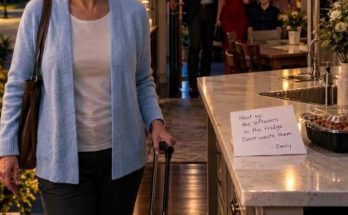
Her message read, “Heat up the leftovers
in the fridge. Don’t waste them.”
I stared at the screen for a moment,
then calmly replied, “Ok.”
That night, I quietly packed my bags
and walked out the door.
When they finally came home and turned
the key, what greeted them inside
the house stopped them cold.
It was 9:30 p.m. in our
little subdivision outside Columbus, Ohio, and the
only light on downstairs was the one
over the sink.
The kitchen looked spotless in that way
that feels less like “clean” and more
like “empty.”
A PTA sign-up sheet was still stuck
to the fridge under a crooked magnet.
The Costco rotisserie chicken tray I’d scrubbed
earlier was drying on the rack like
a trophy no one asked for.
All day, I’d moved through the house
the way I always did—quiet, useful, careful.
I’d walked to the HOA mailbox at
the end of the cul-de-sac and brought
back envelopes that weren’t even for me.
I’d folded school hoodies into perfect stacks.
I’d ironed Daniel’s white shirt until the
collar was crisp enough to cut paper.
I’d wiped fingerprints off the stainless-steel fridge
because Emily hated seeing “smudges.”
When I asked what time we were
leaving, she didn’t even look up from
her phone.
“It’s just us,” she said, smiling like
she was doing me a favor.
“You’ll be fine here. Heat up something
later.”
By evening, I ate instant soup out
of a paper bowl left over from
someone’s birthday party, because it felt wrong
to “make dishes” for a meal no
one would sit with me to share.
The TV murmured in the background—one of
those traffic updates warning about backups on
the interstate—while the house stayed so quiet
I could hear the ice maker drop
cubes.
Then I opened social media, even though
I promised myself I wouldn’t.
The photos hit me like bright little
flashes of truth.
Emily in a fitted red dress, holding
her wine glass high.
Daniel beside her in the shirt I’d
ironed, smiling like he didn’t have a
mother sitting alone in his house.
The kids grinning over fries and dipping
sauce, their cheeks shiny under restaurant lighting.
Her mother was there.
Her sister was there.
People I didn’t recognize were there too—laughing,
leaning in, taking pictures like a postcard
family.
No empty chair.
No caption saying, “Wish you were here.”
Not even a polite lie.
So when my phone buzzed at 9:30,
I already knew it wouldn’t be an
invitation.
It would be an instruction.
“Heat up the leftovers in the fridge.
Don’t waste them.”
She didn’t use my name.
She never did.
Not “Betty.”
Not “Mom.”
Just “mother-in-law,” like I was a job
title.
I stared at my hands.
They still smelled like bleach and lemon
cleaner.
I’d spent years doing the invisible work
that made their lives look effortless.
And in return, I got assigned the
scraps, like that was normal.
I typed back two letters.
“Ok.”
Not because I agreed.
Because I was done explaining my humanity
to people who benefited from ignoring it.
I walked down the hallway and opened
my closet.
My suitcase was still there, the one
I hadn’t touched since the last trip
I took with my husband.
I packed slowly, not like someone running
away—like someone collecting herself.
I took what belonged to me: the
cardigan I wore when the air-conditioning made
my bones ache, the framed photo I
kept turned facedown, the small envelope of
papers I’d kept moving from drawer to
drawer for months.
Downstairs, I left the house exactly the
way they liked it.
Counters clear.
Towels folded.
No dramatic mess.
No shouting.
Just silence, neat and final.
Before I closed the door behind me,
I placed one thing where they wouldn’t
miss it—something they’d notice the second the
lights came on.
Outside, the street was still.
Porch lights.
Trimmed lawns.
The faint hum of late-night cars heading
home.
They thought I’d be there when they
returned, ready to warm up their leftovers
like always.
That’s not what they came home to.
The thing on the kitchen island
was my house key.
I had set it upright
inside an empty drinking glass,
where the overhead light would catch it.
No note.
No accusation.
Just the key,
standing alone in a glass
I had washed that morning.
Later, Daniel told me
he saw it before he saw
that my coat was gone.
He called my name from the kitchen.
Then again from the bottom
of the stairs.
Emily went up to my room
while he checked the garage,
as though I might have chosen
to sleep beside the lawn mower.
The children stayed in the hallway.
They knew something was wrong.
My grandson, Noah, was eleven.
His sister, Sophie, was eight.
They had never come home
and found my door open,
my bed neatly made,
and nobody waiting to ask
whether they’d had a good time.
I learned those details the next morning.
That night, I knew only
the weight of my suitcase
and the strange difficulty
of walking past the neighboring houses
without turning back.
At the end of the block,
I stopped beneath a streetlamp.
My husband, Frank, had driven us
through that subdivision seven years earlier.
Daniel and Emily were house hunting.
We had come to see a place
with a crooked front step
and a maple tree out back.
Frank had liked the tree.
“You could sit there with the kids,”
he’d told me.
Noah had not been born yet.
Frank always spoke about our future
as if he expected
to have plenty of it.
He died the following spring.
When Sophie was born,
I began visiting every weekday.
Then Emily returned to work.
Then Daniel’s hours changed.
Somewhere along the way,
visiting became staying.
Staying became belonging,
or so I told myself.
At the streetlamp,
my phone lit up with Daniel’s name.
I let it ring.
I was afraid
that hearing his voice
would send me back
before I understood why I’d left.
A car slowed beside the curb.
The driver lowered her window.
“Betty?”
It was Marlene Keene,
my friend from the public library.
Two weeks earlier,
she had offered me her spare room.
She had said I could stay
for a night or a month
if I ever needed somewhere quiet.
I had thanked her
and changed the subject.
Now she looked at my suitcase,
then at my face.
“Get in,” she said.
I did.
She put my bag in the trunk
and drove without asking
for an explanation.
When we reached her house,
she switched on the porch light
and handed me a glass of water.
“There are clean sheets upstairs,”
she said.
“You can tell me tomorrow.”
I sat at her kitchen table
until the water lost its chill.
My phone rang six times.
Daniel.
Then Emily.
Then Daniel again.
At 11:47,
a message appeared.
Mom, where are you?
I stared at it.
I had wanted him to notice
that I wasn’t at dinner.
Instead, he had noticed
that I wasn’t home.
The difference hurt
more than I expected.
I typed slowly.
I’m safe with a friend.
The children are safe with you.
We’ll talk tomorrow.
Three dots appeared immediately.
They vanished.
Then appeared again.
What is going on?
I set the phone facedown.
Marlene’s kitchen smelled of toast.
A small clock ticked above her sink.
I could hear her moving upstairs,
leaving me room to breathe.
For the first time in years,
I went to bed
without checking anyone else’s calendar.
I woke before dawn anyway.
My body expected lunch boxes,
missing shoes,
a load of laundry
waiting in the washer.
Instead, there was pale light
across an unfamiliar quilt.
I lay still
and listened to birds outside.
My first feeling was relief.
The second was guilt.
I had brought the envelope
with me in my handbag.
I took it out
and spread its contents
across the bed.
There was a brochure
for a small apartment building
near the library.
A list of monthly expenses.
A copy of my bank statement.
And a photograph of Frank,
taken during our last trip
to Lake Erie.
He was standing ankle-deep
in gray water,
holding his shoes in one hand,
laughing because a wave
had soaked his trousers.
I had kept that photograph facedown
in my bedroom.
Looking at it meant remembering
how easily a whole life
could become a before and after.
But the papers had been there
for months.
I had priced apartments.
I had counted my savings.
I had even spoken
to the building manager.
Then Sophie had broken her arm.
Daniel had taken on overtime.
Emily had a difficult stretch at work.
Each time, I had told myself
to wait another month.
The children needed me.
That much was true.
I had mistaken it
for the whole truth.
Downstairs, Marlene was making coffee.
She glanced at the envelope
in my hand.
“You’ve been planning,” she said.
“I’ve been thinking.”
“That’s usually how it starts.”
She poured two cups.
I told her about the dinner.
Then I told her
about the years before it.
How Emily would leave
a grocery list on the counter
without asking whether I had plans.
How Daniel would promise
to handle school pickup,
then call from work
because something had come up.
How I had stopped volunteering
at the library on Thursdays
because no one remembered
that I had ever done it.
Marlene listened.
When I finished,
she asked one question.
“What do you want this morning?”
It was harder to answer
than anything else she’d asked.
I looked through the window
at her little backyard.
An empty bird feeder hung
from a branch.
“I want to talk to Daniel,”
I said.
“But I don’t want
to go back today.”
“Then tell him that.”
Daniel arrived at ten.
Marlene let him in
and went out to buy bread,
though her breadbox was full.
He looked tired.
His white shirt,
the one I had ironed,
was wrinkled at the sleeves.
He sat opposite me
at the kitchen table.
For a moment,
we regarded each other
like strangers trying to remember
where they had met.
“Are you all right?” he asked.
“Yes.”
“We were worried sick.”
“I told you I was safe.”
“After we found your key
in a glass.”
His voice rose,
then he caught himself.
“Mom, what happened?”
I had imagined saying
many things to him.
Some of them were sharp.
Instead, I asked,
“Did you know Emily told me
to heat up your leftovers?”
His eyes dropped.
“I saw the message.”
“And the dinner?”
“She said you didn’t want
to come out with us.”
I felt the old urge
to make excuses for him.
He had been working.
He had trusted his wife.
He had seen me smile
through a thousand ordinary days.
But he had also seen me
fold his shirts,
cancel appointments,
and eat standing up
because the family had already finished.
“I asked what time we were leaving,”
I said.
“She told me it was just you.”
Daniel rubbed his forehead.
“I didn’t know that.”
“I believe you.”
He looked relieved.
I wasn’t finished.
“I also believe you didn’t ask.”
He sat back.
Outside, a car door closed.
Someone called to a child
across the street.
Daniel turned toward the sound.
“When Dad died,” he said,
“I thought being with us helped.”
“It did.”
“You seemed happy with the kids.”
“I was.”
“Then why didn’t you say something?”
“I did.”
He looked at me.
“Last winter,” I said,
“I asked to keep Thursdays free.”
He remembered slowly.
“That was for the library.”
“You said Emily had meetings.”
“We thought you could switch days.”
“I couldn’t.
They needed me on Thursdays.”
Daniel said nothing.
“In March, I asked
whether you could arrange
after-school care twice a week.
You told me it was expensive.”
“It is.”
“So is giving up my life.”
He flinched.
I had never spoken
to my son that way.
The sight of his face
made me want to soften.
I held the edge of my cup
until that feeling passed.
“I love Noah and Sophie,” I said.
“I will always love them.
But I cannot be the answer
to every problem in your house.”
Daniel stared at the table.
“How long are you staying here?”
“Until my apartment is ready.”
“You got an apartment?”
“I’ve applied for one.”
He looked up sharply.
“Mom.”
“I can afford it.”
“That’s not what I meant.”
“I know.”
For a while,
neither of us spoke.
Then he told me
what had happened
when they came home.
Noah had asked
if I was angry with him.
Sophie had asked
whether I was ever coming back.
Those questions went straight through me.
“I’ll call them today,” I said.
“They shouldn’t have to guess.”
Daniel nodded.
“I’m sorry about dinner.”
I waited.
He looked at his hands.
“And I’m sorry
I let you become
the person who handled everything
because I knew you would.”
That apology reached me.
It did not repair everything.
It gave us somewhere honest
to begin.
Before he left,
I told him I would collect
the rest of my things
when the children were at school.
He offered to help.
“I’d like you there,” I said.
“But I’ll decide what comes with me.”
He nodded again.
At the door, he stopped.
“Emily wants to talk to you.”
“I’ll talk to her.”
“Today?”
“When I’m ready.”
He accepted that.
It was a small thing.
It was also the first time
in a long while
that my answer had been enough.
I called the children after lunch.
Noah answered on speakerphone.
Sophie was close enough
that I heard her breathing.
“Grandma?”
“I’m here, sweetheart.”
“Dad said you’re at Marlene’s.”
“I am.”
“Did we do something bad?”
“No.
Neither of you did.”
There was a rustle.
Sophie must have taken the phone.
“Are you coming home?”
I looked at the apartment brochure
on Marlene’s table.
“I’m going to live
in a place of my own.”
Sophie went quiet.
“Will it have room for us?”
“Yes.”
“Can I bring my drawing stuff?”
“Please do.”
“What about our Friday pancakes?”
“We’ll talk with your parents
about Fridays.”
I wanted to promise immediately.
I wanted to spare her
every uncertain feeling.
But promises had helped build
the life I was leaving.
So I told her the truth.
“I don’t know the schedule yet.
I know I’ll see you.”
Noah came back on.
“Do you still want
my science fair volcano?”
“Of course.”
“I can make it
at your new place.”
“I’d like that very much.”
When the call ended,
I cried so hard
I had to sit down.
Marlene came in
with the bread she hadn’t needed.
She put it away
and sat beside me.
Neither of us spoke
until I could breathe normally.