They were convinced I would walk into that stone barn with no one by my side. What they didn’t know was that another father was already waiting to take my arm—and he was about to change everything.
PART 1
I was standing in my workshop when Dad called, surrounded by fourteen copper vases filled with lavender, rosemary, and white dahlias I had grown myself. My pruning shears were still in my hand when he delivered the sentence as calmly as if he were canceling lunch.
“Why?” I asked.
He sighed. “Vanessa is going through a difficult time. Watching me walk you down the aisle would be painful for her.”
Vanessa was my older sister, the woman my parents had protected from consequences since childhood. Her marriage was collapsing, and somehow that meant my wedding had to shrink around her feelings.
“She isn’t getting married,” I said. “I am.”
Dad lowered his voice. “She said she won’t bring Lily and Owen to Christmas if I walk you.”
There it was.
My sister had used her children as leverage, and my father had folded without even making her repeat the threat.
“So you chose her,” I said.
“Please don’t make this sound cruel.”
That was his gift. He could abandon me and still act offended when I named what he was doing.
I looked at the oak shelves behind my workbench. Marcus’s father, Frank, had built them for me two years earlier. Inside the left panel, he had carved my initials so deeply they would survive every coat of paint.
My own father had forgotten my birthday that year.
“Okay,” I said.
“Clara, I’m sorry.”
“No. You’re uncomfortable. That isn’t the same thing.”
I ended the call.
Ten minutes later, Mom rang.
“Your father told you,” she said. “So let’s not drag this out. Plenty of brides walk alone now. It’s empowering.”
“He promised me a year ago.”
“Things change. Vanessa is hurting. You have Marcus.”
“And that means I don’t get to be hurt?”
Her silence was not guilt. It was irritation.
“Just walk by yourself,” she said. “Smile and don’t embarrass anyone.”
I hung up before she could turn my humiliation into another family duty.
Marcus found me sitting on the back step twenty minutes later, staring at the garden without seeing it. He sat beside me and wrapped an arm around my shoulders.
He did not tell me to forgive them.
He did not tell me to keep the peace.
After I explained what had happened, he looked toward the workshop and said, “You don’t have to walk alone.”
I knew who he meant before he said the name.
“Frank?”
Marcus nodded. “My dad has treated you like a daughter since the first day I brought you home. He knows what an honor it would be.”
The next morning, I drove to Frank’s house.
He was in the driveway wearing a denim apron, feeding a length of cherry wood through his table saw. When he saw my truck, he switched off the machine and removed his safety glasses.
I told him everything.
He listened without interrupting, his jaw tightening when I repeated Vanessa’s threat and my mother’s command to smile.
Then I looked down at my boots.
“Mom says walking alone would be empowering,” I whispered. “But I don’t want to prove I can survive being abandoned. I want to walk with someone who is proud to be there.”
Frank slowly removed his work gloves.
“Are you asking me?”
I nodded.
His eyes filled instantly.
This broad-shouldered man, who showed love through repaired engines and perfectly sanded wood, pulled me into a hug so steady that something inside me finally stopped shaking.
“Clara,” he said, “it would be the greatest privilege of my life.”
On Saturday, the converted stone barn glowed beneath the autumn sun. Nearly two hundred guests filled the wooden pews while a string quartet played near the altar.
My parents arrived late enough for everyone to notice.
Dad sat on the aisle in the third row, relaxed and smiling. Mom settled beside him in a dark blue dress. Vanessa took the next seat, her children beside her, wearing the satisfied expression of someone waiting to inspect the damage she had caused.
They expected me to enter alone.
They expected lowered eyes, trembling hands, and a brave little smile that would protect their reputation.
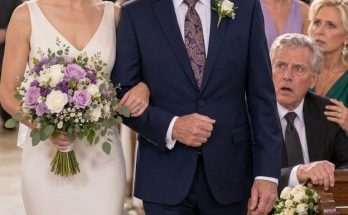
Instead, I stood behind the closed oak doors with my bouquet in one hand and Frank’s arm beneath the other.
He wore a charcoal suit. His silver hair was neatly combed, but I could still see a faint line of sawdust near one cuff.
“Ready, kiddo?” he asked.
I tightened my hand around his arm.
“I am now.”
The music changed.
The oak doors opened.
Every guest rose.
At first, the room filled with warm smiles. Then people recognized the man beside me, and understanding moved through the barn in a sudden, electric wave.
Frank walked with his shoulders back, every step calm and deliberate.
We passed the fifth row.
Then the fourth.
My father turned toward us.
The smile disappeared from his face.