The aircraft had barely stopped when the two sheriff’s cruisers rolled closer.
Rain shimmered beneath their headlights. One vehicle pulled alongside the transport’s nose, while the other positioned itself near the stairs, blocking the most direct route into the terminal.
No sirens.
No flashing lights.
Just two dark cruisers waiting with their engines running.
My former teammate, Daniel Ortiz, studied them through the small window beside my seat.
“Those are county vehicles,” he said quietly.
“I know.”
Across the aisle, Marcus Bell unbuckled his harness. He had served beside me in three countries and rarely asked a question when he already knew the answer.
“Are they supposed to be here?”
“No.”
Daniel glanced at the photograph still open on my phone—the image of Emily’s hospital room, taken from the hallway.
“Then we don’t walk into the terminal.”
The aircraft door opened below us. Cold rain swept into the cabin, carrying the smell of wet pavement and jet fuel.
A uniformed airport employee stood at the bottom of the stairs with a yellow vest pulled tightly around her shoulders. Behind her, a man in a dark suit held an umbrella.
He looked up at us.
Then he lifted one hand and smiled.
I didn’t recognize him.
But he raised his phone at the same moment mine vibrated.
UNKNOWN NUMBER:
You should have stayed overseas.
I showed the message to Daniel.
His expression hardened—not with anger, but with the careful focus I had seen in him during dangerous assignments.
“Is there another exit?”
The crew chief pointed toward a service stairway at the rear of the aircraft. “There’s a maintenance corridor, but it leads to a restricted ramp.”
“Call airport security,” I said.
Daniel was already moving. “And tell them we’re not exiting through the front.”
The pilot contacted the tower. Marcus stepped into the cockpit doorway and explained the situation in a low voice. I called the federal investigator whose number General Hale had given me before we left.
A woman named Rebecca Sloan answered on the second ring.
“Dean?”
“We’re on the ground at Richmond International. Two sheriff’s cruisers are waiting beside the aircraft. Someone photographed my wife’s hospital room, and now an unknown number is threatening me.”
“Are the deputies approaching?”
“Not yet.”
“Do not engage them. Keep everyone inside the aircraft. I’m contacting airport police and federal agents now.”
“What about my wife?”
“She’s being moved.”
My grip tightened around the phone. “Moved where?”
“Somewhere safer.”
“Who is moving her?”
“Hospital security under federal direction. You’ll get confirmation shortly.”
The line went quiet for half a second.
Then Sloan said, “Blake, listen carefully. Your wife may know something she hasn’t told you.”
I looked through the window at the waiting cruisers.
“What are you talking about?”
“We found a second report connected to Cameron Voss. One Emily Dean filed before the parking-garage incident.”
The cabin seemed to shrink around me.
“What report?”
“Your wife reported a missing patient file from St. Jude’s.”
A flash of confusion passed through me.
“Emily works in the hospital records department,” I said. “She told me she noticed irregularities in several discharge summaries. She never said anything about a missing patient file.”
“She may not have wanted you involved.”
“That doesn’t make sense.”
“Nothing about this case makes sense yet. Stay where you are.”
The call ended.
For several seconds, I simply stared at the dark reflection in the aircraft window.
Emily had always told me the truth.
At least, I believed she had.
Before I left for the overseas assignment, she had stood in our kitchen with one hand wrapped around a mug of tea and said, “There’s something strange happening at work, but I’m probably overthinking it.”
I had asked whether she wanted me to come home.
She had smiled sadly.
“No. I want you to finish what you went there to do.”
I remembered her words now, and the quiet way she had looked down at the counter afterward.
At the time, I had thought she was worried about me.
Maybe she had been worried about something else.
A flash of blue and white appeared beyond the aircraft wing. Airport police vehicles approached from the terminal road. The two sheriff’s cruisers remained in place for another few seconds, then pulled away without speaking to anyone.
Daniel watched until they disappeared behind the hangar.
“That was too easy,” Marcus said.
“Maybe they received orders to leave.”
“Maybe.”
A uniformed airport officer came up the rear stairs.
“Mr. Dean?”
“Yes.”
“I’m Lieutenant Harris with airport police. Federal agents are waiting in a secure office. We’ll escort you there.”
“Are the deputies authorized to be on the ramp?”
“They were not.”
“Do you know who sent them?”
Harris shook his head. “We’re looking into it.”
His tone was professional, but his eyes kept moving toward the hangar.
I followed him down the rear stairs with Daniel and Marcus behind me. Two other members of our former unit came next, silent and alert. We had not returned as a military operation. We were simply men trying to make certain I reached my wife safely.
Yet the old instincts returned without invitation.
We entered the maintenance corridor through a steel door. Fluorescent lights hummed overhead. The narrow passage smelled of concrete and machine oil, and our footsteps echoed as we moved toward a secured access point.
Halfway down the corridor, Harris stopped.
A small envelope rested on the floor near the wall.
It had not been there when he entered.
He crouched without touching it.
“Did anyone come through here?” Daniel asked.
Harris looked toward the security camera mounted above the door. Its indicator light was dark.
“The camera’s been disabled,” he said.
My name was written across the envelope in black ink.
Not printed.
Written.
The handwriting was familiar.
My wife’s.
I stepped closer, but did not touch it.
For a moment, I felt something inside me loosen. Maybe Emily had left a message. Maybe she had known I would come through this corridor. Maybe the photograph and the threats had been part of something I did not yet understand.
Then I noticed the envelope’s edge.
A faint blue line ran across the paper.
Emily always used cream-colored stationery. She disliked plain white envelopes and kept a small box of them in the desk beside our bedroom window. The paper in front of me was different.
Someone had copied her handwriting.
Harris sealed the envelope in a clear evidence bag. A federal agent waiting at the secure office examined it under the bright light above the table.
The agent introduced herself as Rebecca Sloan.
She was in her early forties, with tired eyes and a calm manner that made every sentence sound deliberate.
“Your wife is being transferred to a protected medical facility,” she said. “She is conscious and stable.”
“Why didn’t anyone tell me before we landed?”
“Because we were not certain your communications were secure.”
I thought of the message arriving before we had left the aircraft.
“Who has access to my travel information?”
“We’re determining that now.”
Sloan opened a folder.
“Emily reported a missing patient file six weeks ago. The file belonged to a man named Thomas Avery.”
The name struck me with an odd familiarity.
“Who was he?”
“A former county transportation inspector. He was treated at St. Jude’s after a workplace accident. He left the hospital three months ago and died two weeks later.”
“Died how?”
“Heart failure, according to the official record.”
“That sounds like a medical matter.”
“It would be, except his file contains three contradictory discharge summaries, two different medication lists, and a signature belonging to a physician who was out of the country when the document was supposedly completed.”
Daniel leaned forward. “What does that have to do with Cameron Voss?”
Sloan looked at him.
“Thomas Avery had been auditing county contracts involving private ambulance services. One of those companies is partly owned by Richard Voss.”
The room went quiet.
I stared at the folder.
“Emily discovered this?”
“She discovered that Avery’s original file had been removed from the hospital archive. She asked for an internal review.”
“And then someone started following her.”
“Yes.”
“Why didn’t she tell me?”
Sloan didn’t answer immediately.
Instead, she slid a copy of Emily’s internal report across the table.
At the bottom was a handwritten note.
I recognized Emily’s words.
I have no proof anyone intended harm. I only know the records changed after I asked questions.
My chest tightened.
She had not been investigating Cameron because she wanted to play detective. She had noticed something wrong at work and tried to correct it through the proper channels.
Then she had seen Cameron assault a woman in the parking garage and realized the same people might be connected.
“She was scared,” I said.
Sloan nodded. “But not only for herself.”
“What do you mean?”
She turned another page toward me.
It was a list of patients whose files had been altered.
Thomas Avery was at the top.
The other names were unfamiliar.
Then I saw one that made the room tilt.
Emily Dean.
The date beside her name was twelve years old.
Before we had met.
“What is this?” I asked.
Sloan’s expression changed slightly.
“That is what we’re trying to understand.”
I looked at the page again. Emily’s name appeared beside a notation:
TRANSFERRED—SPECIAL HANDLING.
The listed hospital department no longer existed. The physician attached to the entry had retired years ago. The file number was incomplete.
“Emily was never treated at St. Jude’s,” I said.
“Not as an adult,” Sloan replied.
“What does that mean?”
“According to hospital records, Emily was admitted there as a child.”
I pushed back from the table.
“That’s impossible. She grew up in Ohio.”
“Her family moved several times. We’re verifying the details.”
“She never mentioned St. Jude’s.”
“Did you ever ask?”
The question was gentle, but it landed heavily.
I had known Emily for twelve years. I knew the sound of her laugh, the way she folded towels, the names of her cousins, and the recipe her grandmother had taught her.
But I had never asked about every year of her childhood.
I knew she had spent one year in Virginia as a teenager. I knew she avoided hospitals whenever possible. I knew she became quiet whenever anyone mentioned her father.
I had assumed those were ordinary family complications.
Sloan continued.
“Your wife’s childhood record was created under a different surname.”
“What surname?”
She hesitated.
“Reed.”
The word stirred something buried in my memory.
The first time I met Emily, she had been working at a bookstore near the university. She wore a green scarf and had been helping an elderly man find a biography of a former senator.
When I asked her name, she said, “Emily Reed.”
It was only months later, after we became serious, that she told me she had changed her surname when she married.
No—she had not said married.
She had said, “Reed was my mother’s name. Dean is the name I use now.”
I had never pressed her about it.
Sloan watched me carefully. “We believe the missing patient records may be connected to an old county program involving relocated witnesses.”
“Witnesses to what?”
“We don’t know yet.”
A soft knock came at the door. An airport security officer entered and handed Sloan a phone.
“Ma’am, we found the man from the ramp camera.”
“The camera was disabled.”
“Another camera caught him outside the service gate.”
Sloan answered the phone and listened.
Her face tightened.
“What’s his name?”
She looked at me.
“Cameron Voss.”
My chair scraped against the floor as I stood.
“Where is he?”
“Gone,” she said. “But he left something behind.”
The officer placed a small black object on the table.
A hospital visitor badge.
It belonged to Cameron Voss.
The photograph showed a young man with carefully styled blond hair and an expression that seemed almost pleasant.
The badge had been issued that morning.
Authorized visitor: Emily Dean.
I felt the old anger rise, but beneath it was something more painful.
Emily had been lying in a hospital bed, and Cameron had walked through the building wearing a legitimate visitor badge.
“Who gave him access?” Daniel asked.
“We’re reviewing the sign-in records,” Sloan said.
“Review faster,” Marcus replied.
Sloan ignored the tone. She turned the badge over.
A strip of paper had been taped to the back.
This time, the handwriting was not Emily’s.
It was mine.
Or close enough to make my stomach turn.
The message read:
Ask her what happened in Room 417.
I knew immediately that the words were meant to unsettle me.
They succeeded.
“Was Emily ever in Room 417?” I asked.
Sloan picked up another folder.
“St. Jude’s had a pediatric wing twelve years ago. It was closed after a flood. Room 417 was one of the old examination rooms.”
“Why would Cameron know that?”
“We don’t believe Cameron is working alone.”
“His father?”
“Possibly. But Richard Voss is not our only concern.”
The airport officer shifted uneasily near the door.
Sloan looked at him. “Anything else?”
“Yes. The hospital security logs show that a man entered Emily’s floor using an old employee access code.”
“Name?”
“We’re still identifying him.”
“Show me the image.”
The officer placed a tablet on the table.
The photograph came from a hallway camera. The image was grainy, but the man’s face was visible as he approached Emily’s room.
He was older than Cameron, perhaps in his fifties, with thinning gray hair and a narrow face.
I had never seen him before.
Then Daniel leaned over my shoulder.
“Blake.”
“What?”
“Look at his left hand.”
The man wore a plain silver ring.
A small black stone was set into its center.
Daniel pointed to the screen.
“I’ve seen that ring.”
“Where?”
“On the man who met us at the base before our flight.”
I turned toward him.
“You didn’t mention that.”
“I wasn’t sure it mattered. He was with General Hale’s staff.”
Sloan’s gaze sharpened. “Describe him.”
“Civilian. Gray suit. Introduced himself as a logistics consultant. He had clearance to be inside the operations compound.”
“Did he give you a name?”
Daniel thought for a moment.
“Martin Keene.”
Sloan looked down at the papers in front of her.
Then she slowly removed a photograph from the folder.
The same man stared back at us.
Underneath the photograph was a name.
Martin Keene.
Former deputy director, Virginia Witness Protection Office.
I felt the room grow cold.
“Why would someone from witness protection be involved with my wife?”
Sloan’s answer came quietly.
“Because Emily may not be the name she was born with.”
No one spoke.
My mind returned to the envelope, the altered hospital file, the strange notation beside Emily’s childhood record.
Transferred—Special Handling.
I thought of the first time Emily had told me about her father.
“He left when I was little,” she had said.
I had asked whether she wanted to find him.
She had looked out the window for a long time.
“No. Some people leave because staying would be worse.”
At the time, I had assumed she was protecting herself from disappointment.
Now another possibility took shape.
Maybe her father had not abandoned the family.
Maybe someone had hidden her from him.
Sloan received a new call. She listened, asked two questions, then ended it.
“Your wife has been moved safely,” she said. “She’s asking for you.”
The relief was so powerful it hurt.
“Take me to her.”
“There’s something you need to understand first. We can arrange a secure visit, but you have to promise me you will not ask Emily about the records until she is ready.”
“She’s my wife.”
“I know. But if she has been living under a protected identity, forcing her to explain everything while she’s recovering could cause more harm.”
“She was attacked because she tried to report a crime.”
“Exactly. She may still believe silence keeps people safe.”
I wanted to argue.
Instead, I thought about the years Emily had spent carrying something alone while I was away serving people who trusted me with their lives.
Maybe I had been so used to protecting others that I had never learned how to notice when someone close to me was afraid.
“I won’t pressure her,” I said.
Sloan nodded. “Good.”
The protected facility was a small medical center twenty miles outside Richmond, surrounded by trees and guarded by an ordinary-looking fence. No sign identified it as anything unusual.
Emily’s room was on the second floor.
A nurse met me at the door and spoke softly.
“She’s tired, but she’s been waiting.”
I entered alone.
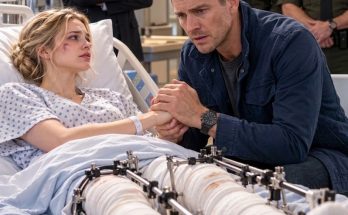
Emily lay beneath a white blanket, her legs elevated and immobilized. Her face looked pale against the pillow, but her eyes opened the moment I crossed the room.
For a few seconds, neither of us said anything.
Then she reached for me.
I took her hand carefully.
“I’m here.”
Her fingers closed around mine.
“I knew you would come.”
“I should have come sooner.”
“You came as soon as you could.”
“I should have listened more carefully before I left.”
A faint sadness touched her face.
“You were trying to protect me.”
“I was trying to solve everything from another country.”
“That sounds like you.”
Despite everything, she managed a small smile.
I sat beside her bed.
Sloan had warned me not to ask questions, but there was one thing I needed to know.
“Did Cameron get inside your room?”
Emily looked toward the window.
“No.”
“Did anyone hurt you after the surgery?”
“No.”
Her voice remained calm, yet her hand tightened around mine.
“Someone came in while I was awake,” she continued. “A man I didn’t recognize. He stood near the door and asked whether you had arrived.”
“Martin Keene?”
Her eyes snapped back to mine.
“You know that name?”
“He was at the base before I left.”
Emily’s breathing changed.
“Blake, you can’t trust him.”
“Who is he?”
She looked toward the closed door.
“He used to work for the people who protected my family.”
“What family?”
For several seconds, the only sound in the room was the steady rhythm of the monitor beside her bed.
Then Emily whispered, “The family I was taken away from.”
My heart sank.
She closed her eyes.
“My name wasn’t Emily Reed when I was born.”
“I know.”
“No,” she said. “You don’t.”
She opened her eyes again, and for the first time since I had known her, I saw not fear but exhaustion from years of hiding.
“My mother’s name was Laura Vale.”
The name meant nothing to me.
But Emily continued.
“My father was a county auditor. He discovered that Richard Voss and several officials were diverting public funds through medical transport contracts. Before he could testify, he disappeared.”
“Did he die?”
“We were told he did.”
“And your mother?”
“She tried to take me and leave. That was when the witness protection office became involved.”
I felt my pulse beating in my throat.
“Why were you placed in the hospital?”
“I wasn’t sick. I was hidden there.”
She looked down at our joined hands.
“I was six years old. The hospital had a secure wing. They gave me a new name, new records, and a story about my father leaving. My mother was supposed to join me after she finished giving evidence.”
“But she never did.”
Emily’s eyes filled with tears, though her voice stayed steady.
“She vanished.”
I held her hand more firmly.
“Why didn’t you ever tell me?”
“Because every time I tried, I was afraid the truth would put you in danger.”
“Emily, I’ve spent my whole life in dangerous places.”
“I know. That’s why I was afraid. You would go looking for answers.”
She was right.
I would have.
I would have followed every trail, questioned every official, and treated the past like an enemy that could be defeated if I pushed hard enough.
But Emily had not needed a soldier.
She had needed a husband willing to sit beside her and listen.
“What does Cameron want?” I asked.
“He wants the original records.”
“Which records?”
“The ones proving my father was alive after he disappeared.”
The room seemed to hold its breath.
I stared at her.
“You saw him?”
“Not recently. Years ago, when I was twenty-one. A man contacted me and said my father had left something for me. I thought it was a trap, so I never met him.”
“Who contacted you?”
Emily swallowed.
“Martin Keene.”
A cold understanding moved through me.
“He has been looking for you.”
“He says he was trying to protect me. But people who protect you don’t usually follow you into hospitals.”
“Did he know about Cameron?”
“He knew about the Voss family. He told me the original evidence disappeared, but one copy might still exist.”
“Where?”
Emily’s expression changed.
Not fear this time.
Recognition.
“Room 417.”
I remembered the message Cameron had left.
Ask her what happened in Room 417.
Emily turned her face toward the window.
“That was where they kept me when I was a child.”
“What was in there?”
“A music box.”
I waited.
She continued in a whisper.
“My mother gave it to me before she disappeared. She told me never to open the bottom panel unless someone came to help me. Years later, when they moved me out of the hospital, the music box was gone.”
“Who took it?”
“I don’t know.”
The door opened slightly, and Sloan appeared.
“We need to leave,” she said.
Emily looked at her. “Did you find him?”
“Find who?”
“Martin Keene.”
Sloan’s expression became guarded.
“He was seen near the hospital, but he left before agents arrived.”
Emily turned toward me.
“He’ll go to the old hospital.”
Sloan shook her head. “The building has been sealed for years.”
“He knows about the music box,” Emily said. “And so does Cameron.”
Sloan stepped fully into the room.
“How do you know?”
Emily’s eyes moved to mine.
“Because the message Cameron left wasn’t meant for Blake.”
“What was it meant for?” Sloan asked.
Emily’s voice dropped.
“For me.”
She reached beneath her pillow and pulled out a folded piece of paper.
“I found this in my hospital room after the surgery.”
Sloan took it carefully and opened it.
There were only six words, written in the same copied handwriting as the envelope at the airport.
THE MUSIC BOX IS NOT EMPTY.
Outside, tires moved across the wet pavement.
Sloan looked toward the window.
A dark sedan had stopped beyond the trees.
Emily’s fingers tightened around mine.
Then, from somewhere beneath the hospital bed, a small melody began to play.