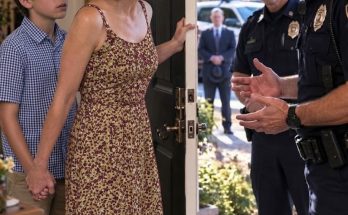
My thirteen-year-old son sold his treasured guitar to buy a wheelchair for a classmate whose peers mocked her broken one. Two mornings later, police officers appeared at our door. I grabbed his hand and asked what he’d done, but the officer replied, “He’s not under arrest. Someone wants to thank him”…
**Part 1**
I noticed the missing guitar while searching for dirty socks.
That’s how most important investigations begin in my home. I’m Victoria, and I’ve learned that when a thirteen-year-old claims his room is clean, it usually means there’s a narrow walkway to his bed.
I entered with a laundry basket on my hip. Clothes lay beside the hamper, which apparently functioned more as a suggestion than an actual destination.
Then I noticed the stand beside Alejandro’s desk.
Empty.
I put the basket down and checked behind his chair, though guitars rarely crawl behind furniture by themselves. I searched the closet, then downstairs, convincing myself he’d taken it somewhere to practice.
His guitar case was missing, too.
The guitar had been his birthday present, the priciest gift we’d ever bought him. We’d discussed its cost repeatedly before purchasing it, whispering as parents do when trying to preserve a surprise.
Alejandro never treated it like an expensive possession adults owed him. To him, it was something extraordinary that had somehow been placed in his care.
He cleaned it regularly, returned it to its stand, and worried about tiny scratches I could barely notice.
The same boy who abandoned wet towels on his bed handled that guitar like a museum curator.
Music drifted from his bedroom every afternoon.
Sometimes an entire song. Other times, three measures repeated so often I learned them better than their composer.
I occasionally complained, since motherhood apparently requires asking for silence from the very things you once hoped your child would love.
But I enjoyed hearing him play.
That afternoon, his room seemed oddly ordinary without the guitar. Just a desk, bed, and scattered school papers. Something deeply meaningful to him was gone.
When Alejandro returned home, I waited until he’d put down his backpack.
“Sweetheart, where’s your guitar?”
He lowered his gaze.
“I sold it, Mom.”
For a moment, I thought I’d misheard.
“You sold it?”
He nodded.
I felt a lecture forming in my throat, complete with several powerful opening lines and no plans to end soon.
“That guitar meant everything to you.”
“It did.”
“Then why would you—”
“Elena needed a wheelchair.”
My lecture vanished.
I knew Elena, a classmate of his with bright, attentive eyes and a lovely smile. At school events, she usually had a book on her lap.
She’d been paralyzed in an accident as a young child. I knew that detail, but knowing one fact about someone’s life doesn’t mean understanding their daily struggles.
“What happened to her chair?”
Alejandro leaned against the doorway and began explaining quickly, as though he needed to finish before I decided he was in trouble.
The wheels jammed. The seams were splitting. Rust covered sections of the frame.
“She can barely get between classrooms sometimes.”
I imagined the crowded hallways, students rushing in groups to reach their next classes before the bell.
“She missed lunch twice last week,” he said. “It took her too long to get across the building.”
“Did anybody know?”
“She keeps saying she’s fine.”
He rubbed his thumb along the doorframe.
“Some kids laugh at the chair.”
That seemed to trouble him most.
Not merely that the wheelchair was damaged, but that Elena struggled while other children found amusement in her difficulties.
“What do they say?”
“Just stuff. About the squeaking. How slow she is.”
He shook his head.
“She acts like she doesn’t hear them.”
I sat on his bed, leaving the laundry basket untouched. Its contents suddenly seemed unimportant.
“Her parents can’t afford a new one right now,” he said. “I knew I could help.”
Until then, I’d been wondering why my son had parted with something so valuable.
Now I was realizing he’d found something he valued even more.
“How did you sell it?”
“I posted it online. Mr. Keller from church bought it.”
“You arranged to sell an expensive guitar to a grown man without telling me?”
“He asked if I was sure.”
“How many times?”
“Like four.”
That sounded exactly like Mr. Keller. Still, I’d have preferred to witness at least one of those four opportunities to discover what was happening.
“Why didn’t you come to me first?”
Alejandro’s shoulders sagged.
“Because you would want to figure out a grown-up way.”
I opened my mouth, then shut it.
He knew me well.
I compare prices, make phone calls, and keep receipts in an envelope that no longer closes properly. Present me with a problem, and I’ll make a list.
“Elena couldn’t wait,” he said. “She needed it now.”
I wanted to explain why adults sometimes proceed cautiously. But I also knew caution could become delay, particularly when someone else was waiting.
“What did you get for it?”
“I asked for twelve hundred.”
“And?”
“Eight hundred fifty.”
I drew a breath.
“It was enough,” he added. “I ordered the chair through the hospital. It’s paid for. They’ll call when it’s ready.”
He’d already completed everything.
While I’d been preparing meals, checking homework, and reminding him to brush his teeth, he’d quietly exchanged his most beloved possession for something his friend desperately needed.
“Are you mad?”
He asked cautiously, studying my expression.
“I’m shocked,” I told him. “And I am very proud of you.”
His face softened.
“I am also unhappy that you sold something that valuable without talking to me.”
“That’s fair.”
Thirteen years old, and suddenly willing to accept a balanced performance review.
I extended my hand.
“Come here.”
He leaned into my embrace, all awkward height and elbows. I held him longer than he probably thought necessary.
I could still wish he’d consulted me and worry about how he’d arranged the transaction.
Neither concern diminished what he’d done for Elena.
The following morning, he made me tea.
Alejandro’s usual breakfast routine involved asking where things were while standing right in front of them. Unrequested tea suggested negotiations were approaching.
“The chair’s ready,” he said. “Can we pick it up?”
I glanced at him over my cup.
“And take it to Elena’s house?”
He nodded.
“She doesn’t know?”
“No. It’s a surprise.”
“What about her parents?”
He hesitated.
“I’m not blaming them, Mom. They couldn’t help her right now. I could.”
I was already reaching for my shoes.
At the hospital, his carefully arranged plan became a box we had to carry. During the drive to Elena’s home, he grew quieter.
Apparently, selling a guitar was easier than explaining an act of kindness to its recipient.
Elena answered in her old wheelchair.
I heard its squeak before seeing her.
“Hey,” Alejandro said.
Her gaze shifted from him to the box.
“What’s that?”
He glanced at me before facing her again.
“It’s a new wheelchair for you.”
She froze.
Her mother, Jillian, appeared behind her holding a dish towel. She began greeting us, then noticed the box.
Alejandro lowered it too quickly and caught it before it hit the ground.
“Your old one wasn’t working right,” he said. “And I found one. I thought maybe—”
“You bought me a wheelchair?” Elena asked.
“Yeah.”
“How?”
He looked helplessly toward me.
“He sold his guitar, sweetie.”
Jillian covered her mouth. Tears filled Elena’s eyes.
“You love playing guitar.”
Alejandro gave the small, embarrassed shrug he used whenever attention became uncomfortable.
“Because you needed it, Elena.”
Standing beside him, I wished I could preserve every detail without making either child feel observed.
We returned home believing the important part was finished.