I asked her to roll up his sleeve. When I saw the bruises, I didn’t scream. I pulled out my phone and started recording everything. But the worst thing was hidden inside my wife’s bedroom.
PART 1
“Your daughter doesn’t deserve a seat at this table. Let her eat standing up. She should be grateful she’s allowed to live here at all.”
Those were the first words I heard when I unexpectedly came home three days early.
My name is Gabriel Torres, and I’d been driving a freight route to Monterrey when the shipment was suddenly canceled. Instead of spending three unnecessary days away, I decided to surprise my family.
It was almost eleven at night when I reached our house in a quiet neighborhood of León.
Something immediately felt wrong.
The entire house was dark.
No television.
No music.
Not even the kitchen light.
Then I heard something coming from the laundry room.
I followed the sound.
That’s where I found my sixteen-year-old daughter, Sofia.
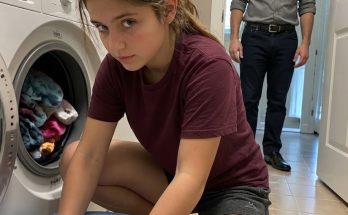
She was bent over a plastic bucket, scrubbing a sweatshirt by hand in freezing water. Her fingers were red and raw.
Beside her, the washing machine was running.
It was filled with everyone else’s clothes.
“Sofia?”
She looked up so quickly that she nearly dropped the shirt.
“Dad?”
She looked terrified to see me.
“Where’s Patricia?”
Patricia was my second wife. Sofia’s mother, Elena, had died from cancer years earlier.
Sofia swallowed.
“They went to Cancún.”
“Who?”
“Patricia, her mom, her sister and Bianca.”
Bianca was Patricia’s sixteen-year-old niece, who had been living with us for almost a year.
“They left you here alone?”
Sofia nodded.
“They’ll be back Sunday. They told me everything had to be clean before they got home.”
I pointed toward the washing machine.
“Then why are you washing your clothes by hand?”
She looked down.
“I’m not allowed to use the machine for my stuff.”
I thought I’d misunderstood her.
“What?”
“They say wasting electricity and water on my clothes costs too much.”
Then she quickly pulled down the sleeves of her sweatshirt.
That movement caught my attention.
“Sofia.”
She froze.
“Pull your sleeves up.”
“Dad, I’m cold.”
“Please.”
Slowly, she obeyed.
I saw fading bruises, scratches and several dark marks along her forearms.
I didn’t yell.
I didn’t call Patricia.
I didn’t start smashing things.
Thirty years of driving trucks had taught me something important: when something goes wrong at highway speed, panic makes everything worse.
I told Sofia to shower and get some sleep.
Then I finished hanging the family’s laundry myself.
Afterward, I sat alone in the kitchen until sunrise.
At five in the morning, I made oatmeal pancakes.
Elena used to make them for Sofia.
When my daughter walked into the kitchen, I placed a plate in front of her usual chair.
“Sit down.”
She hesitated.
“You can sit here.”
She slowly lowered herself into the chair.
“Now tell me everything.”
It took several minutes before she started talking.
And once she did, she spoke without crying.
That frightened me even more.
She told me about meals she’d been denied.
Punishments that kept her awake until early morning.
Bianca hitting and humiliating her.
Her phone being hidden.
Patricia answering calls from school and pretending to speak for her.
Then Sofia told me about her birthday.
They had bought a cake.
Invited people.
Put up decorations.
Even used the candles I’d paid for.
But the party wasn’t for Sofia.
They’d celebrated Bianca instead.
“You called that day,” Sofia said quietly.
I remembered.
Patricia had told me Sofia was asleep.
“I wasn’t asleep,” my daughter said.
“I was outside.”
I stared at her.
“Outside where?”
“In the backyard.”
She looked down at her pancakes.
“I watched them through the window.”
Something inside me broke.
Then Sofia said:
“There’s something else.”
“What?”
“The silver cup Mom left me.”
I immediately knew which one she meant.
Elena had left Sofia a small engraved silver keepsake before she died.
“I found it in Patricia’s nightstand.”
I stood.
Upstairs, I opened the drawer.
The silver keepsake was wrapped inside a handkerchief.
But underneath it were things I wasn’t expecting.
Pawnshop receipts.
Bank cards carrying names I didn’t recognize.
Financial documents.
And a thick folder.
One word was written across the front:
WIDOWERS.
I opened it.
And suddenly, the marks on my daughter’s arms were only the beginning.
PART 2
Inside were printed obituaries from Guanajuato, Querétaro and San Luis Potosí.
Beside each name were handwritten notes.
Owns property.
No children.
Savings.
Vulnerable.
In progress.
Then I reached the fourth page.
My name was there.
Gabriel Torres. Widower. Transportation business. Strong assets. Daughter emotionally dependent on father.
Beside it, Patricia had written:
TARGET ALMOST SECURED.
I felt physically sick.
Patricia hadn’t entered my life by accident six months after Elena died.
Those sympathetic conversations at the cemetery hadn’t been coincidence.
Neither had our “unexpected” encounters at the supermarket.
Even the pot of soup she’d brought me because she supposedly understood grief suddenly looked different.
Before touching anything else, I took out my phone.
I recorded every drawer.
Every page.
Every receipt.
Inside the closet, I found packed suitcases, enough clothes for months, and nearly four hundred thousand pesos in cash.
Then I found Sofia’s phone hidden beneath a stack of towels.
When I turned it on, messages flooded the screen.
Teachers.
Friends.
School administrators.
And nineteen missed calls from me.
For months, Patricia had been controlling Sofia’s communication with the outside world.
Then I found a video.
Bianca was smashing Sofia’s bicycle against the curb while laughing.
The filename read: