She went back to the station.
I stood there another second.
Thursday. And After.
Marcus came back Thursday. And the Thursday after that.
Baby Boy Montgomery was in our unit for six more weeks. In that time, Chloe Montgomery returned twice, briefly, and we connected her with a social worker named Evelyn who was good at the kind of quiet, patient work that doesn’t show up in any chart. That’s a longer story, and it belongs to Chloe, not to me.
What I can tell you is that by week four, the baby had a name written on a small card taped to his incubator. Not a legal name, not yet, but a name the nurses had started using among themselves.
Cub.
Marcus hadn’t suggested it. He’d never called him that in front of us, only in that first whispered minute. But somehow the name had moved through the room on its own, the way things do in a unit where everyone is watching everyone else closer than they let on.
He went home eventually. Healthy enough. The paperwork took longer than the medicine.
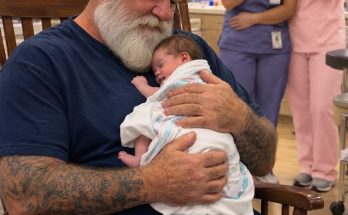
Marcus still volunteers. He’s been doing it for two years now. He has a regular Thursday slot and a backup Wednesday if someone cancels. He holds babies that nobody visits. He sits in that chair for hours at a time and he talks to them in that low rumble about bears and mountains and rivers.
He never makes it about himself.
But on his left wrist, every time his sleeve rides up, there’s Dylan.
Five letters and a date.
And I think that’s why his hands are so careful.
FINAL PART
Three years after that first long Thursday in the NICU, our unit celebrated the tenth anniversary of the Infant Comfort Volunteer Program.
We held a small gathering in the hospital’s courtyard. Doctors, nurses, social workers, and former patients’ families mingled around folding tables covered with punch bowls and platters of cookies.
Marcus stood near the brick perimeter wall, looking as out of place among the pastel decorations as he had on his first day in the nursery. He wore his black leather vest over a clean flannel shirt, his thick beard neatly trimmed, holding a tiny paper cup of lemonade that looked absurdly small in his giant hand.
As I walked over to join him, a young woman pushing a stroller approached from the main entrance.
She looked healthy, confident, and settled. Beside her walked Evelyn, our department social worker, smiling broadly.
“Marcus,” I said gently, touching his forearm. “There’s someone here who wants to meet you.”
Marcus turned. As his eyes fell on the woman and the little boy sitting in the stroller, he went entirely still.
It was Chloe Montgomery.
And strapped into the stroller, holding a plastic toy truck, was a healthy, chubby-cheeked three-year-old boy with bright brown eyes and a mop of curly hair.
Chloe stopped a few feet away, her hands clutching the handles of the stroller. She looked up at Marcus—at his six-foot-seven frame, his tattoos, and his broad, weather-worn face—without a trace of fear.
“You’re Marcus,” she said, her voice small but steady.
Marcus nodded slowly, removing his leather cap. “I am. Ma’am.”
“Evelyn told me about you,” Chloe said, tears welling in her eyes. “She told me about those long Thursdays when I couldn’t be here… when I was too broken, too lost, and too terrified to face that room.”
She stepped closer and took Marcus’s giant, scarred right hand in both of hers.
“You held my son when his own mother couldn’t. You gave him warmth when I had nothing left to give. I never got to thank you.”
Marcus looked down at her, his eyes softening. “You don’t need to thank me, Chloe. You did the hard work. You came back for him.”
He slowly crouched down, his stiff knees popping, until he was eye-level with the little boy in the stroller.
The three-year-old stopped playing with his toy truck and stared at Marcus. Then, without a second of hesitation, the boy reached out his small hand and patted the thick white beard frame on Marcus’s chin.
A soft chuckle rumbled deep in Marcus’s chest—a sound as warm and familiar to our unit as the gentle rock of that old chair.
“Hey there, little cub,” Marcus whispered gently. “Look at you now. Strong as an oak.”
The boy giggled, handing his toy truck up to Marcus.
Chloe wiped a tear from her cheek and smiled. “His legal name is Caleb now,” she said. “But at home… I still call him Cub.”
Marcus stood up slowly, handing the toy back to the boy with infinite care. He looked at Chloe, then at Caleb, and finally at the small gray tattoo resting on his left wrist beneath his watch band.
For three years, I had watched Marcus give hours of his life to nameless, vulnerable babies in the dark corners of the hospital. But standing there in the warm afternoon sunlight, watching Dylan’s memory blossom into life, healing, and hope for another family, I realized something profound.
Marcus hadn’t just saved a lonely baby on a cold Thursday morning three years ago.
By opening his giant, scarred hands to the world’s most fragile lives, he had allowed the world to heal him right back.