PART 1
The first time I saw the giant biker step into our NICU, I thought he had taken a wrong turn.
He was the kind of man people noticed before he ever said a word.
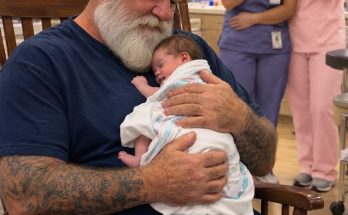
Nearly six-foot-seven. Broad shoulders. Shaved head. Thick white beard. Tattooed arms. And hands so large and scarred they looked more suited for welding steel than holding something as fragile as a newborn baby.
His black leather vest had been left outside the unit because of hospital rules. But even in a blue disposable gown, Marcus “Bear” Miller still looked completely out of place beneath the soft lights of St. Jude Children’s Hospital.
I had been a NICU nurse for thirteen years. I knew that room by heart. The quiet beeping of monitors. The warm glow over incubators. The whispered prayers of parents who thought no one could hear them. I had seen fear, hope, grief, and miracles all folded into the same tiny blankets.
But Marcus did not look like someone who belonged near babies born too soon.
Then the baby in bed nine started crying. And everything changed.
His chart said only Baby Boy Montgomery. No first name. No family pictures taped beside his incubator. No stuffed animals. No balloons. No proud grandparents waiting in the hallway.
He had come into the world too early. Too small. And far too alone.
His mother, Chloe Montgomery, was young and overwhelmed, tangled in problems no single hospital room could solve. She had left before the paperwork was even finished. No father signed in. No relatives called.
Some babies arrived with whole families surrounding them. Baby Boy Montgomery had only a bracelet, a temporary name, and a cry that sounded too tired for someone who had only just begun life.
That morning, we tried everything. We checked his temperature. Adjusted his swaddle. Dimmed the lights. Reviewed his feeding schedule. Watched every tiny breath and every number on the monitor.
Still, he cried.
Marcus turned toward the sound. Then he looked at me and asked in a voice much softer than I expected, “Is that the little one who needs someone to sit with him?”
I glanced at his volunteer badge. He had passed the checks. Completed the training. Been approved for the infant comfort program.
Still, I hesitated. And I’m ashamed of the reason.
I looked at his hands. They were huge. Rough. Scarred. For one second, I wondered if hands like that could possibly be gentle enough.
But Marcus washed exactly as he had been taught. He listened to every instruction. He sat down carefully in the approved rocking chair, his large body stiff with caution, as if he was afraid one wrong breath might be too much.
When I placed Baby Boy Montgomery against his chest, he cried harder. Two nurses looked over. A doctor paused near the doorway.
Marcus only lowered his chin and whispered, “Easy now, little cub. I’m right here…”
PART 2
The baby did not stop immediately.
That’s not how it works. Not in movies, not in real life.
For about ninety seconds, Baby Boy Montgomery screamed against Marcus’s chest, and I stood close enough to intervene if the monitors said anything I didn’t like.
Marcus didn’t flinch. He didn’t look up for reassurance. Didn’t check my face to see if he was doing it right. He just rocked, slow and steady, and kept talking in that low rumble, words I couldn’t fully make out, something about bears and mountains and a river he knew somewhere.
Then the crying softened. Then it stopped.
The room didn’t go silent in some dramatic way. The monitors kept beeping. Someone’s IV pump beeped twice down the hall. A colleague of mine, Sarah, was typing at the nurses’ station with the same rhythm she always used.
But the baby stopped crying. And Marcus closed his eyes. Just for a second. Like he was the one who had needed it.
I wrote it in my notes and went back to work.
The Chair He Didn’t Leave
The first hour, I checked on them every fifteen minutes. The second hour, I stretched it to twenty. By hour four, I had to stop hovering because other babies needed me and because, honestly, watching them made it hard to focus on anything else.
Marcus sat in that rocking chair like he had been bolted to it. He accepted water when Sarah offered it. He used the restroom once, handed the baby carefully to another nurse, and was back before I had finished charting the handoff.
He didn’t use his phone. He didn’t read. He just sat there with this tiny, nameless baby against his chest and rocked. Slow. Even. Patient.
A few parents glanced at him from across the room. One father, a young guy named David who’d been here eleven days with his own premature daughter, walked over around hour six and just nodded at Marcus. Didn’t say anything. Marcus nodded back.
That was enough.
By hour eight, the day shift nurses who had seen Marcus come in were starting to go home, and the night crew was filtering in. They got the rundown. A couple of them stared. One of them, a newer nurse named Julia, asked me quietly if we should “do something about the large man in the rocking chair.”
I told her he was a volunteer.
She said, “He’s been there since this morning.”
I said, “I know.”