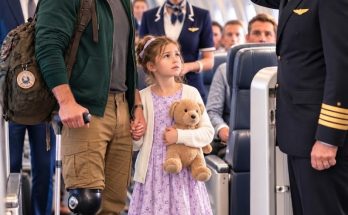
My seven-year-old daughter and I were ordered to give up our first-class seats for a wealthy businessman and “move to the back,” as though that was where we belonged.
**Part 1**
I didn’t argue.
I took my daughter’s trembling hand, lifted my bag, and started down the aisle.
Then the cockpit door opened.
The captain stepped out, looked at me, and froze.
A second later, he straightened and raised his hand in a crisp salute.
The cabin fell silent.
“Sir, we need you and your daughter to move to the back of the aircraft,” the gate agent said.
He spoke loudly enough for nearly everyone around us to hear.
What he didn’t know was that my veteran ID sat behind my boarding pass, my old unit’s challenge coin hung from my carry-on, and my last name appeared on the passenger manifest near someone who might understand what I had once sacrificed.
My daughter Maya looked up at me.
“Daddy, I thought these were our special seats.”
That stung more than losing first class.
My name is Marcus Vance.
I’m forty-one, a widower, a single father, and a veteran who returned from my last deployment missing most of my left leg below the knee.
I rarely talk about my service.
To most people, I’m just a tired father with a cane keeping up with a seven-year-old who still asks if her mother can see her from heaven.
That morning, Maya and I flew to the Carolina coast.
It wasn’t really a vacation.
We were returning to the beach where my wife Elena and I fell in love.
Before cancer took her two years earlier, she asked me for one thing:
Someday, take Maya back there.
My carry-on held a small container I had packed before sunrise.
I was taking Elena back to the ocean.
It had taken nearly two years to afford those first-class tickets.
A coffee can sat on top of our refrigerator with “Mama’s Beach Fund” written across it in Maya’s handwriting.
Some weeks I added twenty dollars.
Other weeks, just a few.
Maya added coins from her pink purse, believing each one brought us closer to saying goodbye to her mother.
When we boarded and she saw the large seats, her face brightened.
“Daddy, are these really ours?”
“They are.”
For ten minutes, I felt I had kept my promise.
Then the gate agent appeared with a tablet.
Behind him was a man in an expensive navy suit.
The businessman had arrived late but was apparently a major corporate traveler whose company expected first-class seating.
According to the agent, he “required” our seat.
Required.
Not requested.
The agent eyed my cane, worn boots, and Maya’s old coat.
I could almost see him decide.
We looked least likely to complain.
I held up our boarding passes.
“These are our seats. I paid for them.”
The agent gave me a stiff smile.
“I understand, sir, but please don’t make this harder than it needs to be.”
Maya squeezed my hand.
I could have argued.
I could have mentioned two years of saving.
The coffee can.
Elena’s hospital room.
Her final request.
The ashes inside my bag.
But Maya was watching me.
So I looked down at her and smiled.
“Maybe the seats in the back will be fun. We’ll get to see the whole plane.”
She nodded.
But tears were forming.
That almost broke me.
I didn’t care about first class.
I had slept in places far worse than an airplane’s last row.
What hurt was seeing my daughter learn that strangers could decide her father mattered less than someone richer.
I stood.
Pain shot through my left side as I steadied myself on my cane.
I lifted the carry-on to my chest.
To everyone else, it was luggage.
To me, it held something sacred.
Then I took Maya’s hand.
The cabin quieted.
Some passengers watched.
Others looked away.
We had taken only a few steps when the cockpit door opened.
The captain stepped into the aisle.
Gray touched his temples; his uniform was immaculate.
At first, he didn’t look at the gate agent.
He looked at me.
Then he noticed my cane.
The challenge coin on my bag.
The veteran ID still visible beside my boarding pass.
His expression changed.
Recognition followed.
Not because he knew me.
Because he understood what they represented.
The captain stepped closer.
Then he squared his shoulders and raised a crisp military salute.
The aircraft fell silent.
For a moment, I nearly lost my grip on the bag.
For two years, I had been the widower limping through school pickup.
The tired father strangers passed in stores.
The man people passed because he walked too slowly.
Now an airline captain saluted me before the whole cabin.
I stood as straight as I could.
Then I returned the salute.
Maya stared as if seeing her father differently for the first time.
The captain lowered his hand.
“Sir,” he said loudly enough for first class to hear, “it’s an honor to have you aboard my aircraft.”
Then he turned toward the gate agent.
“This man and his daughter are not moving.”
The agent went pale.
The businessman dropped his gaze.
The captain continued.
“They are exactly where they belong.”
Nobody spoke.
But then the captain glanced at the passenger manifest near the galley.
His expression shifted again.
This time it was more than respect.
It was something personal.
He looked at me.
“Vance?”
A chill went through me.
The cabin stayed silent.
Then I realized the captain hadn’t saluted me only because I was a veteran.
He knew my name for another reason.