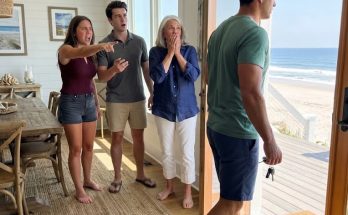
Before that summer, I had seen my father cry only twice in my entire life. The first time was when his father di3d.
**Part 1**
I was seven.
Dad stood beside the woodpile in our backyard with his back toward the house, his shoulders moving in a way I had never seen before.
Mom rested her hand on my head.
“Leave him alone, Lucas. Some things a man has to do by himself.”
The second time was when I graduated from Oregon State.
Dad sat high in the stadium bleachers wearing the only decent jacket he owned—a brown corduroy one with patches on the elbows.
When they called my name, I looked up and caught him wiping his face with a handkerchief.
Afterward, he didn’t hug me.
Sinclair men weren’t very good at hugging back then.
He simply gripped my hand tightly.
“Good job, son.”
Then he walked quickly toward the parking lot before I could see his eyes again.
The third time he cried happened decades later.
On a gray June morning in Cannon Beach, Oregon.
And it happened when I placed a set of house keys into my mother’s hand.
My parents are Samuel and Irene Sinclair.
Dad spent forty-three years working at a paper mill in Longview, Washington.
He started at nineteen sweeping floors.
He retired as a shift supervisor.
In forty-three years, he missed eleven days.
Nine were when my mother had surgery.
The other two were the days my sister and I were born.
Mom worked at the front desk of the local public library for thirty-one years.
She knew nearly every regular.
She knew which elderly men came every morning because they were lonely.
She knew which children stayed after school because nobody was waiting for them at home.
She kept granola bars underneath the desk for those kids.
Bought them with her own money.
Never told anyone.
That was my parents.
Quiet.
Hardworking.
Never asking for anything.
We grew up in a small blue house on Alder Street.
Two bedrooms.
One bathroom.
My older sister, Fiona, had the second bedroom.
I slept on a fold-out couch in the den until I was fourteen.
Then Dad spent an entire summer finishing the attic himself so I could finally have a room.
Dad drove the same brown Ford truck for twenty-two years.
Rust eventually ate holes through the rear wheel wells.
You could literally see the road through part of the passenger-side floor.
When I asked why he didn’t buy another truck, he gave me the answer he gave for almost everything.
“This one still runs.”
That was his philosophy.
If something worked, you kept it.
If it broke, you fixed it.
If it couldn’t be fixed, you figured out how to live without it.
Every summer, families around us went somewhere.
Disneyland.
Yellowstone.
Hawaii.
We never did.
“Maybe next year,” Dad always said.
Next year never came.
I didn’t understand why until I was older.
Every dollar my parents didn’t spend on vacations went into two savings accounts.
One for Fiona.
One for me.
College.
Fiona attended the University of Washington.
I went to Oregon State.
My parents paid most of the cost for both of us.
They never told us how much.
Never once acted as if we owed them anything.
The summer after graduation, I accidentally discovered the truth.
I was searching Dad’s filing cabinet for my birth certificate when I found the statements.
I sat on the floor and added everything up.
My parents had spent nearly twenty years of savings on our education.
Then I found another folder.
On the front, in Mom’s handwriting, was one word:
**SOMEDAY.**
Inside were old real-estate listings clipped from newspapers.
Small cottages in Seaside.
Manzanita.
Cannon Beach.
Some dated back to the 1990s.
On one faded clipping showing a little gray house near the ocean, Mom had circled the porch and written:
**Sam, look at that view.**
That was when I understood.
My parents had once planned to retire near the coast.
And they had spent their someday on us.
I quietly put the folder back.
I never told them I had seen it.
But I never forgot.
Years passed.
I’m forty-four now.
When I was twenty-nine, I started a logistics company with a used box truck and a bank loan.
Today we move freight throughout the West Coast.
More than three hundred employees.
Warehouses in Portland, Sacramento, and Tacoma.
I’m not television-billionaire rich.
But I’ve done well.
Very well.
For years, I tried to give my parents money.
They refused.
“Everything we need is already here,” Dad would say.
I offered him a new truck.
“The old one still runs.”
I offered to pay off their mortgage.
“Almost finished anyway.”
I offered Hawaii.
Dad claimed he hated flying.
He had never actually been on an airplane.
Mom eventually told me,
“Lucas, we didn’t raise you so you could repay us. We raised you so you could have a good life. Go live it.”
Then, two years ago, Dad was diagnosed with Parkinson’s disease.
It began with a tremor in his right hand.
Small at first.
A coffee cup.
A page turning.
He tried hiding it.
Mom noticed.
Then I noticed during Thanksgiving when he struggled to carve the turkey.
The neurologist told us it was still early.
Medication could help.
Dad could have many good years.
But eventually his balance, walking, and possibly his speech would become more difficult.
Dad accepted the diagnosis the same way he accepted everything.
Quietly.
In the hospital parking lot, he said,
“Well, I guess being a brain surgeon is off the table.”
Mom laughed.
Then cried during the drive home.
Dad held her hand with his trembling right hand.
That was the moment I decided.
They had given up their someday for me.
I was going to give it back while Dad could still walk on the beach.
It took four months.
I toured forty-one properties along the Oregon coast.
Then my realtor showed me a house in Cannon Beach.
Cream-colored exterior.
White trim.
Gray roof.
Two stories, but importantly, the main bedroom and bathroom were downstairs.
Dad wouldn’t need stairs later.
A wraparound porch ran along three sides.
Beyond it were dunes.
Sea grass.
Sand.
And the Pacific Ocean.
From the porch you could see Haystack Rock.
I stood there in the cold March wind and remembered Mom’s handwriting on that yellow newspaper clipping.
**Sam, look at that view.**
The house cost $425,000.
I paid cash.
But I made one important decision.
I kept the legal title in my name.
My attorney, Naomi Reyes, recommended it.
She had handled my company’s legal matters for twelve years and had never given me bad advice.
“Your father has a progressive neurological disease,” she said. “Your mother is getting older. They’re kind people, Lucas. Trusting people. That can make them vulnerable.”
“A scammer. A contractor. Even a relative could pressure them.”
I told her my family wasn’t like that.
She gave me a look.
“Every family says that. Until something happens.”
So we created an arrangement.
I remained the legal owner.
My parents received a written lifetime right to live there.
No rent.
No conditions.
Nobody could sell the property.
Mortgage it.
Transfer it.
Or remove them.
Not even me.
The house would always be available to them.
I handled taxes and insurance.
Their only responsibility was to live there.
I placed the original deed and agreement inside a sealed folder bearing the county recording stamp.
Then I locked it inside the bottom drawer of a small antique writing desk by the front windows.
I kept the key.
I remember thinking:
**We’ll never need this.**
I was wrong.
My parents’ fiftieth wedding anniversary fell on June 14.
Fiona wanted a large celebration.
Hall.
DJ.
Two hundred guests.
“Our parents would hate that,” I told her.
She wanted to know what my better idea was.
I didn’t tell her.
Maybe I should have.
On the morning of their anniversary, I picked Mom and Dad up from the blue house on Alder Street.
I told them we were taking a drive.
“To the ocean?”
Dad raised an eyebrow.
“On a Thursday?”
“It’s your anniversary. The ocean works on Thursdays.”
The drive took almost two hours.
The sky was gray.
Typical Oregon coast.
When I pulled into the driveway, Dad looked toward the house.
“Who lives here?”
I didn’t answer.
I got out.
Opened Mom’s door.
Then pulled a silver key ring from my pocket.
Two keys.
A little brass seashell charm.
I placed them in Mom’s palm.
“Happy anniversary, Mom.”
Then I looked toward Dad.
“Happy anniversary. Welcome home.”
Mom stared at the keys.
Then at the house.
Then at me.
“Lucas… what did you do?”
“I bought you your someday.”
For several seconds, she didn’t understand.
Then suddenly she did.
Her hand covered her mouth.
“The folder.”
I smiled.
“You found the folder.”
“Twenty-two years ago.”
She began crying.
No cameras.
No speeches.
No giant party.
That wasn’t who my parents were.
Dad slowly climbed out of the car using his cane.
He walked toward the porch.
One step at a time.
Then around to the side facing the ocean.
He placed both weathered hands on the white railing.
His right hand trembled.
He tightened his grip.
And stared across the dunes toward Haystack Rock.
Mom walked up behind him.
She rested one hand on his back.
“Sam.”
He turned slightly.
“Look at that view.”
That was the third time I saw my father cry.
For the next three weeks, my parents sounded happier than they had in years.
Mom called every evening.
She told me about tide pools.
Puffins.
A bakery selling marionberry scones.
A seal sleeping on the beach.
“Your father walks every morning,” she told me.
“Down to the water and back.”
“The doctor says walking is good for him.”
I asked whether Dad was careful.
“We hold hands.”
She laughed.
“Fifty years together and we’re walking on the beach holding hands like teenagers.”
Once, Dad took the phone.
He hated phones.
He said exactly three sentences.
“The porch is good.”
“I watch the sunset every night.”
“Thank you, son.”
Those words mattered more to me than anything my company had ever earned.
Then Fiona arrived.
My sister is three years older.
We were close as children.
She taught me to ride a bicycle.
Defended me at school.
But somewhere during adulthood, something changed.
Fiona became a dental hygienist.
She worked hard.
Made decent money.
Then she married Gregory Halvorsen.
Gregory sold real estate.
Or tried to.
He was always talking about his next big transaction.
His next investment.
His next opportunity.
He drove an enormous black pickup and wore expensive sunglasses.
At family gatherings, he called me “the trucker.”
Even though I hadn’t personally driven a truck for years.
“How’s the trucking business, trucker?”
My parents never said they disliked him.
But I could tell.
Fiona and Gregory had two sons.
Owen, sixteen.
Quiet and serious.
Caleb, fourteen.
Funny and energetic.
Over the years, Fiona called less often.
And when she did call, she usually needed help.
Roof repairs.
Braces.
Gregory’s truck payment.
I helped.
She was my sister.
When she discovered I had purchased the beach house, she called immediately.
“A beach house?”
“You bought Mom and Dad a house in Cannon Beach?”
“For their anniversary.”
“How much?”
“Why does that matter?”
Her voice tightened.
“You didn’t include me.”
I tried explaining.
She interrupted.
“You didn’t even think about me.”
Then hung up.
Two weeks later, Mom called.
“Your sister is visiting.”
Fiona, Gregory, and the boys were coming for a few days.
Mom sounded delighted.
I thought nothing of it.
Why would I?
My sister was visiting our parents.
Then a few days became a week.
A week became two.
Mom’s evening calls became shorter.
She sounded tired.
“When are they leaving?” I asked.
“Soon.”
Apparently Gregory was experiencing a “slow period” in real estate.
Near the end of the second week, Dad got on the phone.
“Gregory’s asking questions about the house.”
“What questions?”
“Value.”
“Taxes.”
“Whether it’s paid off.”
I told him Gregory could call me.
He never did.
Then Mom stopped calling.
Three days.
Four.
Five.
I called her.
Voicemail.
I called the house.
No answer.
Then I called Fiona.
“Mom’s fine.”
Too quick.
“She’s busy.”
“Why isn’t she answering?”
“Maybe she lost her phone. She’s seventy-three, Lucas.”
“My mother has never lost her phone.”
Fiona became defensive.
“People get old. Dad is sick. Mom’s getting forgetful. Maybe you’d know if you were ever actually around.”
Then she hung up.
I was sitting in my Portland office when an unfamiliar number texted me.
**Uncle Lucas, this is Owen. Please don’t tell Dad I texted you. Something is wrong. Dad keeps yelling at Grandpa. Grandma is scared. I don’t know what to do.**
Everything inside me went cold.
Before I could answer, Mom called.
“Mom?”
For several seconds, all I heard was breathing.
Then her voice came through barely above a whisper.
“Lucas…”
“Sweetheart…”
“Maybe you should come.”
I heard a man shouting somewhere behind her.
Then the call disconnected.