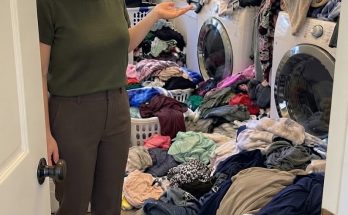
Let me start with the washing machine.
**Part 1**
I bought it the year my husband, Frank, and I moved into our house on Elm Creek Road.
It was a plain white top-loader with absolutely no personality.
The kind of appliance you barely think about because it simply does what it is supposed to do.
For thirty-one years, laundry was my job.
Not because Frank and I ever sat down and divided the chores formally.
It just happened naturally.
He took care of the yard, repairs, the car, and everything outside.
I handled the house.
And I did the laundry.
Every week.
For thirty-one years.
Frank’s shirts were washed, pressed, and hung.
His socks were matched and folded.
When our son Marcus was born, I washed his clothes too.
Grass stains.
Paint on sleeves.
Socks that mysteriously entered the machine in pairs and came out alone.
I became very good at laundry.
I still am.
But after three decades of doing it, I learned something.
Laundry isn’t only laundry.
It is attention.
You handle the things another person wears against their skin.
You see the evidence of their days.
Where they have been.
What they spilled.
What they worked in.
What they lived through.
There is something intimate about caring for someone’s clothes.
I had willingly done that for the people I loved.
What I had never agreed to was becoming the unpaid laundry service for anyone who happened to arrive at my house with a bag.
My name is Dorothy Calloway.
I’m sixty-eight years old.
My husband, Frank, died four years ago.
My son Marcus is thirty-seven and works as a structural engineer.
He is extremely capable professionally.
Personally, he has always been somewhat less skilled at handling uncomfortable situations.
I first noticed that when he was around fifteen.
I kept hoping he would grow out of it.
He’s still working on it.
His wife, Vanessa, is thirty-four.
She is a marketing director at a software company.
Vanessa is intelligent, organized, ambitious, and very efficient.
I respected that about her.
The problem was that her efficiency sometimes meant finding someone else to do whatever she didn’t have time for.
Eventually, that someone became me.
It began with one basket.
Marcus and Vanessa had been married six years.
They lived about twenty minutes away and came over most Sundays with their two children.
Lily was eight.
Theo was five.
Sunday dinner at Grandma’s had become part of the rhythm of our family.
I loved it.
I adored those children.
Lily had Frank’s eyes and his habit of truly listening when people spoke.
Theo had my laugh, which I considered a compliment to both of us.
For those children, I would have done almost anything.
One afternoon, Vanessa carried a laundry basket into the house.
“Would you mind throwing these in with yours?”
It seemed harmless.
I was already doing laundry.
One extra basket was nothing.
So I said yes.
The first time, it really was nothing.
The second time, there were two baskets.
Again, I didn’t mind.
They were busy.
The kids had activities.
Life happens.
But by the sixth or seventh time, baskets had turned into bags.
And requests had turned into assumptions.
Soon, Vanessa was showing up every weekend with bags of laundry and placing them beside my washing machine.
Then she would leave with everything clean, folded, and organized.
I noticed something.
She never helped fold.
And she never thanked me in a way that acknowledged the actual work.
She would say,
“Thanks, Dorothy.”
But in the same tone someone might use at a drive-through window.
Efficient.
Quick.
Barely looking at me.
I also noticed that Marcus never said anything.
That bothered me more.
He would sit at my kitchen table eating the lunch I had prepared while his wife carried bags of laundry into my basement.
He knew exactly what was happening.
He simply chose not to comment.
Silence may not be agreement.
But when someone is being treated unfairly in front of you, silence can start to look a lot like permission.
One Sunday, after Vanessa brought another enormous bag, I finally said something.
“Vanessa, I’m sixty-eight. I don’t mind helping occasionally, but I’m not your laundromat.”
I deliberately kept my voice calm.
I wasn’t trying to start an argument.
I was simply stating a fact.
Vanessa laughed.
Not cruelly.
Almost as if she thought my complaint was slightly ridiculous.
“You’re home all day anyway.”
I looked at Marcus.
He stared at his plate.
That moment stayed with me.
Vanessa’s comment hurt, but at least I understood it.
In her mind, retirement meant availability.
If I was home, then obviously I had time.
It was a selfish way of thinking, but at least it was visible.
Marcus’s reaction was harder.
His wife had dismissed his mother right in front of him.
And he looked at his plate.
He was thirty-seven years old.
And he looked at his plate.
I thought about Frank.
Frank would not have looked at his plate.
He would have spoken quietly and calmly.
He would have said something like,
“My mother asked you not to bring the laundry anymore. We’ll take it home.”
And that would have been the end of it.
But Frank was gone.
And Marcus had said nothing.
I spent the next week thinking.
Not constantly.
But enough.
Two questions kept returning.
What should I do about the laundry?
And what should I do about the deeper issue—the idea that because I was retired, my time belonged to anyone who wanted it?
I decided to deal with the laundry first.
One problem at a time.
The following Saturday, Vanessa arrived with four bags.
Four.
More than she had ever brought before.
Marcus carried them downstairs and lined them up beside my washing machine.
That was apparently where his involvement ended.
I looked at the bags.
Then smiled.
“Leave them downstairs.”
Vanessa looked surprised.
Maybe she had expected another argument.
“Are you sure?”
The question sounded automatic.
“Perfectly.”
She went back upstairs.
I waited until everyone had settled outside.
The afternoon was mild.
Marcus had brought a cooler.
The children were running around the yard.
Vanessa was on her phone.
I went downstairs.
I had already decided exactly what I was going to do.
I was going to sort the laundry.
Not wash it.
Sort it.
Vanessa’s clothes in one bag.
Marcus’s in another.
The children’s things separated as well.
Then I would return everything exactly as it had arrived.
Unwashed.
My original plan was to leave a note explaining that everyone could now take care of their own things.
Simple.
Calm.
No screaming.
No drama.
Just a change in the arrangement.
I opened the first bag.
Nothing unusual.
Then I began sorting the second.
That was when I found the shirts.
Men’s dress shirts.
And they were not Marcus’s.
I knew that instantly.
You might wonder how.
But when you have washed someone’s clothes for the first sixteen years of their life, you know their things.
Marcus preferred practical clothes.
Good quality, but nothing flashy.
These shirts were different.
Expensive.
Tailored.
Chosen by someone who cared very much about how he looked.
I placed them aside.
Then I found a pair of dark gray dress trousers.
Too narrow for Marcus.
Too short.
There was a tailor’s label inside.
Someone else’s trousers.
I placed them beside the shirts.
Then came three white button-down shirts with dry-cleaning tags attached.
The cleaner was located across town.
Not the place Marcus and Vanessa normally used.
I knew because I had once driven Vanessa to collect their clothes when her car was being repaired.
I sat back on the basement floor and stared at the pile.
My first thought was immediate.
Call Marcus.
My phone was in my pocket.
My hand actually moved toward it.
Then I stopped.
I thought about what would happen if I called him.
The children were outside playing.
Marcus was sitting in my backyard.
It was a normal Saturday afternoon.
And the only thing I truly knew was that I had found men’s clothes that did not belong to my son inside Vanessa’s laundry bags.
I didn’t know why they were there.
Of course, one explanation came to mind immediately.
The obvious one.
But I did not actually know.
And once certain words are spoken, you cannot take them back.
I thought about Frank.
Frank would not have called Marcus from the basement without knowing the full story.
He would have asked himself what was his business and what wasn’t.
My business was the laundry.
Their marriage was theirs.
So I continued sorting.
Vanessa’s pile.
Marcus’s pile.
The children’s clothes.
And the unfamiliar men’s clothes went with Vanessa’s things because they had arrived in her bag.
I put everything back into separate bags.
I decided not to leave the note.
I didn’t start the washing machine.
Then I went upstairs and prepared dinner.