**Part 1: The Hospital and the Lake**
**Chapter 1**
He reached for his radio, and for the first time since I had seen those twelve missed calls, something inside my chest unclenched just a little.
It wasn’t relief. It was something steadier than that. It was the feeling of finally not being the only adult in the room who understood what had happened.
“Ma’am,” the officer said after he finished speaking into the radio, “my name is Officer Ramirez. I’m going to need copies of everything you just showed me. Can you forward the text and the voicemail to this email?”
He handed me a card. My hands were steady as I sent them. I remember being surprised by that. I had always imagined that if something truly terrible happened to my child, I would fall apart. Instead, I felt like a glass of water that had been set down very carefully on a table. Completely still. Completely full.
“Is there anyone else with your daughter right now?” he asked.
“Just me.”
“And her father?”
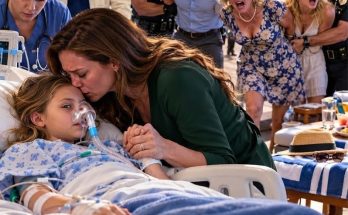
I looked through the glass at Lily. Her small chest rose and fell under the hospital blanket. A nurse was adjusting one of her IV lines, speaking softly to her.
“Her father is at the lake,” I said.
Officer Ramirez didn’t say anything to that. He didn’t have to.
The lake club was forty minutes north of the city, a private place with white umbrellas, a members-only dock, and a restaurant where Patricia liked to be seen. She had been a member for twenty-two years. She talked about it the way some people talk about church.
I wasn’t there when the deputies arrived. I heard about it later, in pieces, from three different people. But I have pictured it so many times that I can see it clearly.
It was four in the afternoon. The kids were in the shallow end of the swimming area. Claire was on a lounge chair with sunglasses pushed up in her hair. Mark, her husband, was at the bar ordering another round of iced tea. Patricia was sitting under the biggest umbrella, telling the other members’ wives about her grandson’s travel soccer team.
Daniel was sitting beside her.
Two uniformed deputies walked onto the pool deck and asked for Patricia Carter by name.
The whole deck went quiet. The club manager hurried over, asking if there was some misunderstanding. Patricia stood up, smoothed her linen dress, and smiled the smile she used on waiters and school principals.
“I’m Patricia Carter. How can I help you?”
“Ma’am, we’re following up on a report involving a ten-year-old child named Lily Carter. We understand she was signed out of Westbrook Elementary under your care at approximately 11:40 this morning.”
“Yes, my granddaughter. She’s fine. She’s with a neighbor.”
“She’s currently in the emergency department at St. Agnes Children’s Hospital,” the deputy said. “She was transported by paramedics after she was found unresponsive with difficulty breathing.”
Mark told me later that Daniel’s face went completely white. He hadn’t known. Or rather, he had let himself not know. His mother had told him Lily was resting next door with Mrs. DeLuca, that she was “a little wheezy” and that I was “blowing it up like always.” My messages had said EMERGENCY and CALL ME NOW and LILY IS IN THE HOSPITAL, and he had turned his phone face down on the table because his mother had put her hand on his arm and said, “Don’t let her ruin the kids’ day.”
**Chapter 2**
He read them all standing on that pool deck, with a deputy watching him.
Patricia kept talking. She said she had “handled it.” She said Lily “always exaggerates to get attention.” She said the school nurse was “a nervous young woman who overreacts to everything.”
Then the deputy asked the question that changed everything.
“Ma’am, did you administer the child’s prescribed epinephrine auto-injector?”
Patricia hesitated.
“I didn’t think it was necessary.”
“Were you instructed by school staff to administer it and call 911?”
“She was talking,” Patricia said. “Children who can talk are not dying.”
Every member on that deck heard it. The women she’d been bragging to heard it. The club manager heard it. And Daniel heard it.
The deputy asked her to come speak with them privately. Claire started crying and saying they hadn’t done anything wrong. Mark set down the iced teas and walked the children to the car without a word.
And my husband, for the first time in his life, did not stand next to his mother.
He ran to his car and drove to St. Agnes.
Lily was awake when he got there.
The doctor had just told me she would be staying at least one night for observation because severe allergic reactions can sometimes come back hours later, even after treatment. They call it a biphasic reaction. I had read about it a hundred times in the pamphlets from her allergist. I had never imagined I’d hear a doctor say it about my own daughter.
The mask had been switched to a small nasal tube. Her voice was scratchy, and she was very tired, but her color was coming back. She was holding a stuffed otter a nurse had given her from the hospital’s donation closet.
Daniel stopped in the doorway.
He looked like someone who had run a very long way. His shirt was wrinkled, his hair was still damp from the lake, and his eyes were red. He looked at Lily. Then he looked at me.
I didn’t say anything. I wasn’t going to make this easier for him. But I wasn’t going to make it harder in front of our daughter either.
“Hey, bug,” he said, his voice breaking.
Lily looked at him for a long moment. Then she said something I will never forget.
“Grandma said I was faking.”
Daniel sat down in the chair beside her bed like his legs had given out.
“I know, sweetheart.”
“I told her my throat felt funny. I told her it was scratchy like the time before. She said if I could talk, I was fine. She said I was ruining everyone’s day.” Lily’s eyes filled with tears. “I tried not to ruin it, Daddy. I tried really hard to breathe quieter.”
I had to turn and look out the window.
My daughter, struggling to get air into her lungs, had tried to breathe quieter so she wouldn’t upset the adults who were supposed to protect her.
Daniel put his face in his hands. When he looked up, he was crying, the kind of crying I had only seen once before, when his father passed away.
**Chapter 3**
“You didn’t ruin anything,” he told her. “You did everything right. You told a grown-up. That’s exactly what you’re supposed to do. The grown-ups are the ones who got it wrong. I’m the one who got it wrong.”
Lily reached out and touched his hand with the one that didn’t have an IV.
“You came, though,” she whispered.
“I should have come hours ago.”
She fell asleep a few minutes later, still holding the otter. Daniel sat and watched her breathe, like he was counting every breath to make sure it was real.
Then he stood and walked into the hallway. I followed.
We stood under the fluorescent lights by the vending machines. I kept my voice low.
“You ignored eleven messages from me.”
“I know.”
“Your mother told you I was hysterical, and you believed her. Over me. Over our daughter.”
“I know.” His jaw tightened. “Jen, I have no excuse. I’ve spent my whole life keeping the peace with her. Smoothing things over. Telling myself she means well. And today, keeping the peace almost cost us Lily.”
I studied his face. I had been married to this man for thirteen years. I knew when he was saying what he thought I wanted to hear. This wasn’t that.
“Where do you stand, Daniel?”
“With you. With Lily.” He didn’t hesitate. “Whatever you’re doing, I’m not going to stop you. And if the police want a statement from me, I’ll tell them the truth. Including the part about me.”
“Even if it means your mother faces charges?”
He closed his eyes. “She left our daughter to struggle alone so she wouldn’t lose a reservation. If there are consequences, she earned them.”
It wasn’t forgiveness. Not yet. But it was the first solid ground I had stood on all day.
The first thing to fall apart was the story Patricia had been telling.
By the next morning, she had called Daniel nine times and left voicemails that shifted every few hours. First, Lily had “a mild reaction” and I had “called the police out of spite.” Then, the school nurse had “never mentioned 911.” Then, Mrs. DeLuca had “offered” to watch Lily. Then, Lily had “eaten the cookie herself.”
That last one was the one that did it.
Because Officer Ramirez had already spoken to the school nurse, whose name was Hannah Brooks. And Hannah had kept careful notes.
Patricia had arrived at the school at 11:15 to sign out Lily and her two cousins early for the lake trip, something I had not approved. She had brought a tin of homemade cookies “for the road.” Lily had asked if they had peanuts. According to two of Lily’s classmates who were standing by the office, Patricia had said, “Just a tiny bit of peanut butter. A little won’t hurt you. That allergy doctor of your mom’s is just scaring you.”
Lily took one bite because her grandmother told her it was safe.
Within ten minutes, she was coughing and scratching at her neck. Hannah Brooks brought her into the nurse’s office, saw the hives, heard the wheezing, and pulled out Lily’s emergency plan. She told Patricia, in front of the front office secretary, that Lily needed her auto-injector immediately and that the school was calling 911.