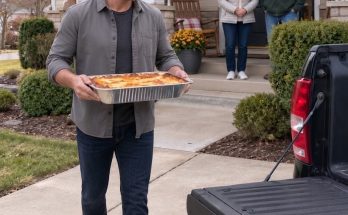
My name is Rick Dalton. I’m fifty-two years old, and I supervise a small HVAC crew in Fort Wayne, Indiana.
**Part 1**
Most of my days are spent around ladders, furnaces, crawl spaces, and the kind of work people rarely notice unless something stops working.
I’ve never minded that.
My father taught me a long time ago that useful work has its own dignity, whether anyone applauds it or not.
Dad’s name is Jack Dalton.
He’s seventy-four now, and he spent fifty years working at the GM plant in Anderson.
He is the kind of man who shows love by showing up.
If your water heater fails at ten o’clock on a Sunday night, Dad appears with a toolbox before you have time to decide who to call.
If you try to thank him, he waves it away like gratitude makes him uncomfortable.
His garage has always smelled like motor oil, cold concrete, and old tools.
To me, that smell has never meant dirt.
It meant reliability.
When I was a kid and something broke, nobody panicked.
We waited for Dad.
Because Dad could usually make things work again.
My wife Karen’s family came from a very different world.
Her parents, Don and Margaret Whitfield, made their money in commercial real estate.
They valued polished manners, expensive clothes, careful presentation, and the kind of social rules nobody ever stated aloud.
They were never openly cruel to my father.
In some ways, that would have been easier.
Instead, they treated him with a kind of exaggerated politeness that always seemed to remind him he was being tolerated.
For twelve years, I let it happen.
Not because I agreed with them.
Not because I thought fifty years of factory work made my father less worthy of sitting at a holiday table.
I stayed quiet because I told myself keeping the peace mattered.
I convinced myself I could stand between both families and absorb whatever discomfort came with it.
That was my mistake.
I didn’t understand just how big a mistake it was until Thanksgiving morning.
It was around eleven.
The turkey had already been roasting for two hours, and the house smelled like every Thanksgiving house somehow does.
Warm.
Familiar.
Comforting.
I called Dad to tell him I was getting ready to pick him up.
Normally, he would make some joke about whether my truck had enough room for a man who had already eaten breakfast twice.
Instead, his voice sounded careful.
“Rick, I don’t think I’m coming this year.”
I stopped.
“What?”
“Karen called last night. She said it was going to be a small dinner and she didn’t want me feeling crowded.”
For a moment, I didn’t say anything.
“She called you?”
“Yeah. She was nice about it.”
He paused.
“She’s probably right anyway. You know me. I’m not much for crowds.”
That wasn’t true.
My father had spent five decades working beside hundreds of people.
He could start a conversation with almost anyone.
He wasn’t making an excuse for himself.
He was making one for Karen.
That was exactly the kind of man he was.
He took someone else’s unkindness and reshaped it into something easier for everyone else to live with.
“I’ll call you back, Dad.”
I walked into the dining room.
Karen was arranging silverware.
The good set.
The one she only used for holidays or special guests.
“Why did you tell my father not to come?”
She placed a fork beside a plate and turned toward me.
She didn’t look surprised.
“Rick, you know how my parents are.”
“What does that have to do with Dad?”
She sighed.
“Your father smells like an old garage. My mother notices things like that, and I don’t want to spend Thanksgiving managing the situation.”
I stared at her.
“He’s not coming,” she added.
She said it calmly.
As though she had solved a logistical problem.
For several seconds, I didn’t respond.
I’m better with problems that have physical solutions.
A broken furnace.
A leaking line.
Something you can take apart, examine, and put back together correctly.
This wasn’t that kind of problem.
But eventually, I understood exactly what I was looking at.
This wasn’t really about a smell.
My father had smelled faintly of his work for as long as Karen had known him.
She had eaten at his table.
Accepted his help.
Let him drive forty minutes one February morning to repair our furnace when it stopped working.
Nobody had complained about his garage smell then.
This was about who Karen believed belonged in the room.
And who did not.
For twelve years, she had assumed I would continue smoothing things over.
That morning, I stopped.
“Fine,” I said.
“Fine?”
“If Dad isn’t welcome, then we’re not having Thanksgiving here.”
Karen blinked.
“What are you talking about?”
“Exactly what I said.”
“My parents will be here in an hour.”
“I know.”
“You can’t be serious.”
“I am.”
I didn’t yell.
I didn’t slam a door.
I didn’t throw anything.
I walked into the kitchen and looked at the meal.
The turkey was beautifully browned.
Sweet potatoes were warming in the oven.
Green bean casserole sat on the counter.
Fresh rolls.
Pumpkin pie cooling nearby.
Everything Karen had prepared for the people she believed deserved a seat at the table.
I opened the cabinet above the refrigerator and pulled out several foil trays.
Karen appeared in the doorway.
“What are you doing?”
“Packing dinner.”
“Rick.”
I kept working.
“I heard you tell my father he wasn’t welcome in his son’s home on Thanksgiving because he smells like the work he spent fifty years doing.”
She stared at me.
“I’m not sitting down to dinner after that.”
“So you’re ruining Thanksgiving?”
“No.”
I covered the sweet potatoes with foil.
“I’m having Thanksgiving with my father.”
Karen told me I was being childish.
She said her parents would be embarrassed.
She said I couldn’t simply take the food and leave.
She said I was making a mistake.
I listened while packing everything into my truck.
But I didn’t argue.
There was nothing left to debate.