**Part 1**
My Daughter-in-Law Ordered Four Thanksgiving Pies From My Bakery, Then I Saw the Table Size and Realized My Son Had Lied
The Pie Lady
Every November my daughter-in-law orders her Thanksgiving pies from the bakery where I work. She has no idea who bakes them.
I want you to sit with that sentence for a moment before we go any further, because the whole shape of the thing lives inside it. Three years of her round little handwriting on the order tickets, three years of my hands pressing the crusts, three years of nutmeg and butter and the particular care you take when you are making something for people who should have known better than to need it delivered.
My name is Dorothy, and I have worked the ovens at Hartley’s Bakery for eleven years. Not the front of the house, not the counter where you see faces and exchange pleasantries and learn, if you pay attention, everything worth knowing about the people who come in. The back, where the light is different and the heat is constant and the work is physical in a way that has been good for me, I think, in the years since Harold died. The back is where the invisible women work. It suited me fine, for a long time.
It suited me rather too well, it turned out.
Hartley’s is not a large operation. We have four full-time bakers, two part-time counter girls, and the delivery arrangement that the owners, Bill and Carol Hartley, added three years ago when it became clear that the holiday orders had grown past what customers could manage to carry home in one trip.
We deliver the big orders, the Thanksgiving orders and the Christmas orders, in the white van with the Hartley’s script on the side. The drivers are usually whoever can be spared from whatever is not time-critical. Sometimes Bill himself drives. More often it is one of the counter girls.
This year I signed the sheet before anyone else could.
Let me tell you how we arrived at this particular Wednesday in November, because the arriving matters as much as the arrival.
Harold died four years ago. He was sixty seven years old and he had been a good man for all of them, which I say not with the automatic generosity of grief but with the specific knowledge of a woman who had watched a man be a person for forty two years and had found him consistently worth watching.
He carved the turkey with his sleeves rolled. He told the same four jokes every Thanksgiving and laughed at them every time. He used to say that the gravy boat was the most important thing on the table, because the gravy was where you put everything you had left at the end of the cooking, and if the gravy was good then everything was good.
The gravy boat was my mother’s. White porcelain with a gold rim, slightly chipped on the inside of the handle where I had once dropped it in the sink when I was twenty three years old and had glued it back with the specific determination of a newlywed who is not going to tell her mother what happened.
The chip had been there for fifty years and my mother had never noticed, or had noticed and chose not to mention, which was also possible with my mother.
My son Ryan brought Melissa into our lives nine years ago with the particular confidence of a man who has decided something important and wants the people he loves to confirm the decision is correct. I confirmed it. She was pretty and she was lively and she had that quality of organizing intelligence that some women have, the quality that can build a home and a social calendar and a family’s logistical life with the same energy that other people spend on much smaller projects. I thought she would be good for Ryan, who had always needed someone to organize him.
I was right about that.
I was wrong about several other things.
The first two years of their marriage, Thanksgiving was at my house. Harold was alive for the first one, barely, he was already ill by that point though none of us had the full picture of it yet, and he carved the turkey with his sleeves rolled and told the four jokes and the gravy boat sat in the middle of the table as it had sat every Thanksgiving of my adult life and Ryan’s childhood.
Melissa made a green bean casserole that was not as good as mine but that I ate with every evidence of appreciation because I understood what it meant to bring something to a table that was not yet fully yours.
The second Thanksgiving Harold was gone.
I do not want to linger on that one except to say that it happened and that it was hard and that Ryan was there and Melissa was there and that the gravy boat sat in the middle of the table because some things you do not disturb in a year like that one.
Then Harold’s things needed to be managed. This was not a small task. He had accumulated, over sixty seven years and forty two of them shared with me in a house with attic access, a quantity of possessions that required significant organizational effort to sort and distribute and donate. Ryan and Melissa came to help, which was genuinely helpful, and Melissa threw herself into it with her organizing intelligence, which was also helpful, and somewhere in the process of three days of sorting and boxing and carrying, my mother’s gravy boat went from the shelf where it lived to somewhere it was not supposed to be.
I noticed two weeks later when I was cooking and went to the shelf for it.
I looked. I asked Ryan. He thought it must have gone to his house in one of the boxes but would check and get it back to me. He would mention it to Melissa. He would send it when he had a chance to get to the post office.
He never mentioned it again.
I did not press, because pressing felt like accusing, and I was not sure enough of what had happened to accuse anyone of anything, and because the first year after Harold’s death was a year in which I was operating with my resources depleted and my willingness to create conflict reduced to nearly nothing.
The third Thanksgiving came, the first one in which I was not included.
Ryan called in early November that year, the way he called every couple of weeks, the check-in call that told me he was functioning and thinking about me without requiring either of us to be very specific about anything. He said they were keeping it small this year, just the two of them, no big production.
He sounded genuinely apologetic. He said next year would be different. He said I understood, didn’t I, and I said of course I did, because I did understand and also because saying you don’t understand when someone asks if you do is a form of confrontation I did not have the energy for in November of the first year after Harold’s death.
I roasted a small hen.
I told the church ladies my family kept things quiet.
The following April, a girl named Kylie who lives two houses down and who has become my phone helper, the person I call when the technology will not cooperate with what I am trying to do, showed me how to look at pictures on the internet. She had been showing me various things for several months by then, and she found the project genuinely interesting, or perhaps she found the window into a generation that could not operate its own devices genuinely interesting, which is also fine.
She showed me how to find the pictures my granddaughter Sophie had posted.
Sophie is eleven, Ryan and Melissa’s daughter, and I see her four times a year at intervals that have been established through an informal scheduling arrangement that never quite became explicit enough to examine. She is a good child. She has Harold’s ears and my stubbornness, which I consider an excellent combination. She posts pictures of things the way children do when they have been given phones too young, which is to say constantly and without much editorial curation.
The pictures from Thanksgiving were in November, posted in November, seen by me in April when Kylie showed me how to look.
A long table. Fourteen chairs occupied. The turkey that Melissa had apparently organized with the same intensity she brought to everything. Harold’s brother Gerald and his wife. Melissa’s parents. Several people I recognized from Ryan’s work life. Several I did not recognize at all.
And in the middle of the table, sitting between the sweet potatoes and the cranberry sauce, my mother’s gravy boat. The white one with the gold rim. Full, presumably, of my recipe.
I looked at that picture for a long time.
I looked at it the way you look at something when your first instinct is to look away and your second instinct, the one that has been with you since childhood and that you trust more than the first, is to look carefully until you understand what you are seeing.
I was seeing a dinner party at which I had not been present and for which my mother’s gravy boat had been used, a dinner party of fourteen at which I had apparently not been invited because the holiday was being kept small.
I made my tea and went to bed.
In the morning I baked ninety pies for other people’s families and did not say a word to anyone.
A mother who invites herself gets pity, and pity is the thing I have least patience for. I have managed on my own since Harold died, not always gracefully but always honestly, and I did not intend to become an object of charity in my own son’s house. If there was a seat at the table for me, I wanted it to be a seat that was offered, not one I had to demand.
I kept the order tickets.
It was an instinct I did not examine too closely at the time. I took the tickets from the three Thanksgivings, the dates and the head counts, and I folded them and put them in my recipe tin behind the index cards for the puff pastry and the shortbread, in the way you keep things when you are not sure yet what they are evidence of but you understand that they might be evidence of something.
The counter girl at Hartley’s, a young woman named Becca who has been working the front for two years and who has the particular gift of appearing to pay no attention while actually paying close attention, told me one afternoon, entirely without knowing what she was telling me, that the nice lady with the big Thanksgiving order always says the same thing when she picks up. “His mother never comes. We invite her every single year, bless her heart. She prefers to be alone.”
I stood in the back holding a sheet pan and received this information with the stillness of a woman who has spent eleven years learning to be invisible in the same room as other people’s conversations.
So. My son believed I refused his invitations. I believed I was never invited. And the fence between those two beliefs had been built and maintained by Melissa, with the specific efficiency of her organizing intelligence applied to a project I had not known was underway.
I did not say anything to Becca. I went back to the ovens and I thought about Harold at the table with his sleeves rolled, and about the four jokes, and about the gravy boat, and about the man in the photograph I had not mentioned yet, the man at the head of the table in Harold’s green cardigan.
I had donated Harold’s clothes to the church thrift sale in the spring after he died, the green cardigan included, because I am not a woman who keeps a dead man’s closet intact as if he is coming back for it, and because it seemed to me that the clothes of a good man ought to do their work on someone else’s back when the man himself was no longer able to use them.
The cardigan had been Harold’s favorite. He had worn it at every family gathering since he bought it at a department store in 1987. I had washed it, folded it, and put it in the donation pile with the same deliberate care I brought to everything I could not keep.
The man at the head of the table was not Harold’s size. He was wearing the cardigan in the way men wear things that fit them well, comfortably and without awareness, the way you wear something that has become yours. I had looked at his face in Kylie’s photograph on her phone screen for as long as I could stand to, and I did not recognize him.
He might be Melissa’s brother’s friend or a colleague or someone I had never met through any of the ordinary routes. He might have bought the cardigan at the thrift sale or been given it by someone who had. He might have no connection to Harold at all beyond the coincidence of a green cardigan, which is a coincidence that exists in the world and has no particular significance.
I had stopped asking Kylie to zoom in.
Some things you let be what they are until you know what they are. Zooming in without more context was not going to tell me anything useful. It was only going to tell me more of what I did not understand, and not understanding things more clearly is not the same as knowing them.
Here is what I knew by Wednesday morning of Thanksgiving week.
I knew that for three years my son had believed his mother refused to come, because his wife had told him so, and that for the same three years his wife had believed or pretended to believe that she was extending me an annual invitation that I was declining, because she had told herself so and apparently rehearsed the telling until it was smooth enough to deliver to the Hartley’s counter girl with a “bless her heart” attached.
I knew that my mother’s gravy boat was on Melissa’s table.
I knew that four pies had been ordered under Melissa’s name for a table of fourteen, that her parents were arriving at eight in the morning, and that Hartley’s offered holiday delivery for the big orders.
I knew how to press a crust.
I had pressed four of them on Tuesday, with the particular attention of someone who is making something for the last time and the first time simultaneously. The apple with its lattice top.
The pumpkin, smooth and dark with spice. The pecan, which Harold always took the largest slice of and which I have made the same way for forty years. And the sweet potato, with extra nutmeg on top, because the order said so, because the family recipe is mine, because my mother taught it to me and I have been making it since before Melissa was born.
I pressed those crusts and I thought about Harold and I thought about what I was going to do in the morning, and then I went home and I laid out my good coat on the chair and I slept without dreams.
At five I was at the ovens. At eight the pies came out. At eight thirty I boxed them with the care I bring to everything I make, with the tissue paper around the edges and the lids closed properly and the boxes stacked with the largest on the bottom and the smallest on top. I put the three folded order tickets in the inside pocket of my good coat. I put the receipt for this year’s order in my other pocket.
At nine I drove the white van to my son’s street.
I had not been on this street in two years, not since a summer visit that had the quality of a scheduled appointment, the kind where everyone is performing a version of normalcy for the benefit of everyone else.
The house was well-kept and larger than it needed to be for three people, which was the house Melissa’s organizing intelligence had selected and that Ryan’s income had made possible. There were cars in the driveway and along the street, which told me that the eight o’clock parents had arrived and that others had likely come as well.
I sat in the van for a moment.
I was not afraid. I want to be precise about this because fear would be understandable and I have nothing against fear in general, but what I was feeling was something quieter than fear and more focused.
It was the feeling of a woman who has been patient for three years and who has arrived at the moment when patience converts into something else, not into anger exactly, though anger was present and legitimate, but into the specific clarity that comes when you have thought about something long enough to know exactly what you want and exactly how to ask for it.
I wanted my mother’s gravy boat.
I wanted my son to know the truth.
I wanted to do both of these things in front of Melissa’s mother, who had raised her better than this, because I had listened at the counter and I had heard enough about Melissa’s mother, Carol Ann, to know that she was a woman who would understand exactly what she was seeing when I walked in with four pie boxes and three folded order tickets and the kind of quiet that only comes from eleven years of baking in the back where the visible women don’t go.
I got out of the van.
I put on my good coat.
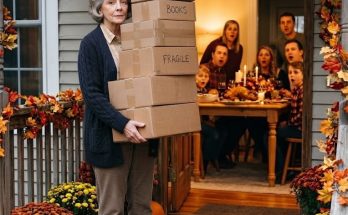
I carried the four boxes up the front steps.
I rang the doorbell.