**Part 3**
There are things that happened after the dinner that I want to tell you, because the after matters as much as the during and because this is not a story that ends at the front door.
The call from Ryan came on Sunday evening, two days after Thanksgiving. He called at the time he always calls, the early evening check-in that I had been receiving every two weeks for years, and the call was different from those calls in the way that calls are different after significant things have happened between the people on either end of them. The familiar rhythms were the same and the frequency of the silences was different and neither of us pretended otherwise.
He apologized again, more specifically this time, naming the particular things he was sorry for: for not asking directly whether I was being invited, for accepting what he was told without verification, for three years of believing I preferred to be alone when he could have called and confirmed it with a single question. He apologized for these things with the specificity of someone who has spent two days thinking about what he actually did wrong rather than offering the general apology that covers everything without requiring understanding.
I received each one.
I told him I was not without fault, which is true. I could have said more, at any point, about what I knew and what I suspected. I could have been less patient and more direct. I had chosen patience because confrontation felt too costly in the years immediately after Harold’s death, and I will not pretend that was entirely wrong, because I was in the years when my resources were depleted and conserving them was a form of survival. But there is a patience that is wisdom and a patience that is avoidance, and mine had become the second thing somewhere in the second year, and I told him this.
He was quiet for a moment.
Then he said, “You assigned yourself the delivery route.”
“I signed the sheet first thing Wednesday morning,” I said.
“Because you knew exactly what you were going to do.”
“I had thought about it carefully,” I said.
He was quiet again.
“You brought three years of order tickets,” he said.
“I kept them in my recipe tin.”
“Mom.”
“Yes.”
“That is,” he paused, “extremely you.”
Which made me laugh, properly, for the first time in what felt like months. The kind of laugh that comes from being known accurately by someone who has known you long enough to have the long view of your character. The laugh of recognition.
We talked for forty five minutes, which was longer than the check-in calls usually ran. He told me things about the three years that I had not known, because I had been listening at the counter of a bakery and he had been living inside a marriage with a woman I had been watching from outside it, and our pictures of the same period were necessarily incomplete.
Melissa had told him, in the early years of the tradition, that she had called me and that I had said I preferred the holidays small and quiet and that it was important to respect what I wanted. He had believed her.
He had not believed her without some doubt, he said, but he had chosen not to examine the doubt because the alternative was a confrontation with his wife that he had not been prepared for. He was thirty eight years old and he was not proud of this and he said so.
I told him that choosing not to examine a doubt that is inconvenient is something most people do and something I had done myself, more than once, in this specific situation and in others.
“You’re being very fair,” he said.
“I am,” I said. “But I am also going to keep the order tickets.”
“I assumed,” he said.
“Good,” I said.
About Melissa I will say this: she called on Monday. The call was brief and it had the quality of something composed in advance, the careful language of a person who has done something wrong and who is smart enough to know that a full accounting of the reasoning behind it is not what the other person needs, that what the other person needs is the acknowledgment.
She said she had not handled my place in their life the way she should have. She said she understood that what she had told Ryan and what she had allowed me to believe were things she owed me a direct apology for. She said she was sorry.
She did not explain herself further.
I received the apology without adding to it, because adding to it was not the right thing and because I have found, over sixty eight years, that the apology received without conditions is given room to mean something, while the apology loaded with conditions becomes something else, a negotiation rather than an acknowledgment.
“Thank you for calling,” I said.
“Thank you for the pies,” she said.
There was a pause that was not entirely uncomfortable.
“The sweet potato was different this year,” she said.
“Extra nutmeg,” I said.
“More than usual?”
“Maybe a little,” I said.
Another pause.
“It was the best one yet,” she said.
Carol Ann called the following Tuesday. She called mid-morning, which is a time when I am sometimes available and sometimes at the bakery, and she had apparently tried my number at the bakery as well, reaching Becca at the counter, who told her yes, Dorothy was scheduled and she could try back at eleven.
She tried back at eleven.
We talked for an hour.
I will not detail all of that conversation either, because some of it was private in the way of two older women discovering that they have more in common than their children’s marriage might suggest, and some of it was the kind of frank exchange that is better experienced than reported.
What I will tell you is that Carol Ann is a woman of direct intelligence and genuine warmth who spent thirty years teaching middle school and who had, as she told me with the candor that decades of teaching produces, developed over those years a comprehensive catalog of the ways that adults lie to themselves and to each other in order to maintain arrangements that are comfortable in the short term.
She had seen the arrangement her daughter had created, she said, but she had not seen it clearly until I walked in the door on Thanksgiving morning, and seeing it clearly had produced in her a clarity about her own role in it, the passive acceptance of a version of events that she had not examined with sufficient rigor.
“I should have called you years ago,” she said. “Not for your sake specifically, though that too. For hers.”
“What would you have said?” I said.
“I would have asked how you were,” she said. “And I would have listened to the answer.”
Which is, I thought, the whole of what most things require.
Sophie called on Thursday, the child calling on her own initiative without parental prompting, which I knew because of the quality of the call, the absence of the parental presence you can feel in a room even when the adult is being quiet.
She called to tell me about the birds of prey project, which had been submitted and graded and received an excellent mark, and she described the grade and the teacher’s comments with the exactness of a child who has put in real effort and is entitled to be pleased about it.
Then she said, in the transition between topics that children make without preliminary: “Grandma, how do you make the sweet potato pie?”
I told her.
She asked questions, good ones, the questions of someone who is actually planning to attempt the thing rather than merely wanting to know about it in the abstract. She asked about the nutmeg and about how you knew when it was done and about whether it had to be a certain kind of sweet potato or whether any kind would work.
I told her.
Then I said: “Sophie, would you like to come to the bakery sometime and help me press the crusts?”
She was quiet for a moment with the seriousness she applied to significant offers.
“Could I?” she said.
“Call your parents and ask,” I said. “And if they say yes, I will teach you to press a crust properly, which is the first thing.”
She said she would ask.
She asked.
The answer was yes.
She came on the first Saturday of December, the one that fell before the holiday orders began in earnest, the last quiet Saturday before the Christmas rush. She came in her winter coat at half past eight, which was the time I had told her to come, and she walked into the back of Hartley’s with the careful observant attention of a child entering a new place that she had already decided was significant.
The ovens. The flour. The particular light of a professional kitchen before the sun has fully arrived.
She stood at the counter beside me and I put an apron on her, the smallest one we had, which was still large on an eleven year old, and I showed her the pastry board and the rolling pin and the way you work the dough when it is ready and the way you know it is ready.
I showed her the press. The heel of the hand. The edge of the thumb.
She listened with the whole-body attention of a child who wants to learn something real.
We pressed crusts for two hours, she and I, in the back of Hartley’s where the invisible women work, and we talked about Harold, who she did not remember with clarity because she had been too young when he died, and about my mother, who she did not remember at all but who she knew from the gravy boat and the sweet potato pie and the recipe written in my mother’s handwriting in the tin.
I told her about the gravy boat. About the chip inside the handle and the fifty years of Thanksgivings and the three years on Melissa’s table.
She listened.
Then she said, “I didn’t know it was yours. I just knew it was always there.”
“Most important things,” I said, “you only notice when they are gone.”
She was quiet for a moment, pressing the crust the way I had shown her, with the heel of the hand.
“Is that why you kept the tickets?” she said.
I looked at my granddaughter.
“That is exactly why,” I said.
She nodded once, with the gravity of someone who has understood something and intends to remember it.
We finished the crusts and washed our hands and Becca from the counter brought us both a cup of hot chocolate, because it was December and cold and because Becca has good instincts about what moments require.
Sophie wrapped her hands around the cup.
“Grandma,” she said.
“Yes.”
“The tickets. You kept them for three years and you didn’t say anything to anyone.”
“That’s right.”
“How did you know when to use them?”
I thought about this.
“When I had enough,” I said. “When the tickets plus the delivery route plus three years of thinking came to the same place at the same time.”
She was quiet.
“That’s a long time to wait,” she said.
“Some things,” I said, “you bake low and slow.”
She almost smiled. Then she did smile, the smile that was her grandmother’s and her grandfather’s mixed together in a face that would grow into its own configuration in time.
“Like the sweet potato pie,” she said.
“Exactly like the sweet potato pie,” I said.
We drove home at noon, Sophie in the passenger seat with a small pie she had pressed herself, a practice one that I had let her fill and bake and that was slightly uneven on one side but was otherwise a creditable first effort. She held it in her lap with the care she had brought to the gravy boat.
At Christmas I brought the sweet potato pie with the extra nutmeg, and the gravy boat, and my good coat. I came at noon when Ryan had said to come, and the door opened and the house was full and Sophie was at the top of the stairs calling down before I had my coat off.
I put the gravy boat in the center of the table.
I sat in a chair that was mine because it had been offered, which is the only way to sit at a table.
Ryan carved the roast with his sleeves rolled, the way his father had, and I thought about Harold and I thought about how things persist through the people who carry them, through the hands that know the gesture, through the granddaughter at the counter learning to press the crusts the way her grandmother pressed them for eleven years in the back where the visible women don’t go.
The world is full of invisible women who know exactly what they are doing.
Some of them bake pies.
Some of them keep the tickets.
Some of them assign themselves the route.
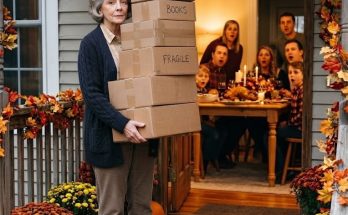
And some of them, when the time is right and the conditions have been met and the crust has been pressed to the correct thickness and the ovens are at the correct temperature, ring the doorbell with four boxes stacked in their arms and let the whole house go quiet one fork at a time.
Harold would have laughed.
I drove home at ten o’clock on Christmas night with the gravy boat on the passenger seat and the particular quality of tired that comes from a full and real day rather than from exhaustion.
Good tired.
The best kind.
I put the gravy boat on the shelf.
I went to bed.
Tomorrow the ovens start at five.