**Part 2**
I want to tell you what happened next as accurately as I can, which means I need to tell you that it did not go quite the way I had dreamed it, because life is more untidy than dreams and because what actually happened was, in its untidiness, considerably more complete than what I had imagined.
The door opened on Ryan.
He was wearing a good shirt and he had Harold’s way of standing in a doorway, the slight forward lean of a tall man who has learned to compensate for the height, and he was holding, God help him, a ladle, which is close enough to a gravy boat that I nearly laughed.
His face did the thing it does when he encounters something that does not fit the category he was expecting. He looked at me. He looked at the boxes. He looked at my coat, which he had last seen at Harold’s funeral and which apparently prompted the same association in him that it had in me when I laid it out the night before.
“Mom,” he said. The single syllable of a man arriving, without warning, at a significant place.
“Good morning,” I said. “I have the pies.”
Behind him, through the open door, I could hear the specific acoustic of a full house, the overlapping registers of people who have been comfortable together for a while, the clink of the kitchen being organized, someone laughing at something at the far end of the house.
“What are you doing here?” he said.
Not unkindly. With genuine bewilderment, which told me that he genuinely did not know. Which confirmed what I had needed confirmed before anything else could happen.
“I work at Hartley’s,” I said. “I baked the pies. I assigned myself the delivery.”
His mouth opened and then did not produce a word.
“May I come in?” I said.
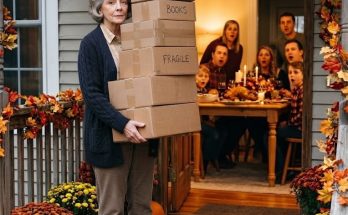
He stepped aside the way people step aside when they are not yet capable of a more intentional response, and I walked into the front hall of my son’s house with four boxes of pies and three years of folded order tickets and my good coat and the particular quality of composure that you develop when you have been doing physical work since five in the morning and have nothing left to be nervous about because you have already decided everything.
The hallway opened into the dining room, and the dining room was set for a large gathering, and it was mostly full. I could see Melissa’s back at the far end as she moved between kitchen and table. I could see her parents, Carol Ann and Franklin, who had arrived at eight as the ticket said they would.
I could see Harold’s brother Gerald and his wife Patricia. I could see Sophie, my granddaughter with Harold’s ears and my stubbornness, who looked up from whatever she was drawing and said, in the direct way of eleven-year-olds: “Grandma?”
The room did not go quiet all at once. It went quiet the way the order tickets described: one fork at a time, one conversation at a time, the awareness spreading from wherever Sophie’s voice landed outward to the edges of the room.
Melissa came through the kitchen door.
She was carrying a platter of something and she was looking at the kitchen doorway rather than the dining room, and when she looked up and saw me standing in the doorway with the boxes stacked in my arms, her face did several things in quick succession that I observed with the attentiveness of someone who has been watching that face from a distance for three years through photographs and has never had the direct version to study.
She was surprised. Of course she was surprised. She had not known I was coming and she had not known I worked at Hartley’s and she was seeing, in one moment, the convergence of two things she had believed existed separately.
She was also, I saw, afraid. Not of me specifically. Of what I represented, standing there in the doorway. Of what the boxes contained and what I might know and what was about to be known by everyone in the room behind her.
I had planned for anger. I had prepared, in my mind, for the version of Melissa that got sharp and managed and pivoted to offense when cornered. I had not precisely prepared for the version that stood still with a platter in her hands and looked at me with the expression of someone who has known, at some level, that this moment was coming and has not found a way to be ready for it.
Carol Ann, her mother, had risen from her chair.
Carol Ann was in her early seventies, a small woman with the upright posture of someone who spent decades teaching school, and she was looking between me and Melissa and back to me with the assembled intelligence of a woman who has raised a child and knows all of that child’s faces, including the ones the child would prefer she not recognize.
“Dorothy?” Carol Ann said. “Dorothy Hartwell?”
She knew me. Of course she knew me. We had met at the wedding and at several subsequent occasions over nine years and she was the kind of woman who remembered the people she had met.
“Hello, Carol Ann,” I said.
“Melissa,” Carol Ann said, not looking at her daughter, still looking at me. “Isn’t that the pie lady you told us about?”
The room was entirely quiet.
Melissa said, carefully, “She works at Hartley’s, Mom.”
“I know she works at Hartley’s,” Carol Ann said. “I meant isn’t that Ryan’s mother. The one you said prefers to spend the holiday alone.”
Ryan was behind me. I heard him take a breath.
“Melissa,” he said.
She looked at him over my shoulder.
I set the four boxes on the sideboard, because I had been holding them for some time and the moment felt right and I did not want to be encumbered for what came next. I set them down carefully, the way I set everything down, and then I straightened and I put my hand in my inside pocket and I took out the three folded order tickets.
“I brought something else,” I said. “Along with the pies.”
I held the tickets up, not dramatically, just clearly.
“Three years of orders,” I said. “The dates are on the tickets. The head counts are on the tickets. The first year is thirty eight people, which I understand was a wonderful gathering.” I was looking at Melissa when I said this, and to her very great credit she did not look away. “The second year was twenty two. This year is fourteen.” I paused. “I’ve been baking these pies for three years. I wanted you to have the receipts.”
The room made no sound.
Ryan said, “Mom.” Again just the one word, but this time it contained something different, the sound of a man putting several things together that should have been put together much sooner.
“I am not here to make a scene,” I said. “I am not here to shout or to embarrass anyone. Ryan, I want you to know that I have never once been invited to this table, and that I have never once said I preferred to be alone, and that I have been told by the Hartley’s counter girl that I have been described as a woman who refuses her family’s invitations. I am telling you this now, in front of people who love you both, because you deserve to know the truth and because I am too old to keep the truth in my recipe tin indefinitely.”
Sophie had come to stand beside me at some point during this. She was standing close to my arm, not touching, in the way of a child who is registering something important and is not sure yet what her role is.
I looked at the table.
The gravy boat was there, in the middle, exactly where it had been in the photographs.
“There is one more thing,” I said.
Carol Ann was very still.
“The gravy boat in the center of your table,” I said, “is my mother’s. It went missing from my china when Harold’s things were being sorted, and I haven’t seen it since except in the photographs from these dinners.” I paused. “I would like it back, please.”
No one moved for a moment.
Then Sophie walked to the middle of the table and picked up the gravy boat with both hands, careful in the way of a child who understands that something is precious, and brought it to me.
“Here, Grandma,” she said.
I took it with both hands.
The chip on the inside of the handle where I dropped it in the sink at twenty three years old. Still there. Fifty years later.
I held it and I looked at my son, who was standing in the doorway to his own dining room with his mouth open and the ladle still in his hand, looking at me with the expression of a man who is understanding things in a sequence that is happening too quickly for him to process each one fully before the next arrives.
“Ryan,” I said.
“Mom,” he said.
“I would like to sit down,” I said. “If there is a chair.”
Sophie had already gone to find one.
What happened after that was not a dramatic continuation of the scene but something quieter and more complicated, the way real things are after the moment of revelation, when everyone has to figure out what they are doing in the new situation. Melissa sat down at the table without speaking for a long time.
Carol Ann sat beside her and I watched the conversation that happened between them in gestures and in brief low sentences and in Carol Ann’s particular quality of attention, the attention of a woman who taught school for thirty years and who knows the difference between an explanation and an excuse.
Ryan came to sit beside me. He took the ladle into the kitchen and came back without it and he sat next to my chair and he said things that I will not repeat entirely because they were between a son and his mother and they belonged in that category. The essential thing was that he said them and he meant them and he was not performing apology but actually apologizing, which I know how to tell apart by now.
Franklin, Melissa’s father, a quiet man who had spent the morning in the living room being amiable and who had observed everything from a distance, came and introduced himself to me properly, as if we were meeting for the first time, which in some sense we were.
Sophie stayed beside me.
She told me about school and about her best friend and about a project she was doing on birds of prey, which she described with the focused enthusiasm of someone who has found a subject and intends to know everything about it. I told her about the pies and about pressing the crusts and about the nutmeg on the sweet potato, and she said she always loved the sweet potato pie the best.
“I know,” I said.
“How do you know?”
“Because it was your grandfather’s favorite too,” I said.
She looked at the gravy boat in my hands.
“Was that really his?” she said.
“It was his mother’s first,” I said. “Then mine. Then the table here for a while. Now it is going home.”
She was quiet for a moment with the seriousness of eleven years old applied to the gravity of a situation she was old enough to understand was complicated and young enough to have not yet developed the adult capacity for pretending it was not.
“Will you come for Christmas?” she said.
I looked at her.
“If I am invited,” I said.
“I’m inviting you,” she said. “Right now.”
I looked across the table at my son.
“I’ll need to hear from your father,” I said.
“Dad,” Sophie said, with the directness of a child who has decided something and is implementing it. “Invite Grandma for Christmas.”
Ryan looked at his daughter and then at me.
“Mom,” he said. “Will you come for Christmas?”
He meant it. I could tell he meant it in the way you can tell when the word and the intention have not separated. It was the beginning of a different kind of conversation, one that was going to take longer than a Thanksgiving morning and that was going to require things from both of us that one morning could not supply. But it was the beginning.
“Yes,” I said. “I’ll come for Christmas.”
The dinner was served around noon, later than planned because the morning had taken the time that mornings take when significant things happen in them. The pies came out of the boxes and went on the sideboard and the smell of the nutmeg filled the room in the way that good baking fills a room, entirely and without apology. Melissa served them herself, cutting each one with the precision of her organizing intelligence applied to the task at hand, and when she handed me the first slice of sweet potato I looked at her and she looked at me and neither of us said anything that was not already said.
The gravy boat was at my elbow.
I had put it there myself.
I would like to tell you that the dinner was easy or that the conversation was natural or that three years of fences came down over a single meal, but that is not what happened and I would not tell you a comfortable lie when the truth is more interesting. The dinner was what it was, which is to say: complicated and real, with long stretches of ordinary conversation about ordinary things and occasional stretches where the weight of the morning was present in the way that significant mornings are present at subsequent meals, felt without being named.
Harold’s brother Gerald told one of Harold’s four jokes.
He told it wrong, but I recognized it.
After dinner, while the plates were being cleared and Sophie was showing me her birds of prey project on her tablet and the adults were moving between kitchen and dining room in the comfortable efficient way of people at the end of a good meal, Carol Ann came to sit beside me.
She was quiet for a moment in the way of a person who is choosing her words with care.
“Dorothy,” she said. “I owe you an apology.”
“You don’t,” I said.
“I do,” she said. “I should have asked about you directly. I should have called you myself, years ago, rather than accepting what I was told. I had suspicions and I chose not to act on them because it was easier not to.” She paused. “That is not a good enough reason.”
I looked at her.
“I have spent three years baking pies for this table,” I said, “and not one of those years was particularly easy. So I understand choosing the easier thing. I have some sympathy for it.”
She was quiet.
“But you still came,” she said.
“I came when I had what I needed to come,” I said. “The tickets. Three years of them. And a delivery route.”
She almost smiled.
“Did you really assign yourself the route?”
“I signed the sheet before anyone else was awake,” I said.
She did smile then, fully, the smile of a woman recognizing something familiar in another woman.
“Good,” she said.
The green cardigan I will tell you about separately, because it deserves its own accounting.
Near the end of the afternoon, a man came in from the back porch where several people had stepped out for air. He was wearing Harold’s green cardigan. Up close, and with three years of prepared distance behind me, I was able to look at him with the clarity I had not trusted myself to have from Kylie’s zoomed-in photograph.
He was Melissa’s brother Daniel’s colleague, a man named Mike who had been at the dinner by virtue of having nowhere else to go for the holiday and having been invited in the generous way that large family gatherings absorb the solitary.
He had bought the cardigan at the church thrift sale two winters ago and he wore it because it was warm and because he liked green. He had no idea it had belonged to anyone’s husband. He was pleasant and unassuming and he admired the pies with the genuine enthusiasm of a man who had been eating them at this table for two years and had always wondered where they came from.
When he found out, he looked at me with the expression of someone who has just understood a connection he did not know existed.
“You made these?” he said.
“Every one of them,” I said.
“They’re the best thing about this table,” he said, with the honesty of someone who does not know the full context of what he is saying and therefore says it without calculation.
I thanked him.
I did not ask for the cardigan. I had taken one thing back today and I did not need two. The cardigan was his and it was warm and Harold, who was a generous man, would not have wanted it back. Harold would have told the joke wrong on purpose, the way Gerald had, and laughed the loudest at himself.
I drove the white van home at four in the afternoon with the gravy boat in my lap, wrapped in one of the Hartley’s tissue paper sheets, cushioned by my good coat folded on the passenger seat.
I drove past the church and past the elms on Meridian Street and past the hardware store where Harold used to stop on Saturday mornings for no particular reason except that he liked hardware stores.
I drove past all of it and I came home to my small house and I put the gravy boat back on the shelf where it belongs, in the spot where the outline of it is still faintly visible in the dust after three years of absence.
It is not a large object. Its presence on the shelf does not change the dimensions of the room or the quality of the light. But it is there, and the thereness of it is the kind of thing that is not reducible to the object itself, that contains also everything the object has touched and held and been used for and been carried through.
My mother’s hands. My hands. Three years on Melissa’s table.
Home.
I made tea.
I sat at my kitchen table with the tea and I thought about tomorrow, which was a Friday with no baking scheduled, and about Sunday, which was the church ladies’ lunch, and about Christmas, which was five weeks away and which would apparently now involve a chair at a table that had a chair for me.
I thought about Sophie with Harold’s ears and my stubbornness, carrying the gravy boat across the table with both hands and saying here, Grandma, with the simplicity of a child who has not yet learned to make the right things complicated.
I thought about Ryan at the doorway with the ladle and the single syllable of my name.
I thought about Carol Ann and her school-teacher’s posture and the apology she had offered and the honesty she had extended, and about what it would mean to build something different with a woman I had only encountered at the edges of her daughter’s life.
I thought about Melissa, sitting quietly at the table while the meal was served, not absent exactly but contained, and I thought about what came next for the two of us, which was going to be a long and imperfect process that would not resolve cleanly and that I was going to have to approach with the same patience I had brought to three years of baking pies for a table I was not at.
I am sixty eight years old and I have been baking since before most of the people at that table were born and I have pressed enough crusts to know that the work is not the dramatic thing.
The dramatic thing is the moment it comes out of the oven, the moment you hand it to the person it was made for. But the work is the pressing of the crusts. The work is the five o’clock mornings and the heat and the patience and the attention brought to each thing as if it is the only thing, which is what makes the finished product what it is.
I am going to keep working.
I am going to go to Christmas.
I am going to bring the sweet potato pie with the extra nutmeg, which is the family recipe, which is mine.
And I am going to put the gravy boat in the center of my son’s table, because it belongs at the center of a table that has family around it, and for the first time in three years, that is going to be the table I am sitting at.
Harold, I think, would find this satisfying.
He would pour the gravy.
He would tell the jokes in the wrong order.
He would laugh the loudest.
I put my tea cup in the sink and went to press tomorrow’s crusts, because the ovens start at five and the work does not stop for the dramatic things.
It continues.
That is the whole of it.
It continues.