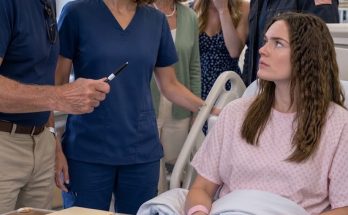
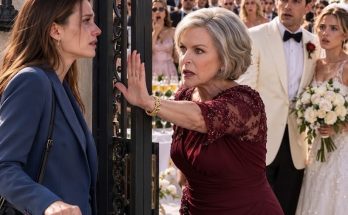
“She fainted? She’ll live. Our flight with your sister leaves at six,” Dad said, and they went. I spent nine days in that ward alone. They strolled back demanding to sign me out. The head nurse blocked the door: “She’s not yours to discharge anymore. Ask the man who—”
**PART 1**
Their suitcases sat neatly by the front door, tags already secured to the handles. My mother applied lipstick in the hall mirror while my father paced with his phone, refreshing the flight status as if the world might leave without him.
“You didn’t have to come,” my mother said. She didn’t turn around.
“I wanted to see you off,” I said.
Then the floor tilted.
It always began the same way: a flutter high in my chest, like a bird trapped behind my ribs. My pulse lost its rhythm and sprinted toward nowhere. The kitchen flashed bright, narrowed, then grayed at the edges.
I reached for the counter.
Missed.
The cold tile met my cheek, carrying the lemon scent my mother used.
Somewhere above me, my sister’s distant voice said, “Is she doing this now? Seriously?” Not, “Is she okay?” As if I were performing. Throwing a tantrum on cue.
My mother crouched beside me, but her hand landed on my shoulder like she was shaking someone awake, not holding someone who was breaking.
Florence, Florence, we do not have time for this today.
I couldn’t answer. My mouth stopped obeying me. My heart battered itself inside my chest while consciousness faded, slowly at first, then completely.
The last thing I saw was the row of packed suitcases by the door.
Ready to leave.
More ready than my family had ever been to stay.
Someone called 911. I learned later it was my father, and I’ll give him that. He dialed.
But even with the operator on speaker, I could hear the conversation happening over my body.
The flight’s at 6. If we leave now, we make it. We can’t just— She’s had these before. She always comes out of it.
I did not always come out of it.
That was exactly what nobody in that kitchen had ever wanted to hear.
But I was on the floor, and the floor doesn’t get a vote.
The paramedics arrived in 7 minutes. I know because my father mentioned the time to them, the way you’d mention an inconvenient delay.
There were two of them, a woman and a younger man.
The woman’s hands were the first that morning to touch me as though I was worth saving.
“Ma’am, can you hear me? Squeeze if you can hear me.”
I barely squeezed.
It felt like lifting a car.
They started an IV and read the strip from their machine. The younger paramedic’s professional calm cracked for half a second.
He looked at his partner.
She looked toward the door.
“We need to transport now,” she said. “This isn’t a fainting spell.”
That was when my father, keys already in hand, said the words that would follow me through nine days, one ballroom, and the rest of my life.
“She’ll live,” he told her. Gates at 6.
He said it kindly.
“That’s the part people never believe.”
There was no cruelty in his voice. He said it like someone reassuring a stranger, gently patting the air while steering everyone toward the exit.
Then he touched my mother’s back.
My sister lifted her garment bag.
All three stepped around the gurney and walked through the front door into the pale morning.
The last things I heard were three car doors.
An engine.
Then the ambulance siren traveling the opposite way.
I woke under an unfamiliar ceiling to a sound I recognized.
Beep.
Steady. Mechanical. Slightly too fast.
A cardiac monitor counting the beats my own body couldn’t reliably keep.
An oxygen line rested beneath my nose. A purple bruise spread across my sternum where they had shocked my heart back into rhythm.
Cardioversion, a nurse would tell me later. My heart had gone into something called torsades de pointes and a body count and a machine and two strangers had argued it back into line while my family was somewhere over Virginia.
A young doctor with tired, kind eyes stood at the foot of my bed.
Florence, you’re at St. Brendan’s. You’re in the cardiac unit. You gave us a scare.
My family, I said. My voice came out like gravel.
We’re trying to reach them. The number on file goes to voicemail.
She paused.
Is there someone else? Anyone we can call for you? Someone who should be here?
There it was.
The simplest question in medicine.
Who’s your person?
The person they call so a frightened patient doesn’t have to be alone.
I lay there in a paper gown with a burn on my chest, 34 years old, unable to think of one name.
Above me, the monitor kept beeping, patiently counting a heartbeat nobody who shared my blood considered worth missing a flight for.
“There’s no one,” I said.
She wrote something down.
She didn’t argue, but her eyes moved to the empty vinyl chair beside my bed.
The chair meant for someone who stays.
It was empty.
It would remain that way for a while.
I should explain who I was, because otherwise you won’t understand why I didn’t cry.
I was the second child, the middle of nothing, born 3 years after Reed and 5 years before Camille.
I read too much and talked too little.
When I fainted at 9 during a school assembly, then again at 11 in gym class, my parents developed a theory.
And once they had a theory, they never allowed facts near it.
Florence was sensitive.
Florence was dramatic.
Florence had learned that collapsing earned attention, so Florence collapsed.
I grew up inside that explanation like a coat two sizes too small.
So I did what quiet children do.
I stopped asking anyone to believe me.
I earned a scholarship, then a degree, then a professional license carrying my name and a state seal.
I learned to calculate exactly how much weight a structure could bear before failing.
A strange career for a woman whose own family had never bothered running those numbers on her.
I didn’t cry in that hospital bed because in my family, tears had always been exhibit A.
Proof of the performance.
I had trained myself out of crying the way someone trains themselves out of a limp.
But beneath the calm, beneath the engineer, there was still a 9-year-old lying on a gymnasium floor waiting for someone to run toward her instead of away.
That first night, the ward darkened except for my monitor and the strip of light beneath the door.
Near midnight, an older nurse entered.
Solid build. Silver cross at her throat. Reading glasses pushed into gray hair.
Her badge read Ruth Vance, Charge RN.
She checked my line and monitor.
Then she did something nobody in scrubs had done yet.
She stopped.
Your throat’s raw, she said.
From the tube here, she set a paper cup of ice chips on my tray and folded my fingers around it.
Small sips, let them melt.
I stared at the plain white cup sweating a ring onto the tray.
Something inside my chest that the paddles hadn’t reached finally loosened.
A cup of ice.
That was all it took.
The first thing anyone had given me in 18 hours had come from a stranger being paid to be there.
Thank you, I said.
Ruth looked at the empty chair, then at me.
She didn’t ask where everyone was.
I think she already understood the answer.
I’m on till 7, she said. You need anything, you press the button. I mean it.
After she left, I stayed awake holding the melting cup.
I did not call my parents.
I need you to understand that was deliberate.
My phone was right there. Part of me still wanted to call, the same way you want to press on a bruise just to see if it still hurts.
I didn’t.
Instead, I watched the door and waited to see whether anyone would come through it.
What I stood to lose was larger than a hospital bill.
I was 34, and my heart was a problem nobody had ever allowed me to solve.
Whatever was wrong had likely been wrong for 25 years.
Every untreated year was one I might never get back.
That was the medical loss.
There was another loss, harder to measure.
My entire life, I had protected one belief with both hands: if things ever became bad enough—truly bad, life-and-death bad—my family would come.
Surely their theory about my sensitivity had a limit.
Surely beneath all the eye rolls was a line they would never cross.
I had just watched them literally step over that line.
Over my actual arm.
On the actual floor.
If they wouldn’t stay for this, there was no version of this they would stay for.
A person can survive many things.
I’m less certain anyone survives realizing they have always been optional.
My phone buzzed.
Hope rushed through me before I could stop it.
It wasn’t a call.
It wasn’t even a private message.
It was the family group chat.
A photo loaded.
Camille in a champagne-colored gown beneath a chandelier, laughing mid-frame, a diamond catching the light.
My mother had captioned it:
Our girl. What a night. So proud. Three hearts.
19 hours had passed since I hit the kitchen floor.
Not one of them had typed my name.
I put the phone face down.
Picked it up.
Set it down again.
Then another message appeared.
This one directly from my mother.
So glad you’re okay. Camille was radiant tonight. You should have seen her. We land in a few days. Rest up. Xoxo.
I read it once.
Then again, slowly, like checking a contract for the hidden clause.
So glad you’re okay.
She had no idea whether I was okay.
Nobody had even called the hospital.
She was glad the way someone is glad the weather held—an assumption, not a fact—because confirming otherwise might have disrupted the trip.
Camille was radiant.
My sister glowed beneath a chandelier while a machine counted my heartbeat in the dark.
And my mother’s first instinct toward her hospitalized daughter was to tell me about the party I had missed.
Rest up.
As though I had stayed home with a cold.
I began typing.
I nearly died on your kitchen floor and you got on the plane.
I stared at the sentence.
Then deleted it one letter at a time.
I already knew how that conversation would end. I had lived smaller versions of it a hundred times.
I would send the truth.
They would say I was making everything about myself, being dramatic, trying to ruin Camille’s night from a hospital three states away.
Somehow, they would become the injured party.
They always did.
So I sent nothing.
Instead, an old memory surfaced.
A piece of paper I had signed six years earlier, during a moment when I had been too broken to understand its importance.
A form.
A blank.
A name I had written beside the question asking who should speak for me if I could no longer speak for myself.
I hadn’t thought about it in years.
Now I did.
I didn’t yet know it would become the most important document I had ever signed.
I only knew that when the doctor asked who my person was, I had said there was no one.
I had been wrong.
I simply hadn’t remembered yet.
Morning arrived gray and slow.
Ruth returned at 7 as promised, carrying fresh ice without being asked.
Sleep? She said some.
She didn’t believe me, and she let me know she didn’t.
Somehow, that was kinder than pretending.
While clearing the tray, she paused near the empty chair.
She had worked that floor for 30 years, she later told me.
She could read a room by its visitors.
Too many visitors meant a large, loud family fraying under stress.
The right visitors meant love had shown up.
And a room like mine?
A woman coding on a Saturday.
Nobody at the desk asking after her.
A phone lighting up with gala photographs but never with we’re coming.
That told its own story.
Your people know you’re here, she asked. Light, careful.
They know, I said.
Ruth’s mouth made a small, complicated movement.
She straightened the blanket over my feet.
Well, she said, you’ve got me and you’ve got Dr. Lingren coming by this morning. And between you and me, she’s the best set of hands in this building. She’s been in your chart since last night.
At the time, I thought nothing of it.
Doctors read charts.
That’s their job.
I didn’t know that one of the best doctors in the building had spent her night tracing 25 years of my medical history and discovered, buried in the oldest pages, a hole exactly shaped like the truth.
Dr. Lingren arrived at 9 carrying a laptop.
There was a stillness about her that made the room feel serious before she spoke.
She introduced herself as an electrophysiologist and explained that she specialized in the heart’s electrical system—its rhythm, timing, and signals.
My entire problem, apparently, had always been about timing.
My heart knew how to beat.
It simply couldn’t always be trusted to keep schedule.
“I’ve been going through your records,” she said, settling into the chair. The empty one finally filled, though not by anyone I was related to.
“Florence, I want to ask you something, and I want you to think carefully before you answer.”
Okay.
When were you first told there was something wrong with your heart?
My first instinct was to say never.
That was the family version.
Nothing was wrong.
I was fine.
I was dramatic.
I was fine.
But Dr. Lingren watched me with an attention I wasn’t accustomed to.
Her question carried weight, like she already knew the answer and wanted to know whether I did.
They said I was sensitive, I said slowly. I fainted as a kid. They took me to a doctor once, I think, when I was little, and then we just never went back.
Dr. Lingren turned the laptop toward me.
That’s the part I want to talk about, she said. Because according to your own chart, someone flagged this when you were 9 years old.
The monitor continued beeping above us, steady and slightly fast, counting the years I had lost.
Then she said softly, “The file just stops.”
Those four words changed the room.
On the screen was an entry from when I was nine.
A referral.
A specialist.
And a phrase I didn’t yet understand.
Prolonged QT interval.
It sat in the medical record like a stone beneath clear water, visible all along if anyone had bothered looking.
Below it was nothing.
No follow-up.
No treatment.
A lifetime of silence recorded as blank space.
I remember that doctor, I said.
The memory returned cold and complete.
An office with a fish tank.
Stickers placed across my chest.
My mother holding my hand in the waiting room and telling me to sit still and not make a scene.
Do you remember going back?
No.
I searched honestly.
We never returned.
For years, I had assumed that meant there was nothing to return for.
They had checked.
I was fine.
The fainting was simply me being me.
Dr. Lingren stayed quiet before answering, choosing her words carefully.
Florence, I don’t want to get ahead of the record. I’ve ordered your full pediatric cardiology file from the archive, the actual pages, not just the summary. It should be here tomorrow.
She closed the laptop.
But I need you to know something now so you can rest tonight understanding it. What you have is a real physical dangerous condition. It is not sensitivity. It never was. And it does not go away because someone decides not to look at it.
I went completely still.
25 years.
25 years of being treated like the girl who invented things.
And proof that I hadn’t invented anything had been sitting in a file the entire time.
One records request away from anyone who cared enough to look.
Who? I started and stopped and made myself finish. Who decided not to look at it?
Dr. Lingren stood, tucked the laptop under her arm, and gave me the only honest answer she had.
That, she said, is what the rest of the file is going to tell us.