Part 1
For two long years, I watched my daughter come home from school looking just a little smaller than she had that morning. Sometimes it was because someone had mocked her clothes, while other times it was because someone had hidden her backpack. Once, someone even wrote a cruel word across her locker in permanent marker.
And every time I asked what had happened, Madeline gave me the same tired answer.
“They will get bored eventually, Mom,” she whispered.
I desperately wanted to believe her words.
Then, at sixteen years old, Madeline became seriously ill. She was admitted to the main hospital in Minneapolis, and for six terrifying days, the medical staff could not tell us exactly what was wrong with her.
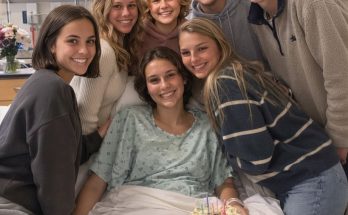
And then something very strange happened. The same classmates who had spent two whole years making her miserable suddenly began showing up at her hospital room every single day. They brought bright balloons, get-well cards, frosted cupcakes, class notes, and small gifts. They laughed with her, knew her favorite things, and shared details about her life that I had not even known as her mother.
I wanted to believe they had genuinely changed, and I wanted to believe my daughter had finally found true friends.
Then one afternoon, one of the boys who had hurt her the most followed me into the quiet hallway. His name was Travis. His face was completely pale, and his smartphone was visibly shaking in his hand.
“Do you really have no idea what she did?” Travis asked me in a voice that made my stomach drop instantly.
I stared back at him in complete confusion. “What did she do?”
Travis glanced anxiously back toward Madeline’s hospital room. “We promised we would never tell anyone.”
“Then why are you telling me right now?” I asked, looking at him closely.
His voice cracked with emotion. “Because she keeps protecting us, and she should not have to do that from a hospital bed.”
He quickly unlocked his phone screen and held it out. “Just watch this.”
The video started playing immediately, and I lasted only three seconds before I had to grab the sturdy back of a hallway chair to keep my balance. But to understand why that short clip shattered my heart, I have to take you back to the exact week Madeline fell ill.
Part 2
Madeline was sixteen years old, gentle, funny, stubbornly resilient, and determined enough to argue with a street sign if she thought it was wrong. At her high school, however, she had almost no friends at all. For two continuous years, her peers had made her daily life completely miserable. They mocked her thrift-store sweaters, hid her school backpack, and laughed whenever she walked into class. Once, a classmate wrote a cruel word across her locker door.
I had called parents directly, spoken with her home-room teacher, Mrs. Albright, and documented every incident carefully. Madeline hated every single minute of my intervention.
“They will get bored eventually, Mom,” she told me with a deep sigh.
“They have not gotten bored yet, honey,” I replied.
“Eventually, they will find a new hobby to distract themselves,” she insisted.
“Cruelty should never count as a hobby,” I argued firmly.
“You should go tell them that,” she said, shrugging her shoulders. “I survive lunch every day, and that is the absolute worst part of my routine.”
That sentence stayed with me because she had learned to make intense daily suffering sound perfectly ordinary.
Then, on a gloomy Tuesday morning, Madeline simply could not get out of bed. At first, I thought she was just deeply exhausted from school stress, but by the afternoon, we were sitting anxiously in the hospital emergency room. Dr. Gable ordered test after test, but for six whole days, nobody could give me a clear medical answer. Madeline grew physically weaker, so I became completely obsessed with monitoring charts, medication schedules, body temperatures, daily meals, and medical test results in my small notebook.
On the seventh morning, Dr. Gable finished looking through her medical chart. “We are still ruling out several possibilities, Laura,” he told me calmly.
I opened my notebook instantly. “Then why is my daughter not getting any better?”
“Some answers simply take time, and right now we just have to keep watching the lab results,” Dr. Gable explained.
“I hate everything about waiting,” I admitted loudly.
Madeline shifted uncomfortably against her soft white pillow. “Mom.”
“What is it, sweetie?” I asked.
She glanced down at my open pages. “You wrote the doctor’s name on the margin again.”
I looked down at the handwriting. “You always do that when you are deeply scared, Mom.”
My pen stopped moving completely across the page. “I am not scared at all.”
Madeline gave me a tired look from her bed.
“Okay, maybe I am a little scared,” I admitted as I closed the notebook firmly.
She reached across the blanket for my hand. “I am scared too, Mom.”
I squeezed her cold fingers tightly, and for five seconds, she looked like her normal self again.
Then teenage laughter exploded down the quiet hospital hallway, and Madeline’s smile disappeared instantly.
I stood up from my chair immediately. “I will go handle this right now.”
“Mom, please do not,” Madeline pleaded.
“I am just going to ask them to keep the noise down,” I insisted.
“That is never what you actually mean when you say you will handle something,” she countered softly.
I opened the heavy door and stopped dead in my tracks. Nearly Madeline’s entire class was standing right there in the narrow hallway with balloons, cards, cupcakes, fresh flowers, and even a giant stuffed bear. Travis was standing right in the middle of the crowd. Travis was the exact same boy who had shoved Madeline’s heavy textbooks off her desk only a month earlier.
I stared at him in complete disbelief. “What are all of you doing here today?”
“We came to visit Madeline,” Travis answered quietly.
“I can clearly see that, but I am asking why you are here,” I pressed.
Nobody offered a reply, but then Mrs. Albright hurried down the hallway toward us. “Laura, I tried calling your phone earlier.”
“Did you organize this group visit?” I asked her.
“No, the students organized all of this completely on their own,” Mrs. Albright replied.
A hospital staff member walked over to remind us that only a few visitors could enter the room at a time.
Travis stepped forward immediately. “Can I please go in first?”
I shook my head without hesitation. “No, I really do not think that is a good idea, Travis.”
From right behind me, Madeline’s weak voice cut through the air. “Let him come in, Mom.”
I turned around to face her. “Madeline, he knocked your books onto the classroom floor and laughed at you.”
“I remember that perfectly well,” she replied softly.
“You do not owe him any kindness just because you are lying in a hospital bed,” I told her.
“I am not paying off any debt, Mom,” she said.
“Then why are you letting him in?” I asked.
She looked at me with clear focus. “Please just let him in.”
She was not frightened of him at all, but rather completely certain of her choice. I stepped aside, and Travis walked cautiously into the small room.
“Hey,” Travis said awkwardly.
“Hey,” Madeline replied from her bed.
He lifted the giant stuffed bear up for her to see. “This whole bear thing was not my personal idea.”
She stared at the fluffy toy for a second. “It looks like it knows where missing bodies are buried.”
Travis laughed out loud, and three other kids standing near the open doorway joined in. Then Madeline laughed too, making a sound I had not heard in several weeks. For the very first time, I genuinely did not know what to think about her classmates.
Part 3
Madeline’s classmates came back to the hospital the very next day, and then the day after that as well. They usually arrived in small, quiet groups, bringing high school algebra notes, colorful nail polish, a stack of teen magazines, and once, even a fresh blueberry muffin.
Madeline stared at the boy holding the bakery bag. “You actually remembered that?”
“You always give your blueberry muffins away at lunch,” he answered softly.
I had not known that anyone at school ever noticed her small habits. Her classmates soon covered one entire wall of the room with printed photographs, and Madeline pointed at a picture of herself caught right in the middle of a big sneeze.
“Take that down immediately because I look completely haunted in it,” she complained jokingly.
“You always look haunted in pictures,” a girl teased back.
“That makes it so much worse,” Madeline laughed, and everyone in the room joined in.
Every single visit told me the exact same story as I watched from the corner. These kids clearly knew my daughter, understood when she was getting tired, knew that she hated raisins, and even knew which high school teacher she secretly imitated whenever she felt bored. And Madeline knew every single one of them in return, which confused me more than anything else had. How could the exact people who had made her daily life miserable know her so intimately?
One afternoon, I stepped out into the hallway to grab a hot coffee from the machine near the elevators. I overheard two students talking quietly near the corner.
“Did you tell her about the situation?” a girl asked.
“No, I did not say anything,” a boy replied.
“She told me that I was the only person who knew,” the girl whispered nervously.