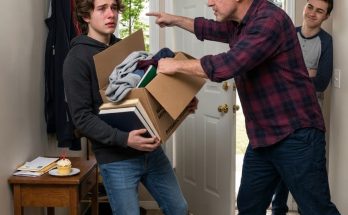
**Part 1**
My voice sounded calmer than I felt.
“But it changes who you can order out.”
Silence.
The refrigerator hummed behind us.
A car passed outside.
My stepbrother looked from Dad to me.
Dad pushed the papers across the table as if they had personally insulted him.
“You have no idea how property works.”
“Maybe not.”
“You think because you turned eighteen this morning, suddenly you own a house?”
“I think that’s what the document says.”
Dad laughed once.
It wasn’t amusement.
It was anger.
“I’ve lived here for years. I’ve maintained this house. I’ve paid taxes. I’ve repaired it. I’ve paid insurance. I replaced half the windows.”
I nodded.
“Okay.”
“Okay?”
“Then show me the paperwork that says you own it.”
His face froze.
My stepbrother looked at him.
Dad pointed toward me.
“Watch your tone.”
“I’m asking a question.”
“I don’t have to prove anything to you.”
“You just told me to leave by tonight.”
“Because you’re eighteen.”
“So show me the document that gives you the right to throw me out.”
He didn’t answer.
For the first time in years, Dad had nothing ready to say.
His eyes moved toward the hallway.
Then toward the moving boxes.
Then back to Mom’s blue envelope.
And that was when I noticed something I hadn’t noticed before.
Beside Dad’s toolbox in the hallway was a brand-new lockset.
Still sealed in clear plastic.
Deadbolt.
Door handle.
Two new keys.
I stared at it.
Dad noticed where I was looking.
So did my stepbrother.
Something cold slid through my stomach.
The boxes hadn’t appeared because Dad lost his temper that morning.
The packing tape wasn’t an impulse purchase.
And the lock wasn’t for some repair he had forgotten to mention.
He had planned this.
He had expected me to pack.
He had expected me to walk out.
And after I left, he intended to make sure my key no longer worked.
My stepbrother pointed toward the hallway.
“You already bought a new lock?”
Dad said nothing.
“You bought that before today?”
Still nothing.
I looked at the lockset.
Then the boxes.
Then Dad.
“You planned to lock me out.”
“You’re being dramatic.”
“It’s still in the package.”
“The front lock sticks.”
“It’s been sticking for two years.”
My stepbrother’s voice changed.
“You told me yesterday I could move my gaming setup into her room this weekend.”
Dad turned toward him.
“Stay out of this.”
My chest tightened.
I looked at my stepbrother.
“What?”
He looked uncomfortable now.
“He said your room would be empty.”
“When?”
“Yesterday.”
Dad slammed one palm onto the counter.
“That’s enough.”
Nobody moved.
I understood then that this wasn’t a birthday argument.
It wasn’t about teaching me responsibility.
Dad had already decided the outcome.
My room cleared.
My belongings gone.
The locks changed.
Someone else using my bedroom.
All before I graduated high school.
I looked at him.
“I’m not asking you to leave.”
That surprised him.
It surprised my stepbrother too.
I continued.
“I’m asking why you were so sure you could throw me out without even knowing whose house this was.”
Dad reached across the table and grabbed the folder.
My stepbrother moved before I could.
He stepped between us.
Then he took the folder from Dad’s hand.
For several seconds, they stared at each other.
“Give me that,” Dad said.
My stepbrother opened the first page himself.
He read slowly.
Then he turned toward Dad.
“You told me this was your house.”
“It is.”
“This says it was hers.”
“I’ve explained that.”
“No. You said Mom’s house became yours after she died.”
Dad’s face hardened.
“I said I was responsible for the property.”
“That’s not the same thing.”
Dad stepped closer.
My stepbrother didn’t move.
Then, to my surprise, he turned and placed the folder back in my hands.
“I’m not helping you put her out.”
Dad stared at him.
“What did you say?”
“I said I’m not helping.”
“You were laughing five minutes ago.”
My stepbrother looked embarrassed.
“Because I thought she was getting kicked out of your house.”
He pointed toward the papers.
“Apparently it isn’t your house.”
Dad’s jaw tightened.
Then he walked to the wall hook beside the kitchen door.
There were usually three keys there.
His.
Mine.
And the spare.
He took the spare house key.
Closed his fist around it.
Shoved it into his pocket.
Then walked toward the front door.
“Where are you going?” I asked.
He opened the door.
“To get some actual answers.”
The door slammed behind him.
The house went silent.
My stepbrother and I stood there staring at each other.
Finally, he said, “I’m sorry.”
I almost laughed because it sounded so strange coming from him.
“For which part?”
“The laughing.”
“That narrows it down.”
He looked toward the flattened boxes.
“I really thought Dad owned this place.”
“So did I.”
He frowned.
“Then why did you have those papers?”
I looked down at Mom’s envelope.
“I found them a few weeks ago.”
“And you never opened them?”
“Mom told me not to.”
He stared at the handwritten instruction.
Then he pulled out a chair.
“There’s a letter too.”
I had noticed it.
But everything had happened so quickly I hadn’t opened it.
Now I did.
The first line almost broke me.
Happy eighteenth birthday, sweetheart.
I stopped reading.
My eyes blurred instantly.
For three years, I had imagined hearing Mom’s voice again.
I had replayed old videos just to hear her laugh.
I had saved one voicemail where she reminded me to bring an umbrella.
And now, on a birthday when my own father hadn’t even said the words, Mom had managed to say them from three years in the past.
My stepbrother quietly sat across from me.
I kept reading.
Mom explained that the house had belonged to her before she married Dad.
She had bought it using money from her parents and savings from years of work.
She loved Dad, she wrote.
But she wanted one thing protected specifically for me.
A home.
Not money.
Not jewelry.
Not something that could disappear.
A place.
She wrote that Dad had been permitted to live there and manage ordinary household expenses while I was a minor.
When I became an adult, control of the property would become mine.
Then I reached one sentence that made me stop.
If anyone ever tells you that you have no place in this house, please remember that I made certain you always would.
I covered my mouth.
My stepbrother looked away.
I kept reading.
Mom didn’t tell me to throw Dad out.
She didn’t warn me that he was evil.
She didn’t accuse him of anything.
That somehow hurt more.
She simply told me to protect myself.
There was also a phone number.
An attorney’s office.
I called it.
I expected voicemail.
Instead, a receptionist answered.
When I gave Mom’s name, there was a pause.
Then I was transferred.
The attorney on the line knew exactly who I was.
“I wondered when I might hear from you,” he said.
My stomach turned.
“Does that mean these documents are real?”
“Yes.”
“All of them?”
“Yes.”
“And the house?”
There was another pause.
“The property was placed into a trust for your benefit. Your mother retained ownership before her death, and under the trust instructions, your father had the ability to reside there and handle routine matters while you were a minor. Your eighteenth birthday changes your legal authority over the property.”
I looked at my stepbrother.
He could hear enough from my side of the conversation to understand.
“So Dad doesn’t own it?”
“Based on the recorded documents, no.”
I sat very still.
“Can he throw me out?”
“No.”
That one word almost made my knees weak.
I hadn’t realized until that moment how terrified I had been.
Not angry.
Terrified.
I was eighteen for less than two hours, three months from graduation, and my father had told me I would be homeless by dinner.
The attorney continued.
“Do not surrender possession voluntarily. Do not hand over original documents. And do not sign anything your father gives you without independent review.”
My skin prickled.
“Why would he give me something to sign?”
“I’m giving you general advice.”
But the way he said it made me pay attention.
“Has he contacted you before?”
Silence.
Then the attorney said carefully, “There have been inquiries over the years regarding the property.”
“From Dad?”
“I would rather discuss the file with you in person.”
That was not the answer I wanted.
It was worse.
We arranged to meet after school the following day.
Then I called my school.
For the first time in four years, I said I wouldn’t be coming in.
My stepbrother didn’t go either.
We spent the next hour looking through Mom’s documents.
That was when he found another envelope inside the folder.
Not from Mom.
A bank envelope.
Inside were copies of letters addressed to Dad.
One mentioned the trust.
Another referenced his right to occupy the property while I remained a minor.
My stepbrother read it twice.
“He knew.”
“No.”
My voice came out quietly.
“He knew something.”
Maybe Dad had never read every legal detail.
Maybe he misunderstood.
Maybe he assumed years of paying expenses had somehow turned into ownership.
But this was not a situation where nobody had ever told him the house had conditions attached.
There had been letters.
Notices.
Paperwork.
And suddenly his exact words from breakfast sounded different.
Mine, for all practical purposes.
Not legally.
Practically.
At 12:37, Dad came back.
He wasn’t alone.
A man in a gray jacket walked behind him carrying a leather folder.
My stepbrother whispered, “Who’s that?”
“I don’t know.”
Dad entered without knocking.
Technically, he still lived there.
But something about watching him walk through that door felt different now.
The man introduced himself as someone who had “helped Dad with financial matters.”
Not an attorney.
Not a police officer.
Not anyone with authority over me.
Dad sat at the kitchen table.
“You’ve caused a lot of unnecessary drama.”
I stared at him.
“You tried to make me homeless before dinner.”
“I told you it was time to start acting like an adult.”
“Adults usually get more than eight hours to find somewhere to live.”
The man cleared his throat.
“There may be a misunderstanding regarding the ownership structure.”
I placed copies of Mom’s documents on the table.
“Great. Explain it.”
He looked at them.
Then at Dad.
Then he stopped talking.
Dad leaned forward.
“The point is, I have invested years of money into this property.”
“I already know that.”
“You don’t know the amount.”
“No.”
“Tens of thousands.”
I looked at him.
“So?”
His face reddened.
“So you don’t get to wave a piece of paper around and pretend none of that matters.”
“I haven’t.”
“You’re acting like I’m some stranger living in your house.”
“No.”
My voice shook now, but I kept going.
“I’m acting like I’m your daughter who woke up on her birthday and found boxes waiting for her.”
Dad looked away.
I pointed toward the hallway.
“And a new lock.”
The man glanced toward it.
Dad changed direction immediately.
“If you intend to assert ownership, there are expenses that need to be addressed.”
There it was.
Not an apology.
Not I made a mistake.
Money.
“What expenses?”
“Repairs. Taxes. Insurance. Maintenance.”
“Send them to the attorney.”
Dad’s eyes narrowed.
“What attorney?”
“The one Mom used.”
His expression changed.
Only for a second.
But I saw it.
“So you called him.”
“Yes.”
My stepbrother looked at Dad.
“You knew there was an attorney?”
Dad stood.
“I’m done having this conversation with children.”
I stood too.
“I’m eighteen, remember? That was the whole reason you told me to pack.”
His chair scraped hard against the floor.
“You think this is funny?”
“No.”
My eyes burned.
“I think it’s my birthday.”
That stopped him.
For one second, nobody moved.
Then my stepbrother said quietly, “You didn’t even tell her happy birthday.”
Dad looked at him like he had betrayed him.
Maybe in Dad’s mind, he had.
Dad picked up his keys.
“You want to play homeowner? Fine.”
He pointed at me.
“Pay everything.”
Then he walked out again.
The man in the gray jacket hesitated.
He looked embarrassed.
Then he followed.
My stepbrother stared through the window as Dad’s car backed away.
“He’s trying to scare you.”
“It’s working.”
That was the truth.
Owning a house sounded powerful when someone said it quickly.
In reality, I was eighteen.
I had no idea what property taxes cost.
I didn’t know how insurance worked.
I didn’t know whether I could even afford electricity next month.
Dad knew that.
And he knew I knew it.
For the first time, I understood his new strategy.
If he couldn’t convince me the house legally belonged to him, he could convince me I was incapable of keeping it.
For the rest of the afternoon, I made calls.
The utility company.
Insurance.
The attorney again.
I wrote everything in a notebook.
Numbers.
Deadlines.
Questions.
Some of the answers frightened me.
Others didn’t.
The trust still contained a modest reserve Mom had left specifically for property expenses until I finished high school.
That changed everything.
Mom had thought ahead.
Again.
At 4:15, while searching through one of the drawers for an old insurance statement, my stepbrother found something else.
A printed email.
It had fallen behind a stack of manuals.
He read the top line and went silent.
“What?”
He handed it to me.
It was dated two weeks earlier.
Dad had contacted a real estate agent.
The email discussed a possible valuation of the house.
My heart started pounding.
Another page mentioned “vacant possession.”
Another mentioned making cosmetic improvements once “the bedroom situation” was resolved.
My stepbrother swore under his breath.
“He was going to sell it?”
“I don’t know.”
But suddenly the boxes made even more sense.
Get me out.
Change the locks.
Clear the room.
Make the house look ready.
Maybe Dad thought he owned it.
Maybe he believed he could sell it.
Maybe he had never checked whether he actually had the authority.
Whatever the explanation, my eighteenth birthday had not been chosen randomly.
He wanted me legally adult.
Gone.
And out of the way.
At 5:03, Dad returned.
This time, he looked exhausted rather than angry.
He walked into the kitchen and saw the email in front of me.
He stopped.
“Where did you get that?”
My stepbrother answered.
“It was in the drawer.”
Dad looked at him.
Then me.
I slid the email across the table.
“Were you planning to sell the house?”
“No.”
“Then why were you talking to a real estate agent?”
“I was exploring options.”
“For my house.”
“For this family.”
“You were throwing me out.”
“You keep saying that like I dumped you on the street.”
“You gave me until tonight.”
“You have friends.”
I stared at him.
He actually said it.
Like sleeping on someone’s couch three months before high school graduation was a reasonable birthday plan.
“Why today?”
He didn’t answer.
“Why did it have to happen today?”
“Because you’re eighteen.”
“That’s not an explanation.”
“It’s exactly the explanation.”
“No.”
I pushed the email toward him.
“You needed me to be an adult before you made me leave.”
Dad’s face changed.
Not guilt.
Something closer to defeat.
He sat down.
For several seconds, he stared at his hands.
Then he said something I didn’t expect.
“I thought the house would become mine.”
The anger drained out of the room.
I stayed silent.
He continued.
“When your mother died, I was the husband. I lived here. I handled everything. I assumed eventually the property would transfer.”
“You assumed?”
“I was grieving.”
“So was I.”
His eyes lifted.
“I had a mortgage payment before I married your mother. I gave that up. I moved here. I put money into this place. Years of my life.”
“And you never checked?”
His jaw tightened.
“I checked enough to know I could stay while you were a minor.”
There it was.
The truth.
Not all of it.
But enough.
“You knew.”
“I knew there was a trust.”
“You knew this house was connected to me.”
“I did not understand that you would control everything the day you turned eighteen.”
The room went silent.
I thought about Mom’s paperwork.
The attorney’s warning.
The letters addressed to Dad.
Maybe he truly hadn’t understood every clause.
But he understood enough to know the house had never simply become his.
And instead of finding out before telling his eighteen-year-old daughter to leave, he had bought boxes.
And locks.
I asked the question that had been sitting inside me all day.
“Why didn’t you just talk to me?”
He laughed bitterly.
“About what? Asking permission to stay in the house I’ve maintained for years?”
“Yes.”
He looked shocked.
I continued.
“That’s what adults do, right? They talk. They make agreements. They don’t put boxes beside someone’s backpack and tell them to disappear.”
His eyes dropped.
My stepbrother leaned against the counter.
Nobody spoke for a while.
Then Dad said, “So what now?”
It was the first time all day he had asked instead of ordered.